
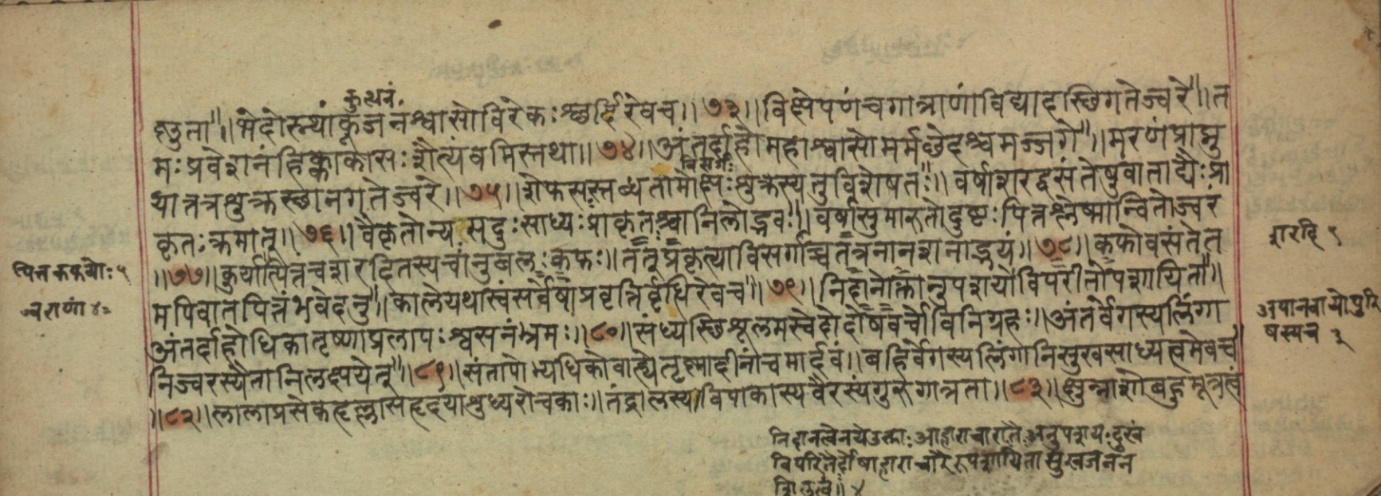
No disease receives more attention in the Mādhavanidāna than jvara, fever. The manuscript classifies fevers eight ways by doṣa — vātaja, pittaja, kaphaja, and their dual and triple combinations — and adds a mythological etiology: fever as the progeny of Rudra's wrath. Both frames, divine and humoral, operate at once.
The text also imagines disease hierarchies in which one illness generates another, an early formulation of comorbidity. Certain pathologies serve as causative agents for subsequent disorders, and the physician who reads the fever must track the sequence.
Location and Prognosis
Fever is located in the tissues through which it travels. In the flesh, it brings tremor; in the bone, loss of consciousness and purgation; in the marrow, hiccup, internal burning, and cutting pain in the vital points — a stage the text marks as fatal. External manifestation, by contrast, is a good sign: excessive external heat with soft thirst marks a fever that is easy to cure.
Pain in the joints at the junctures of day and night, absence of sweating, and suppression of doṣas and feces — these are declared as signs of internal manifestation of fever.
Season as Diagnosis
Time of year is built into the diagnosis. In the rainy season, corrupted wind accompanied by pitta and kapha causes fever; in autumn, pitta dominates with kapha secondary; in spring, kapha leads while vāta and pitta may be present. Prognosis follows suit — wind-fever is described as natural and generally safe, while the unnatural fevers are always difficult to cure. The Mādhavanidāna thus offers a fever nosology at once humoral, seasonal, and prognostic, a system that gave the practicing physician a structured path from first sign to final verdict.