
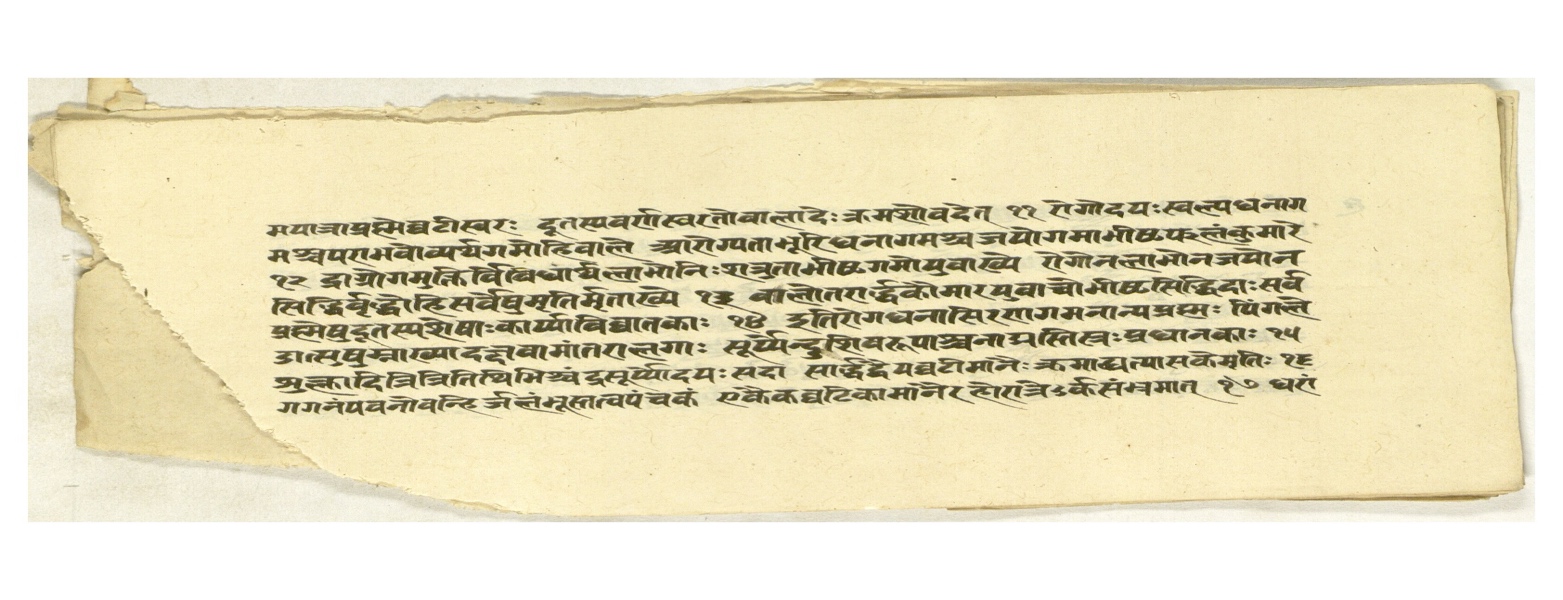
Yuddhādarśa — 'the mirror of war' — is a compact manual of the divination that surrounded battle. Its instrument is not the sword but the syllable: the five vowels A, I, U, E, O, and the chain of correspondences that run from a name to a lunar day to an outcome.
Vowels as the key
The text opens by establishing its system — the vowels as the foundation of calculation.
Salutation to Śrī Gaṇeśa. Having bowed down to Gaṇeśa, the son of Savitrī, and to the guru, I shall speak for the understanding of children, that which is seen by the seer. The first vowels are sixteen; among them five — A, I, U, E, O — are known as short, called mātrās (measures), indeed the life-breath, the sun, the moon, the body, the union, the earth, the waters. From their distinct rising, the first letter of the name is the mātrā; from the mātrā, the tithi (lunar day); from the tithi, the nakṣatra (lunar mansion), the rising, and the ascendant.
A single chain: name to vowel, vowel to day, day to star, star to the moment of battle.
The messenger's syllable
The practice of reading is applied to the messenger — the one who arrives with news of the enemy.
The messenger's color and vowel — according to the stages of child, youth, young adult, and old, one should speak in order: in the child, the arising of disease and small gain; in the youth, health and abundant gain; in the young adult, release from disease and victory; in the old, neither gain nor victory, and in the dead, death.
War as a science of signs
Yuddhādarśa belongs to a family of texts that treated war as a science of reading — the sky, the syllable, the messenger — as much as a science of arms. Its 'mirror' is the system itself: the correspondence between sound and outcome, name and fate, that let a commander look at a word and see a battle.