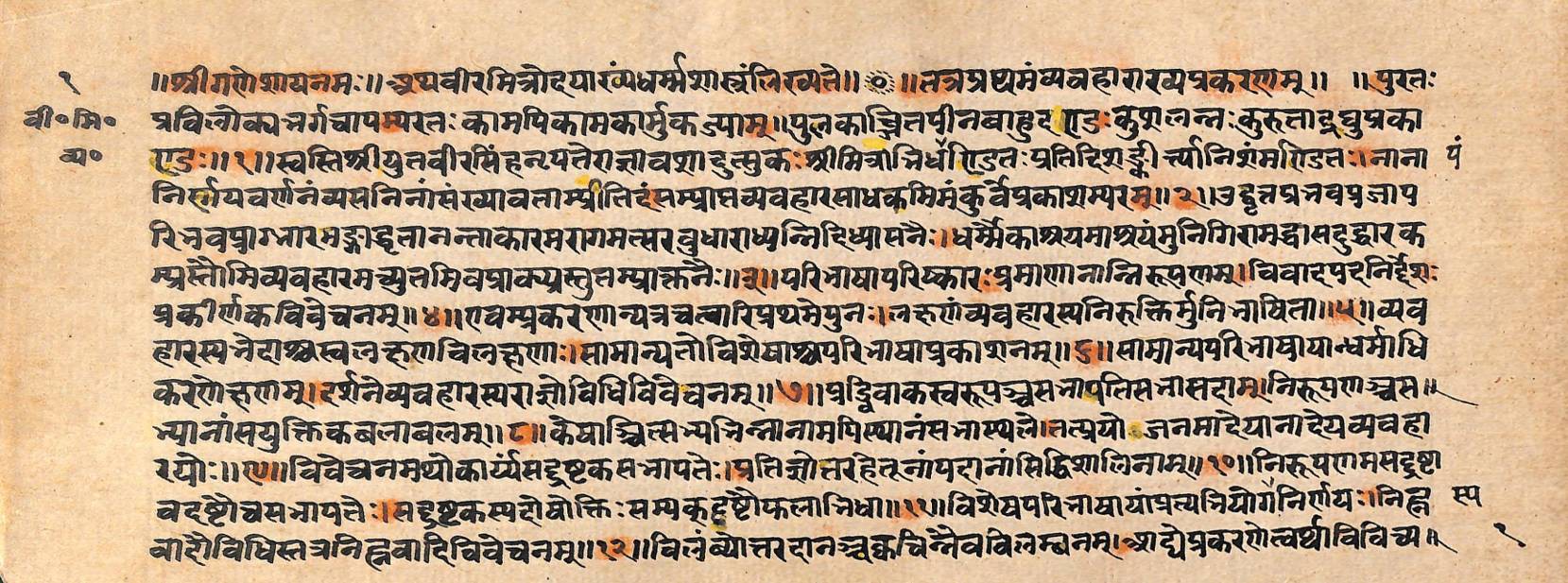
What do you do when the law is unclear? The Vīramitrodaya, a comprehensive legal digest composed by Mitramiśra under King Vīrasimha in the seventeenth century, answers with a scheme that goes back to Bṛhaspati: doubtful matters are decided four ways — by dharma, by vyavahāra, by caritra, and by the king's command.
The fourfold means of decision
The Vyavahārakāṇḍa — the section on legal procedure — opens by establishing the hierarchy of methods.
By dharma, by vyavahāra, by caritra, and by the king's command — the fourfold means has been declared for deciding doubtful matters.
Each has its sphere: dharma is the moral law, vyavahāra the written procedure and evidence, caritra the established custom of the region, and the king's command the royal decree. The digest spends its pages working out how these four interact, which prevails when, and what happens when they conflict.
The machinery of the court
The text is equally careful about the parts of a legal proceeding — defining the roles that make a court work.
From the plundering of the four castes, he is called 'four-benefiting' (caturhita). The actor, the nayaka, the witness, the assembly member, and the king — these five. Whatever kind one obtains from which, therefore it is called 'four-taking.'
It reads like a definition of jurisdiction: who can bring a suit, who hears it, who testifies, who judges. The technical vocabulary — caturhita, caturhara — shows a legal culture that had thought carefully about the anatomy of a trial.
A working legal library
At 602 pages, the Vīramitrodaya manuscript is a major legal reference — the kind of digest a court would consult, combining the authority of the smṛtis with the reasoning of the commentators. Its preservation is a reminder that the Indian legal tradition was not a set of scattered rules but a literature, built to be argued with — and that a seventeenth-century jurist could still reach back to Bṛhaspati for the first principles of deciding a case.