
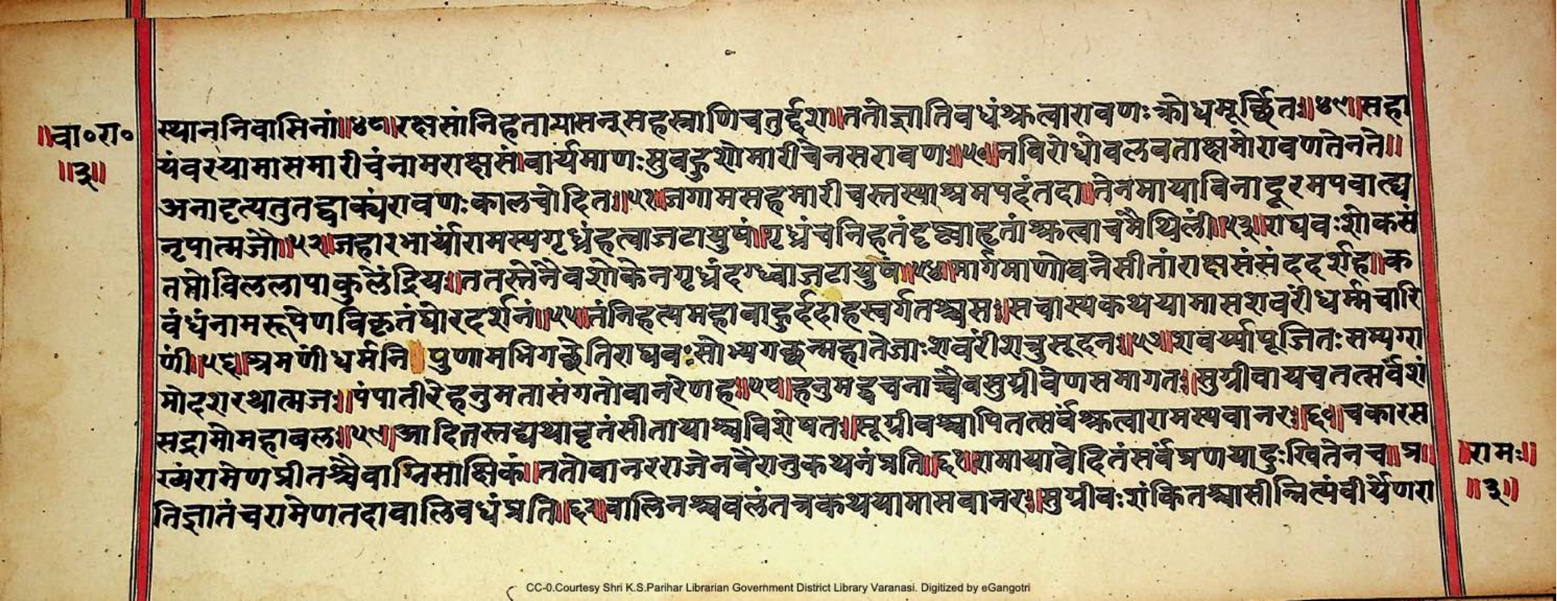
Before the Rāmāyaṇa tells its story, it praises its own teller. This manuscript opens with the famous invocatory verses — salutations to Rāma and his companions, and a chain of images for Vālmīki himself, culminating in the loveliest: the sage as a cuckoo perched on the branch of poetry.
Salutations before the story
The opening verses set the devotional frame for the whole epic.
Oṃ, to the Supreme Person, known through the Vedas, born as the son of Daśaratha — the Veda became the sage of the mind, embodied as the Rāmāyaṇa. I bow again and again to Rāma, to his brother, to Sītā, to Bharata and his brother, to Sugrīva and the son of the wind (Hanumān).
The homage covers the whole cast in two verses — the hero, the family, the allies — before the narrative begins.
The cuckoo of poetry
Then comes the image of Vālmīki himself — the poet as a bird singing on the tree of the epic.
The cuckoo singing sweetly 'Rāma, Rāma' in its sweet syllables — having climbed the branch of poetry, I bow to that Vālmīki-cuckoo. Hearing the sound of the Rāma-story from the lion of sages roaming the forest of poetry, who does not go to the highest goal?
The epic is a tree; the poet is a cuckoo; the story is a song — and the verse invites every listener to follow that sound to liberation.
The hero announced
The narrative proper opens with Nārada's account of Rāma's virtues — the famous catalogue that makes the hero known before he acts.
Pleasing to behold at first sight, self-controlled, having conquered anger, radiant, free from envy. Like the fire at the end of time in anger, like the earth in forgiveness, like Kubera in generosity, like Dharma itself in truth — that Rāma, endowed with such qualities, of true valor.
This manuscript, 158 pages of the epic, opens that long story with the poet's prayer — a reminder that the Rāmāyaṇa has always been read as both literature and devotion, beginning with a bow.