
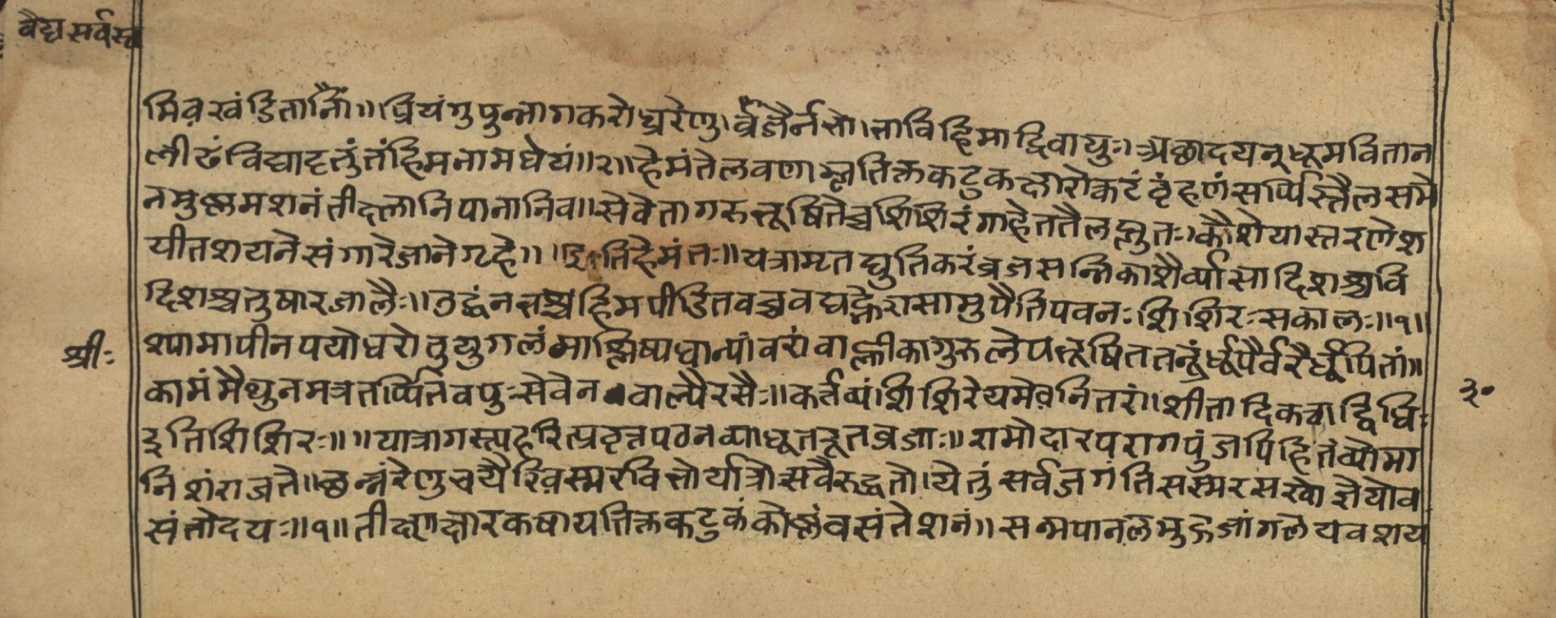
The Vaidyasarvasva is not only an anatomy and pharmacy manual — a long stretch of it is a calendar. Kāśīrāma devotes page after page to ṛtucaryā, the seasonal regimen: which doṣa is building up, which one is about to erupt, and what to eat, drink, and avoid to stay ahead of all three. It is preventive medicine organized as an annual schedule.
Six seasons, three doṣas, one predictable cycle
The logic is simple and total. The year has six seasons, and each doṣa has a season of accumulation, a season of aggravation, and a season of quiet. The manuscript states the clock plainly: "The accumulation of vāyu occurs in summer, it aggravates in the rainy season. Pitta accumulates in the rains and aggravates in autumn. Kapha decreases in early winter and aggravates in spring." Know the season and you can predict the disease before it arrives.
The accumulation of vāyu occurs in summer, it aggravates in the rainy season. Pitta accumulates in the rains and aggravates in autumn. Kapha decreases in early winter and aggravates in spring.
The rains: a festival of description and a warning
The monsoon gets the most lyrical treatment in the manuscript. "Kadambas and other trees burst open in all directions; clouds accompanied by winds, raining, thunder — the sky, O Indra, is delighted by your rainbow and lightning. The peacock, the frog, and the Kalapi bird sing sweetly." Then, without missing a beat, the text prescribes the post-monsoon diet: "grapes, milk, white sugarcane, rice, honey, good wheat, mung." For a physician in the Deccan, the rains were when vāta exploded — and this was the diet to meet it.
Winter: bulk, warmth, and restraint
Winter gets an equally concrete regimen. "In winter, one should consume salty, bitter, pungent, and strongly alkaline foods that promote bulk; abundant food with ghee and oil; or sharp drinks. In a house perfumed with agaru, cool, with heated silk coverings." The body's digestive fire burns highest in the cold, the text argues, so this is the season for heavy food — and for the pleasures the text lists without embarrassment.
In winter, one should consume salty, bitter, pungent, and strongly alkaline foods that promote bulk; abundant food with ghee and oil; or sharp drinks. In a house perfumed with agaru, cool, with heated silk coverings.
Summer: cool houses, lakes, and daytime sleep
Summer is the mirror image. "In summer, one should resort to cool houses, lakes, rivers, wells, forests, garlands, necklaces, cool breezes from palm-leaf fans, and sleep during the day." The same text that told you to feast in winter now tells you to rest, drink cooling preparations "mixed with milk," and smear yourself with camphor and sandalwood. Spring, meanwhile, is when stored kapha melts — the season for light food and the cuckoo's call.
The same clock governs water
Even drinking water is seasonal arithmetic. The manuscript repeats a graded rule: water reduced by a quarter pacifies vāta, by half pacifies pitta, and by three-quarters destroys kapha. In hemanta, śiśira, and the rains you drink water reduced by half; in spring and summer, reduced by a quarter. It is the same framework as the seasons — everything in the regimen, from the heaviness of your food to the boiling of your water, is tuned to the doṣa that the calendar says is coming.
What impresses me about this section is how usable it is. No astrological tables, no ritual — just a physician's annual plan, organized around the simple claim that the body changes with the sky and the diet should change with it.