
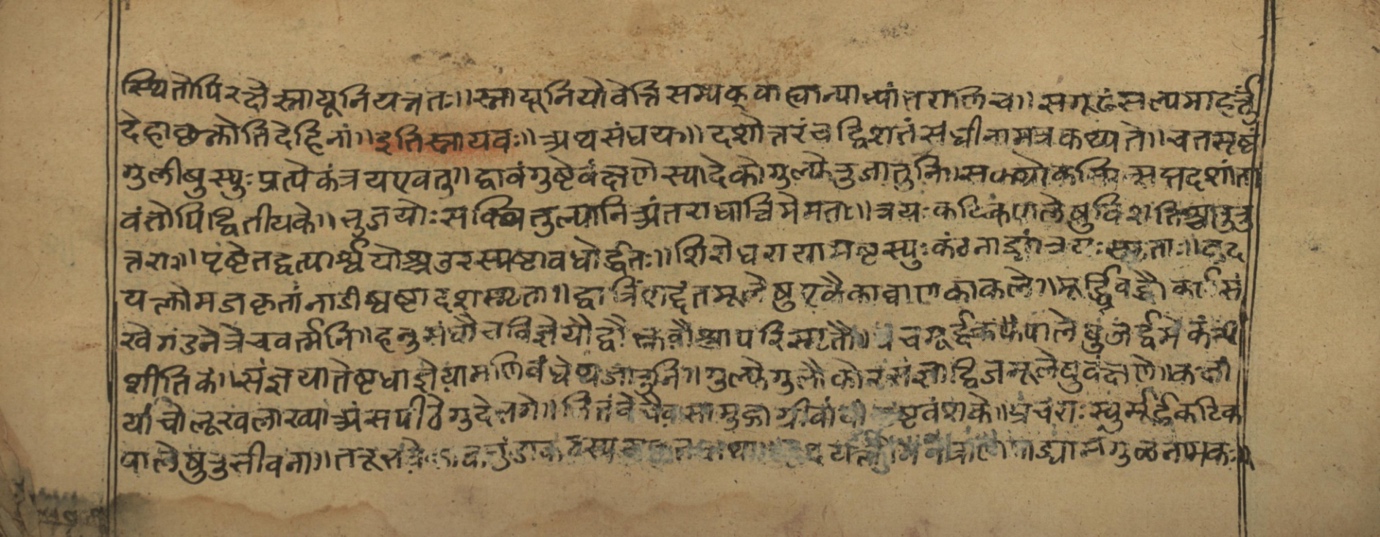
The Vaidyasarvasva — 'The Entirety of Medicine' — by Kāśīrāma is a Bhandarkar manuscript (No. 949 of 1891–95) that lives up to its title. It is part anatomy textbook, part pharmacology manual, and part philosophy: it counts the body's tendons to the last one, classifies honey into four varieties, and still finds room for the twenty-four tattvas of Sāṃkhya.
The body, itemized
Anatomy here is an arithmetic. The text enumerates the snāyu — tendons and ligaments — region by region: five in each foot, thirty in the ankle, ten in the lower leg, counting upward until it reaches a total of nine hundred. The joints follow: two hundred and ten, "increasing by tens," with sixty in the cheekbones alone. Then the srotas, the channels: seven hundred in number, "their root in the body is the navel; they are extremely subtle, spreading like leaf-veins." A physician who knew this list could "extract a hidden arrow from the body of embodied beings" — anatomy as surgical readiness.
Two hundred and ten joints are spoken of here, increasing by tens. Of these, sixty are in the cheekbones, three in each... One who knows the ligaments well [knows] the branches and intervals. He is able to extract a hidden arrow from the body of embodied beings.
Honey, four ways
The pharmacology section opens with honey, classified into four varieties — mākṣika, paittika, kṣaudra, and bhrāmara. The catalog of its virtues is one long sentence of confidence: beneficial for the eyes, stimulating, promoting complexion, cleansing and healing wounds, improving skin color, enhancing intellect, aphrodisiac, appetizing, and victorious — conquering skin diseases, hemorrhoids, cough, bleeding disorders, phlegm, diabetes, worms, fat, thirst, asthma, hiccup, severe diarrhea, and heart disease, while promoting the movement of drugs.
Beneficial for the eyes, stimulating, promoting complexion, cleansing and healing wounds, improving skin color, enhancing intellect... It conquers skin diseases, hemorrhoids, cough, bleeding disorders, phlegm, diabetes, and worms.
The twenty qualities of every drug
Behind every remedy sits a theory of drug action. The manuscript lists twenty guṇas — the qualities drugs work through: cold and hot, unctuous and dry, slow and sharp, heavy and light, slimy and clear, smooth and rough, hard and soft — and attributes the list to Ātreya. It then works through the six tastes, their elemental composition (sweet from earth and water, pungent from fire and air, astringent from earth and air), the pairs and triads of taste combinations, and the concept of prabhāva — a specific power that can overrule taste, potency, and post-digestive effect, as when sahadevī and jaṭā "quickly destroy fever and headache."
Water, milk, and the seasons
The manuscript's later chapters read like a course in daily living: which waters suit which season (well, tank, and spring water in summer; rainwater in the rains), which milks suit which body (cow's milk as rasāyana for the wounded and emaciated; goat's milk for bleeding disorders), and how each season moves the doṣas — vāta accumulates in summer and aggravates in the rains; kapha aggravates in spring. Even the meal is regulated: "With food, fill two parts of the stomach; with drink, one part; and leave one part for the movement of vāta and others."
What makes Vaidyasarvasva fascinating is the scale of its ambition — from the last tendon in the foot to the order of creation — and the confidence that it all belongs to one science. I suspect that is exactly why a physician named Kāśīrāma called it 'the entirety of medicine.'