
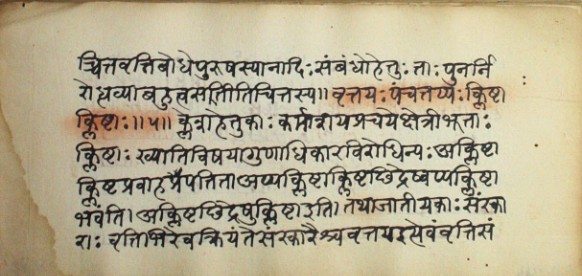
Yoga begins with a diagnosis of the mind. The Pātañjalayogasūtra, the foundational text of classical yoga, opens not with postures but with a map of mental states — distracted, stupefied, scattered, one-pointed, restrained — and defines yoga as the restraint of the modifications of the mind.
The five states of mind
From its opening pages, the commentary in this manuscript lays out the spectrum of the mind's conditions.
Now the instruction on yoga. Yoga is samādhi, and that is the universal characteristic of the mind. Distracted, stupefied, scattered, one-pointed, restrained — thus the states of mind.
Two of the five — one-pointed and restrained — belong to yoga; the other three are the mind's ordinary turbulence. The path is a movement along this spectrum.
Modifications, afflicted and unafflicted
The second chapter of the inquiry is the fivefold classification of the mind's modifications (vṛttis) — valid cognition, misconception, verbal construction, sleep, and memory — each either afflicted or unafflicted.
The modifications are fivefold, afflicted and unafflicted. Those that are caused by afflictions are the accumulations of the deposits of karma, becoming the field (of experience). Fallen into the stream of the afflicted, even the unafflicted become afflicted; in the breaches of the afflicted, even the unafflicted become unafflicted.
The passage is subtle: whether a mental state helps or harms depends on the current it falls into. Affliction is contagious, and so is its opposite.
The definition that launched a school
Yogaś citta-vṛtti-nirodhaḥ — 'yoga is the restraint of the modifications of the mind' — is perhaps the most quoted definition in Indian philosophy, and this manuscript preserves it in its native context: the opening of the sūtras, with a commentary working out exactly which modifications are restrained and which are not. It is a reminder that the Yogasūtra is not a book of postures but a systematic psychology — and its first act is to name the five minds we all carry.