
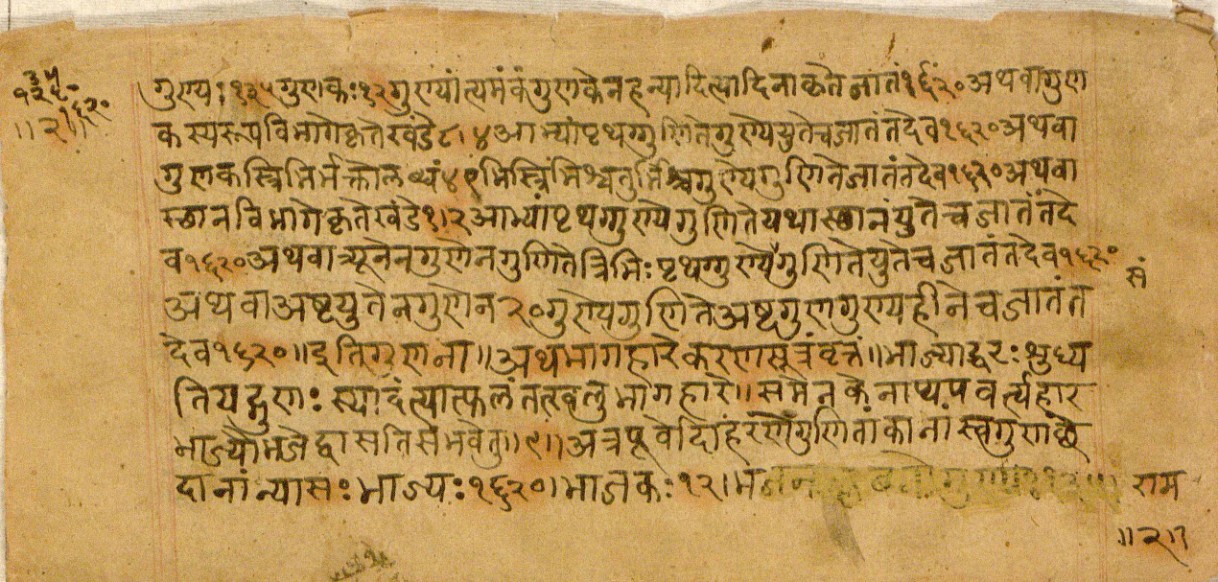
Before zero made big numbers easy, big numbers had to be named. The Līlāvatī — Bhāskara's arithmetic — opens its practical teaching with the names of the number-places, and the list is a poem of scale: lakh, crore, arbuda, kharva, mahāpadma, śaṅku, jaladhi, antya, madhya, parārdha — each ten times the last.
The ladder of names
The text gives the whole series in a single verse, then notes who made it.
One, ten, hundred, thousand, ayuta, lakh, prayuta, crore in order, arbuda, abja, kharva, nikharva, mahāpadma, śaṅku — beyond that, jaladhi, antya, madhya, parārdha — these are the names increasing tenfold. These names of places of numbers were made by the ancients for practical use.
The names are drawn from the world — abja, the lotus-born (a billion), śaṅku, the stake, jaladhi, the ocean, parārdha, the far shore — so that numbers become images, and the place-value system becomes a landscape.
One problem, many methods
The same manuscript then demonstrates the Līlāvatī's pedagogical love: showing one multiplication solved many ways.
The multiplicand is 135, the multiplier is 12. The product obtained is 1620. Or else, when the multiplier is divided into its component parts 8 and 4, and these are multiplied separately with the multiplicand and then added, the same 1620 is produced. Or else, the multiplier divided by 3 gives 4. When the multiplicand is multiplied by these three and four separately and added, the same 1620 is produced.
Split into 8 and 4, split into 3 and 4, split by place value — every route arrives at 1620, and the student sees that arithmetic is not one fixed procedure but a family of them.
A mathematics that could speak
The Līlāvatī's names of numbers are a reminder that the tradition did not treat large numbers as an abstraction — it gave them names from the natural world, so that a crore and a parārdha could be said, heard, and remembered. This copy, one of several in the collection, keeps that ladder of tens intact.