
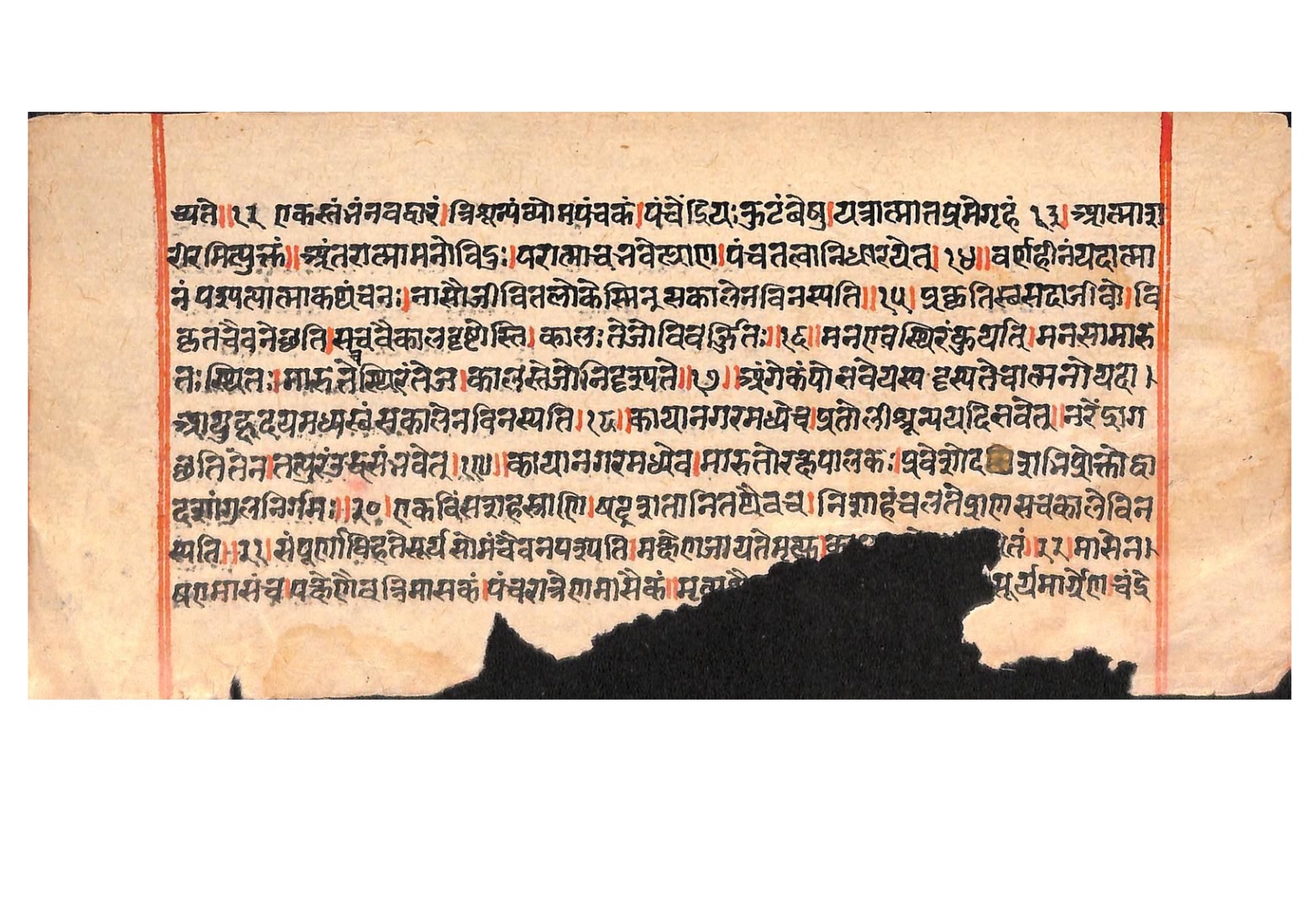
Attributed to Śambhunātha, the Kālajñāna — 'knowledge of time' — is a treatise on medical prognostication built on a striking premise: that time, kāla, is the true physician's subject. The manuscript opens with time as the creator and destroyer of all beings, and declares that only through knowledge (jñāna yoga) and the proper timing of actions can one be protected from its power.
The physiology is cosmic. The body is a city (kāya-nagara) with one pillar, nine doors, three voids, and five spaces, where the self dwells with the five senses as its household. The text counts 21,600 breaths in the cycle of a day's inhalation and exhalation — the number that became famous in later yogic literature — and treats breath as the very currency of lifespan.
Signs of the End
Much of the manuscript is devoted to recognizing approaching death. Unfavorable signs include burning at night with coldness by day, throat fullness, cough, diminished voice, and prolapsed rectum. More fatal still are hiccup with sorrow, cold hands and feet with a burning head, discharge from teeth, nose, and ears, and a black tongue or saffron-red face. The text assigns timelines — seven nights, seven days, two months — and maps the body onto the sky: the tongue represents Arundhatī, the nose tip Dhruva, the eyebrow center Viṣṇu's step.
Krodhalo bhaye rogaḥ kālaḥ kalitadehināṃ jñānayogasadābhyāsī kālaṃ rakṣati sarvadāḥ — from anger and fear comes disease; for embodied beings, constant practice of jñāna-yoga always protects one from time.
The Pulse That Tells the Story
The manuscript also contains a compact treatment of pulse diagnosis (nāḍī parīkṣā). Pulses are classified as slow, swift, hard, steady, white, and bloody; a vāta pulse moves like a serpent, and dark or mixed pulses indicate death. Fever treatment follows the same temporal logic — three days of fasting (laṅghana) first, then water, then medicine — with fevers mapped to the seasons and the months each doṣa rules.
The Kālajñāna is the most esoteric of the manuscripts surveyed here, but it is not unsystematic. Its central claim — that the physician must know time to know the disease — gives prognostication a mathematical frame: count the breaths, read the pulse, and time will tell.