
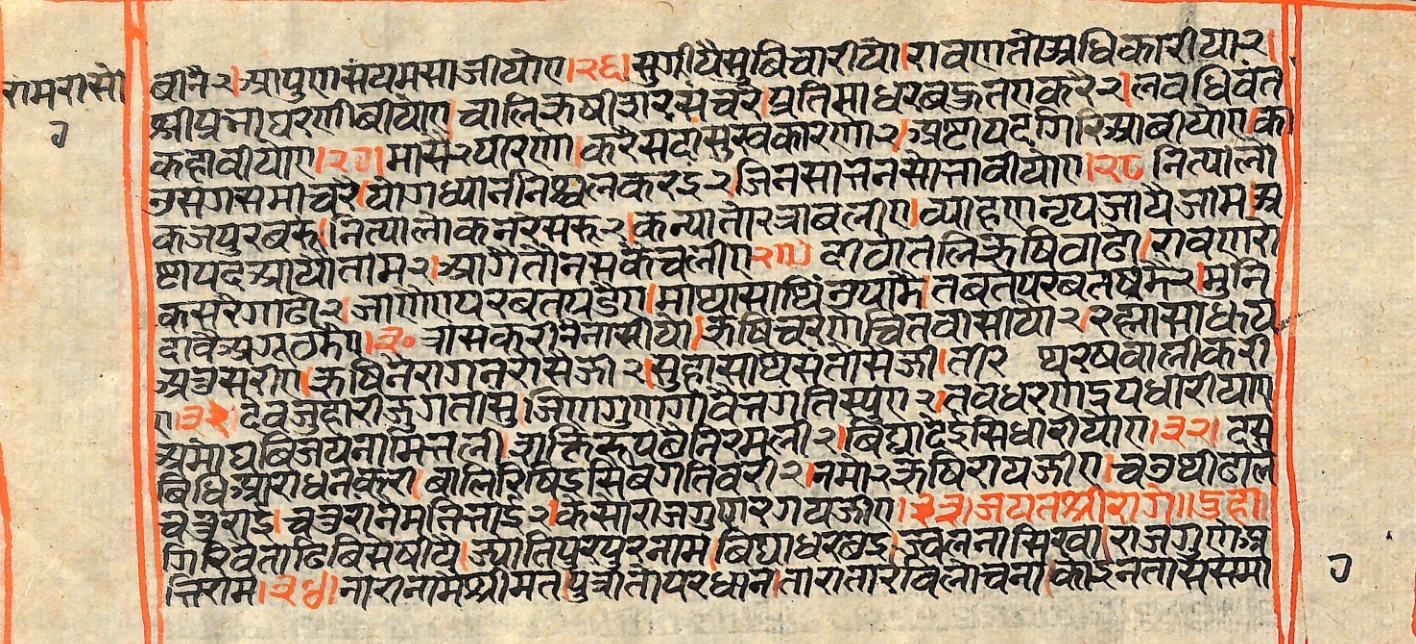
In the standard Rāmāyaṇa, Rāma is an avatāra of Viṣṇu. In this Jain retelling, composed as devotional verse in Old Gujarati, he is something else entirely — a pious king who bows to the Jina, and whose whole story is sung as devotion.
A Rāmāyaṇa Sung in Desāvala Rāga
The manuscript opens as a songbook would: it names its rāga and meter, attributes itself to Muni Suvratasvāmī, and its very first verse bows not to Rāma's divine father but to the Jina. "O Lord who saves the three worlds, I bow at your feet; I am not equal to the gods and best of men who bow to you. Therefore, I bow to the best Jina, who is called Rājagṛhi." The strategy is appropriation: keep the beloved story, change the theology at its root. The Ramayana becomes a text of Jain devotion, Rama becomes a devotee of the Jina, and the epic's entire arc bends toward renunciation.
O Lord who saves the three worlds, I bow at your feet; I am not equal to the gods and best of men who bow to you. Therefore I bow to the best Jina, who is called Rājagṛhi.
Bali the Sage, Rāvaṇa the Authority
Even the epic's warriors get Jain makeovers. In one striking passage, Bali — in the Hindu telling, the warrior-king killed by Rāma — is shown in the forest practicing perfect restraint. With excellent conduct and good judgment, he wanders the forest with his queen Prabha. The text presents Rāvaṇa, typically the villain, as a standing authority in the passage. This is radical: the Jain Ramayana reframes the moral landscape. Bali becomes a sage, Rāvaṇa becomes a keeper of wisdom, and restraint and austerity replace martial prowess as the true measures of greatness.
In the forest, he practiced perfect restraint. With excellent conduct and good judgment. Ravana was the authority there. Shri Prabha, the queen, and Bali, the sage, wandered much; the sage performed great austerities.
Liberation at the End of the Epic
The story's goal is not victory but mokṣa: characters who keep the vows of restraint end as kevalins, enlightened beings. "The best sage became a kevalin, O beloved. The best gods come, crores of kevalins, the glory is true, O beloved." Rāma himself receives the highest teaching of the tradition — the Guru's restraint is drunk like nectar. "On the fourth day, from the true Guru I received self-restraint; I drank the nectar of equanimity's form." This is the Jain vision: not conquest but enlightenment; not empire but the state of kevala-jnana, perfect knowledge.
The best sage became a kevalin, O beloved. The best gods come, crores of kevalins, the glory is true, O beloved. The body does not bow, hands joined.
On the fourth day, from the true Guru I received self-restraint; I drank the nectar of equanimity's form.
The Epic as Bhakti
What survives in this nineteenth-century copy is a whole regional culture of Jain devotion: the Rāmāyaṇa re-sung in dūhās (couplets), the hero remade as a jinavar—a lord of the Jina's path—and the villain himself never beyond the reach of the dharma. This is not a marginal interpretation; it is a fundamental Jain strategy. Rather than reject the beloved epic, the Jain community sang it into their own tradition, line by line, until Rāma's story became a story about the Jina, and the epic itself became an instrument of Jain teaching. For listeners in Gujarat, hearing this Ramayana was not heresy—it was devotion made local, made singable, made their own.