
Everyone knows Hanuman, the monkey devotee of Rāma. Far fewer know the Hanuman of the Jain Rāmāyaṇa: born in secret, married to a thousand celestial women, and finally renouncing the world to take a monk's vow.
The Wind-Born Child
The birth story in the Rāmarāsa is tender and strange: the beautiful Anjana conceives in secret, and the newborn is saved from the mountain by the wind-god, Bajarang, the dispeller of distress. This is not the Hanuman of devotional tradition, born through divine blessing alone. The Jain version emphasizes the danger and rescue—a child nearly lost to the mountain, saved by the very force of air that will later allow him to leap the ocean.
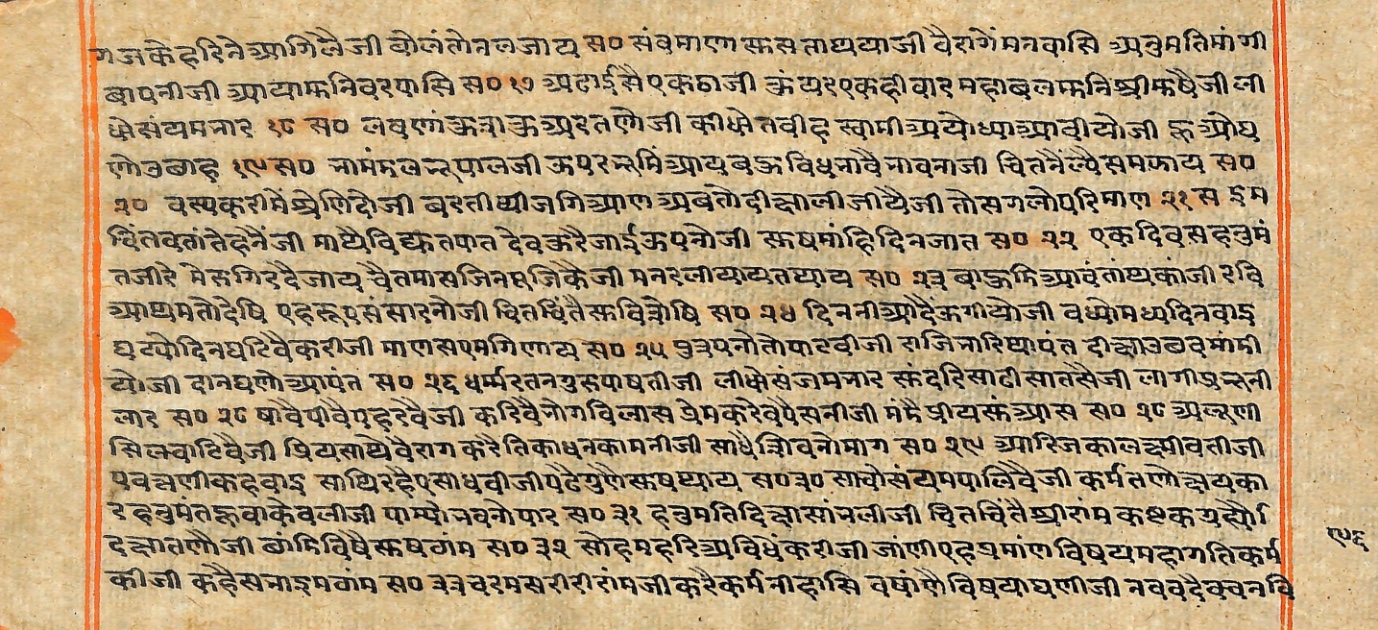
He fell upon the mountain, coming to the mountain peak; he could not bear it, this child—save him, O Lord of Puras, Bajrang, as you are the dispeller of distress.
Servant of Rāma, Son of Anjana
The praise-poems frame him as the perfect servant — pure-born, without equal. One hymn describes his nature with precision: "Pure, of noble mother, born in the body at the end—such is Hanuman. Pure nectar, I bow to him. Sixteen times I go to him. There is no other equal to him. Hanuman, the servant, is like Rama, like the king, born of a monkey mother. Son of Anjana, pure." The Jain text emphasizes not his power but his purity—his fitness for the ascetic path.
Pure, of noble mother, born in the body at the end—such is Hanuman. Pure nectar, I bow to him. Sixteen times I go to him. There is no other equal to him. Hanuman, the servant, is like Rama, like the king, born of a monkey mother. Son of Anjana, pure.
Ten Thousand Weddings
The Jain epic even marries him off—lavishly, and with Rāvaṇa's approval. "Varunadhara had a daughter named Satyavati; Hanuman married her. Thus a thousand Vidyādharas' daughters, ten thousand, Hanuman married." This is not sexual indulgence in the ascetic sense; it is a narrative of worldly entanglement. The Jain text records his marriages not to glorify him but to establish his progression from the household life through increasing spiritual discipline toward renunciation.
Varunadhara had a daughter named Satyavati; Hanuman married her. Thus a thousand Vidyādharas' daughters, ten thousand, Hanuman married; may they all find joy.
The Path to Asceticism
And then the great turn: in the closing sections, the wind-born hero asks permission of his parents and takes the burden of restraint. He keeps the salt-ankuśa vow—an ascetic discipline—on his way to Ayodhyā. This is the moment the entire Jain narrative has been building toward. All the earlier episodes—the rescue, the service, the marriages—have been stages in a journey toward inner freedom.
From father and mother, from the great sage, having taken permission, the prince, one day to the great sage, took the burden of restraint, the salt-ankusha vow, the ascetic Swami came to Ayodhya.
In the Jain telling, even Hanuman's story bends toward renunciation. The same hero who leaps oceans and burns Laṅkā ends here as a would-be monk—proof that in this tradition every road, even a monkey's, leads to the vow. For the Jain community, Hanuman becomes not just Rāma's faithful servant but a model of spiritual progression: from birth in danger, through service, through worldly entanglements, and finally to the vow that alone brings liberation.