
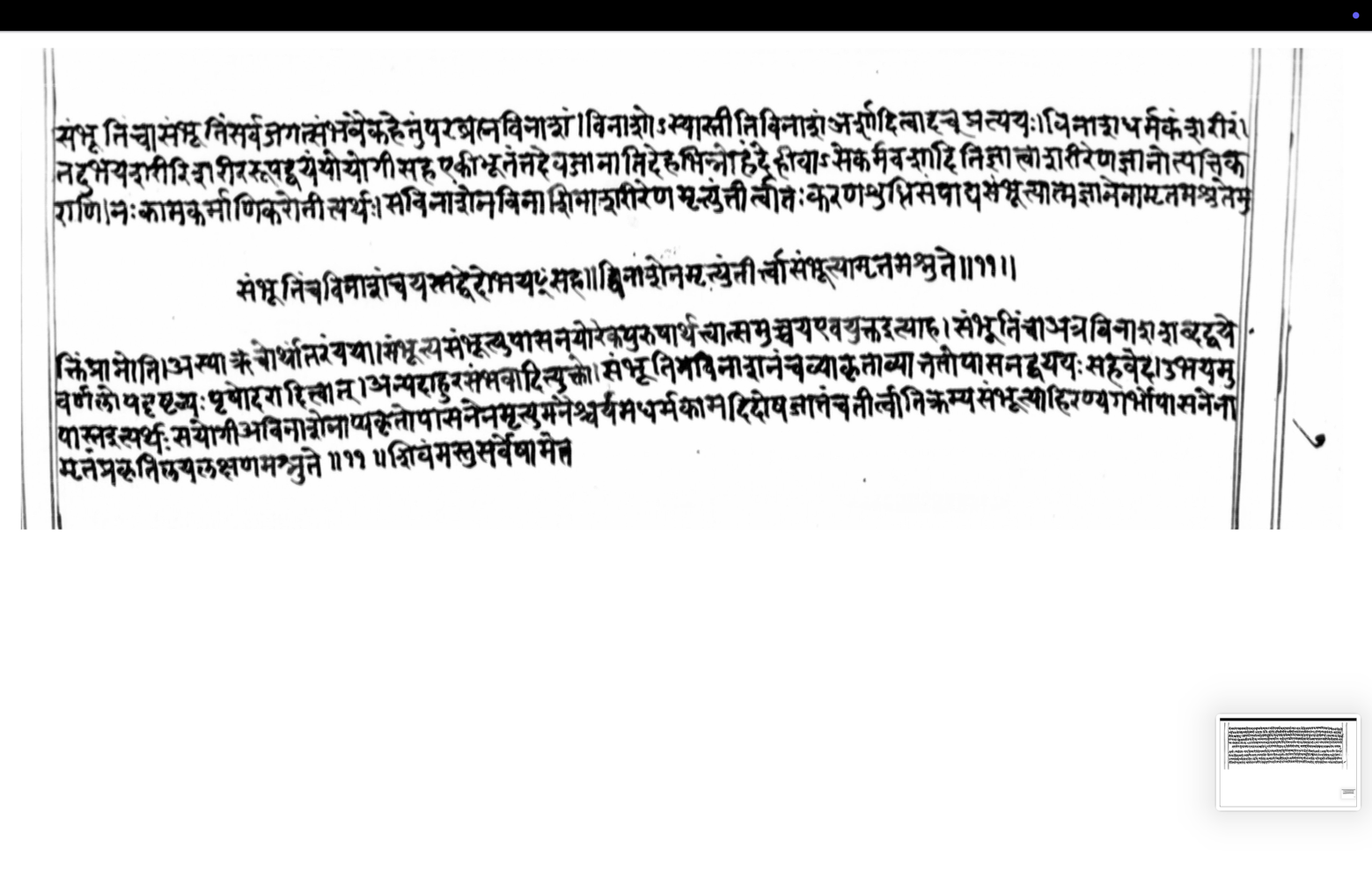
The shortest of the principal Upaniṣads carries one of the boldest opening lines in all of scripture: everything that moves in the moving world is to be covered by the Lord. The Īśāvāsyopaniṣad begins there — and this manuscript pairs that famous verse with the ritual context in which it was chanted.
The first mantra
The text opens with the verse that gives the Upaniṣad its name — īśāvāsya, 'enveloped by the Lord.'
All this — whatever moves in the moving world — should be covered by the Lord. Protect your Self through that. Do not covet anyone's wealth. Enjoy by renouncing that. Do not be greedy.
The injunction is not to escape the world but to see it differently — as already inhabited by the divine. And with that vision comes renunciation: enjoy by renouncing, covet nothing.
A verse with a ritual life
What makes this manuscript distinctive is that it records the Upaniṣad's verses in use — how they are employed in the saṃhitā, with the middle tone, for the daily and occasional rites.
In the Samhita, with the middle tone, with the daily and occasional, one distinguishes the ritual action. Isha Upanishad — these verses are to be used. With the golden vessel, having covered, having covered the golden. With the golden vessel, the face of truth is covered.
The two powers of the Self
The text closes with the Upaniṣad's famous pairing of sambhūti and asambhūti — the manifest and the unmanifest — and the knowledge that transcends both.
Sambhūti and asambhūti — one who knows both, transcending death through asambhūti and attaining immortality through sambhūti.
The Īśāvāsya is a whole philosophy in six pages — and this manuscript shows it living in both worlds: as meditation on the unmanifest, and as a text to be recited, with a golden vessel, in the daily ritual.