
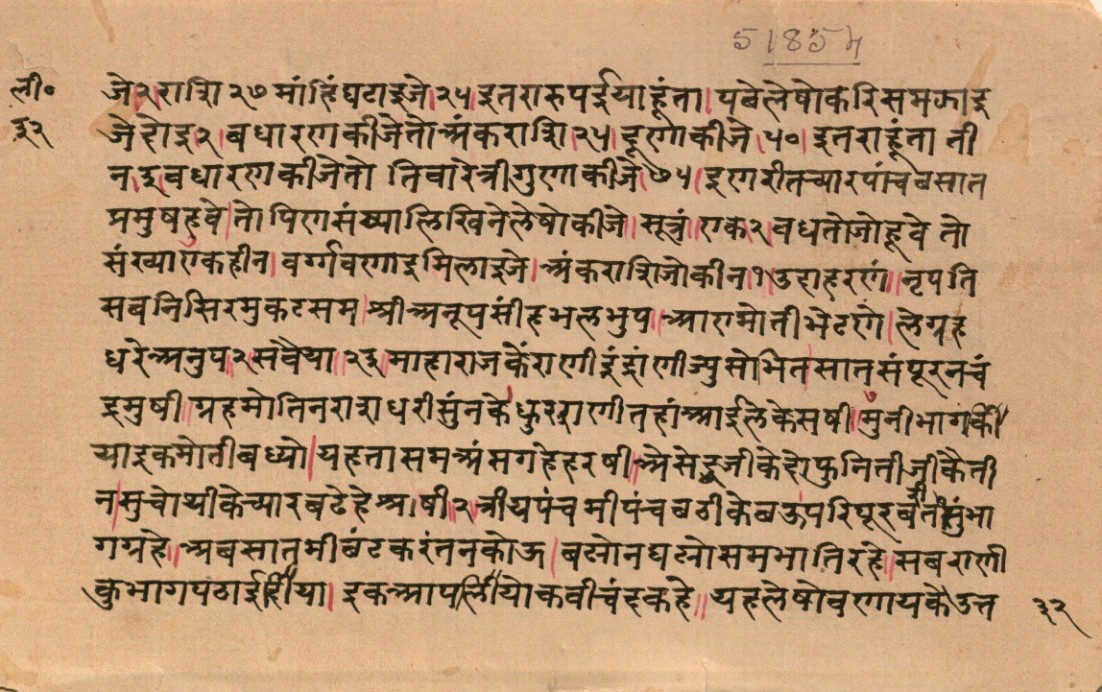
Most people know the Līlāvatī as Bhāskara II's great twelfth-century Sanskrit classic of mathematics. This fragment, accession 51854, is different: the same textbook re-voiced in Hindi verse, with dohās doing the teaching instead of Sanskrit ślokas — arithmetic carried in the language a trader or a student actually spoke, not the language of the court pandit.
Mathematics in dohā
The fragment preserves the classic sūtra-udāharaṇa structure of its Sanskrit parent — rule, then worked example — but compresses each rule into a couplet terse enough to rhyme. The pattern used for summing a series is a small poem in itself: double the term, then subtract one.
The heap, continuously diminished. Doubled, diminished by one... A heap of grain, one kos, continuously moved. One kos per day, the seed increases. Both become equal, on which day — the sum of the series, make it clever.
The worked answer follows immediately, in the same clipped rhythm: set down 10, double it to 20, subtract one to get 19 — the heap becomes equal to the moving grain on the nineteenth day. It's the sūtra-udāharaṇa method distilled to its smallest possible form, small enough to fit a verse a student could actually memorize on first hearing.
A fort with four gates
The manuscript's other worked problem trades the grain-heap for a war scene — a fort with four gates, waves of attackers arriving at each in a strict multiple of the last.
One fort, four gates. Four gates, innumerable heroes. One day, the first division arrived. The force reached, the army trembled. At the first gate, thus defeated. Three times as many came. The second division was defeated. At the second gate, the first, twice.
It's the same doubling-and-diminishing logic as the grain problem, dressed in epic imagery instead of agricultural — proof that this Hindi Līlāvatī, like its Sanskrit source, reached for whatever scene would make an abstract progression memorable, whether that meant a farmer's heap or a fort under siege.
Three carts, equal weights
The most visually striking page in the fragment is a distribution problem, with its numbers stacked in a little box — 8, 8, 8 — the fingerprint of a teacher working the problem live on the page in front of a student.
The first number 3, plus 1 makes 4, doubled minus 1 makes 7, doubled minus 1 makes 13. The other weight. They were mutually exchanged. The three carts in it [8,8,8] became equal weight.
A companion problem on the same page reframes the puzzle as a story about money: three men each divide their rupees into three parts, one part is handed to a third man along with a one-rupee bonus, and the process repeats until all three end up holding equal shares. The stacked notation — numbers written directly beneath one another rather than embedded in the sentence — is the manuscript speaking in its own hand: a teacher's aid, showing the equal weights or equal shares at a glance rather than making the student parse them out of prose.
Interest, the vernacular way
The fragment's final page turns to compound growth — an interest problem worked in the plain speech of the bazaar rather than the technical vocabulary of trairāśika.
If 2 is subtracted from 27, 25 remains. After understanding this method of writing: If 1 is added, double the amount 25, making 50. If 3 is added, make it triple on the third day, making 75. In this manner, if 4, 5, 6, 7 become prominent, then write the final number and do the calculation.
What follows is one of the manuscript's most charming touches: the interest problem is set inside a courtly scene, with King Anup Singh's queen Indrāṇī dividing a heap of pearls among nine friends, giving one extra pearl to the first, two to the second, three to the third, and so on, with the poet Chand credited by name for the verse itself — a reminder that even a dry arithmetic exercise was, in this tradition, still expected to be a poem with characters in it.
Arithmetic that traveled
The Hindi Līlāvatī is proof that Bhāskara's science was never locked inside a learned language. The same sūtra-udāharaṇa method, the same delight in dressing a calculation as a small story, survived the move from Sanskrit into vernacular dohā verse — carried by traders, students, and teachers who needed their arithmetic to rhyme as much as it needed to add up.