
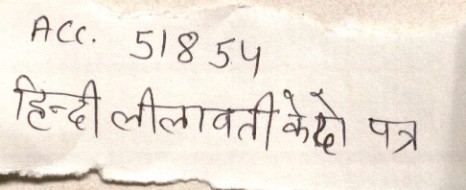
Hindīilīlāvatī ke do patra
This manuscript fragment (Acc. 51854) preserves portions of the *Līlāvatī*, the renowned 12th-century Sanskrit mathematical treatise by Bhāskara II, here transmitted in a Hindi vernacular adaptation. The text exhibits distinctive Western Indian orthographic conventions, notably the use of ṣa (ष) to represent the kha (ख) sound, and contains worked examples (udāharaṇa) illustrating arithmetic progressions (śreḍhī), fractions, and proportional distribution problems. The presence of numerical arrays in stacked box notation and marginal calculations demonstrates active pedagogical use, while the mixed verse-prose format with *nyāsa* (statement of terms) and *sūtra* (rule) reflects traditional Indian mathematical exposition. The fragment's bilingual Sanskrit-Hindi character and accession numbering suggest it belongs to a colonial-era manuscript collection, offering valuable evidence for the vernacularization of scientific knowledge in early modern India.