
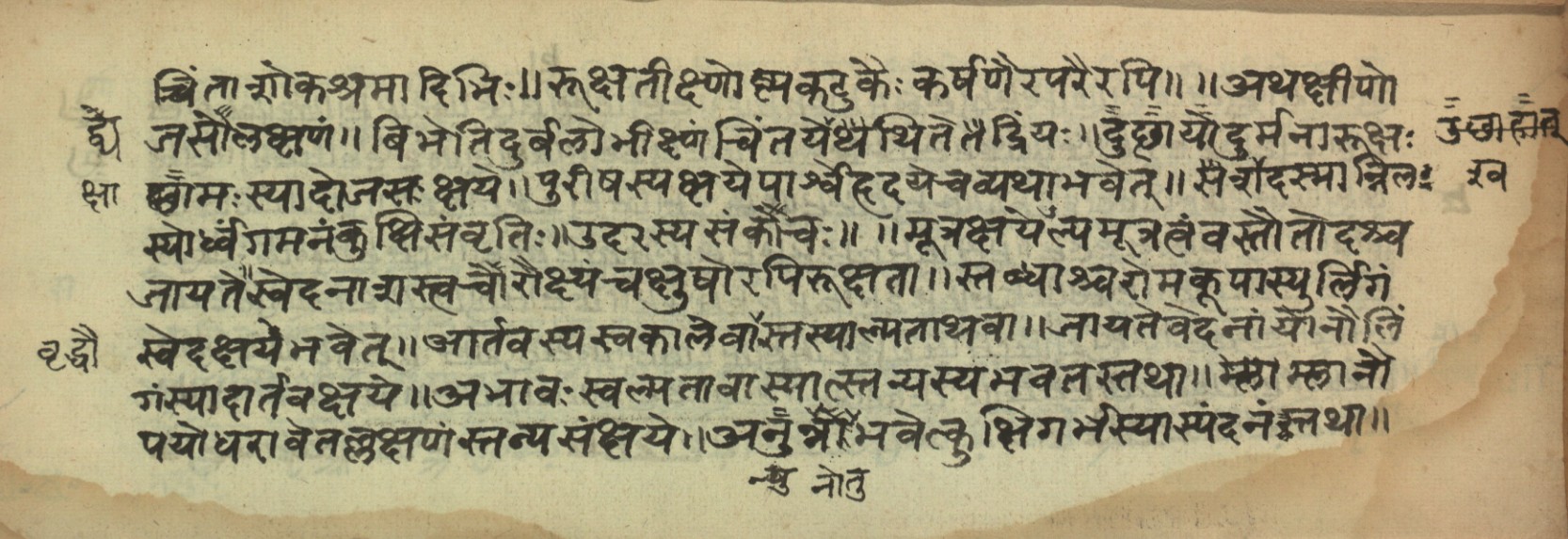
There is a difference between a doṣa that is raw and one that is cooked. The Bhāvaprakāśa — the great sixteenth-century compendium of Miśrabhāva, here in a short working copy — devotes careful attention to āma, the undigested residue that clogs the body, and nirāma, the same humor once the digestive fire has matured it. Telling them apart, the text insists, changes the treatment.
What āma looks like
The manuscript gives each doṣa two portraits — raw and cooked — with precise sensory signs.
He describes the characteristics of a non-āma condition of vāta: Non-āma is clear, rough, without obstruction, and causes little pain. It is pacified by opposite qualities, especially by unctuous ones. He describes the characteristics of āma-pitta: Pitta becomes āma — luminous, foul-smelling, green, heavy, sour, causing burning in the throat and heart, dark brown, stable, impairing appetite, and said to deplete strength.
The language is diagnostic: nirāma vāta is clear and rough; āma-pitta is foul, heavy, sour, burning. One look at the tongue, one question about appetite, and the physician knows which state they are in.
Why the distinction matters
The reason for all this observation is therapeutic. Āma and nirāma demand opposite approaches — the raw state must be dried, heated, and digested; the cooked state can be pacified directly. Prescribing for one when the patient has the other is how treatment fails.
A manual of depletions
The same manuscript carries a careful catalogue of depletions — of kapha, rasa, vāta, and vitality — each with its own signs.
From anxiety, grief, exertion, and the like; from rough, sharp, hot, pungent, and other depleting factors. Now, the symptoms of diminished vitality: the weakened one fears, is frequently anxious, and has distressed senses; his complexion is poor, his mind troubled, and his body rough. In the depletion of vitality, he becomes emaciated.
The Bhāvaprakāśa's genius is observational: it teaches physicians to see. Whether it is the foul heaviness of āma or the anxious thinness of depleted vitality, the body is always giving signs — and this manuscript is a lesson in how to read them.