
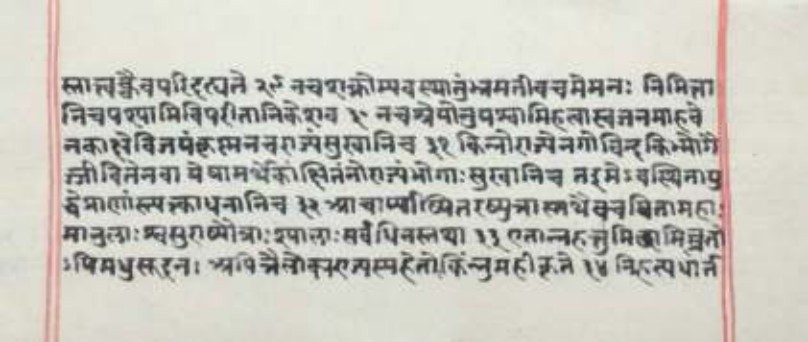
The Bhagavadgītā begins not with philosophy but with a collapse. Before Krishna teaches anything, Arjuna falls apart — his limbs fail, his mouth dries, his skin burns — and the entire teaching is an answer to that moment. This manuscript opens at the very beginning, at the moment the crisis is set in motion.
The field and the question
The text opens with the famous frame: the blind king asking what happened on the battlefield.
Dhritarashtra said: On the field of righteousness, the field of the Kurus, gathered together desiring to fight, what did my sons and the sons of Pandu do, Sanjaya? Sanjaya said: Seeing the army of the Pandavas drawn up in battle formation, Duryodhana then approached the teacher and spoke these words: Behold this great army of the sons of Pandu, O teacher, drawn up in battle formation by the son of Drupada, your wise disciple.
The stage is set with deliberate slowness — the armies named, the heroes listed — so that the collapse, when it comes, lands with full weight.
Arjuna's body speaks
Arjuna's crisis is described physically, in the body, before it becomes an argument.
My skin burns, and I cannot stand still. My mind seems to whirl, O Keshava. I see omens that are contrary. I do not see any good in killing my own people in battle. I do not desire victory, Krishna, nor kingdom, nor pleasures. What use is kingdom to us, O Govinda? What use are enjoyments or even life?
The teaching that follows
It is worth remembering that every verse of the Gītā — the yoga of action, the yoga of knowledge, the vision of the cosmic form — is spoken to a man who said his mouth had gone dry. The teaching is not abstract; it is emergency medicine for a warrior in moral freefall. This manuscript preserves the beginning of that conversation, the moment before the cure.