
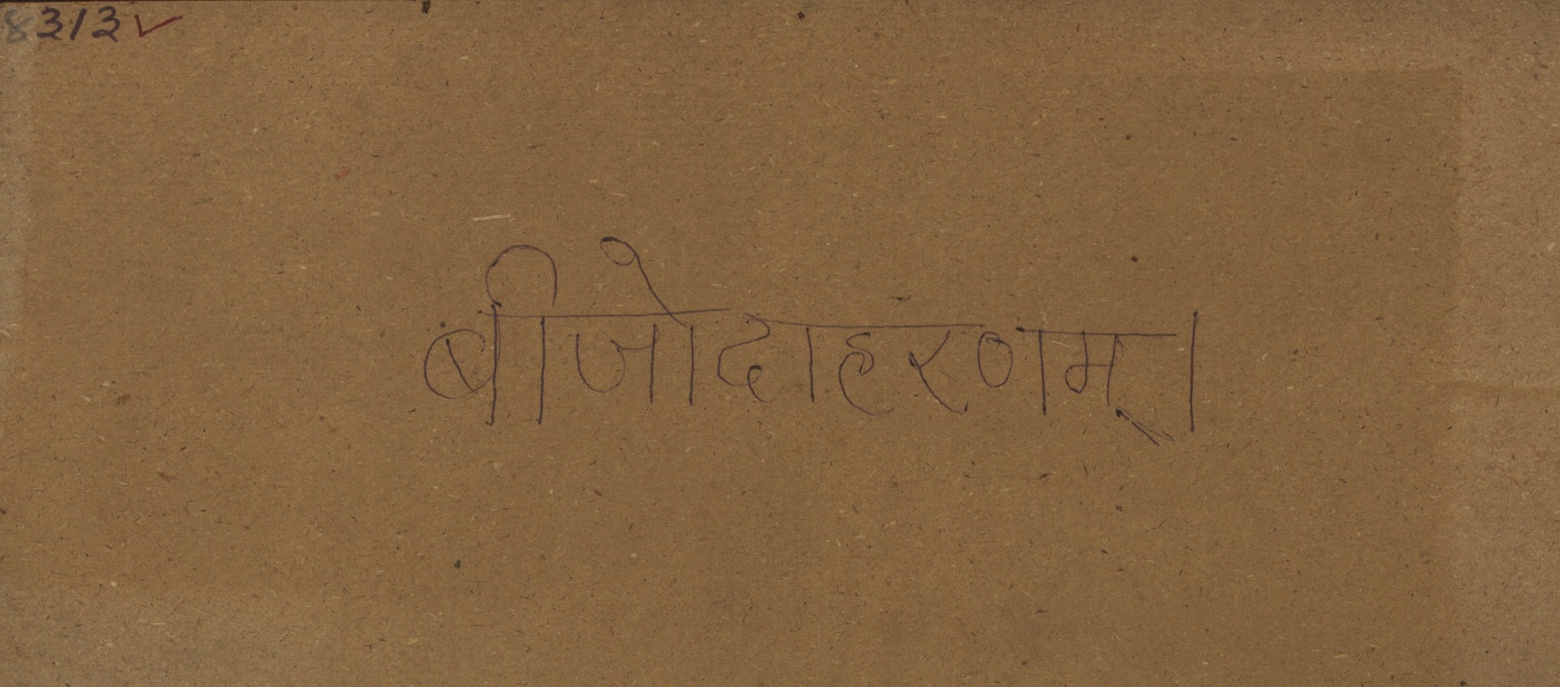
Śiśubodhana (Bijodaharana)
This manuscript presents a Sanskrit treatise on *bījagaṇita* (algebra), specifically the *Bījodāharaṇam* (Algebraic Examples), composed by Rāmacandra Bālakṛṣṇa Jośī in early 20th-century Pune. The text exemplifies the pedagogical tradition of Indian mathematics, opening with devotional verses to Gaṇeśa, Mahālakṣmī, and the author's guru, before systematically expounding algebraic operations including the rules for addition and subtraction of positive (*dhana*) and negative (*ṛṇa*) quantities. Notable is its dual philosophical framing, invoking both Sāṃkhya metaphysics (the *avyakta* or unmanifest as source of manifest number) and theistic devotion, thereby embedding mathematical practice within broader Indian intellectual traditions. The manuscript preserves the characteristic Indic algebraic notation system, employing symbols with superscript dots to denote negative quantities, and demonstrates the continued vitality of Sanskrit mathematical scholarship well into the colonial period.