
Līlāvatī
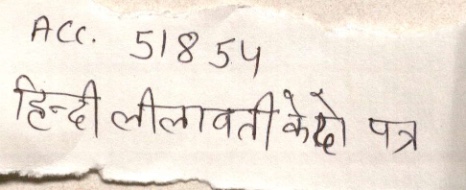
This manuscript fragment presents a rare vernacular Hindi adaptation of Bhāskara II's *Līlāvatī*, a foundational Sanskrit mathematical treatise from the twelfth century. The text employs traditional verse formats (*dohā*, *caupāī*) alongside numerical notation to explicate arithmetic progressions, geometric series, and practical commercial mathematics, including problems of distribution and proportional division. Notable features include the use of indigenous Rajasthani or Old Hindi linguistic forms (e.g., *leṣo* for 'remainder,' *nyāsa* for 'setting down') and the integration of *sūtra* (rule) and *udāharaṇa* (example) structures characteristic of classical Indian mathematical pedagogy. The presence of accession number 51854 and bilingual numerical notation (Devanagari and Arabic numerals) suggests institutional archival provenance, while the didactic narrative involving royal distributions (*rāṇī*, *nṛpati*) reflects the text's continued role in courtly and mercantile education.