
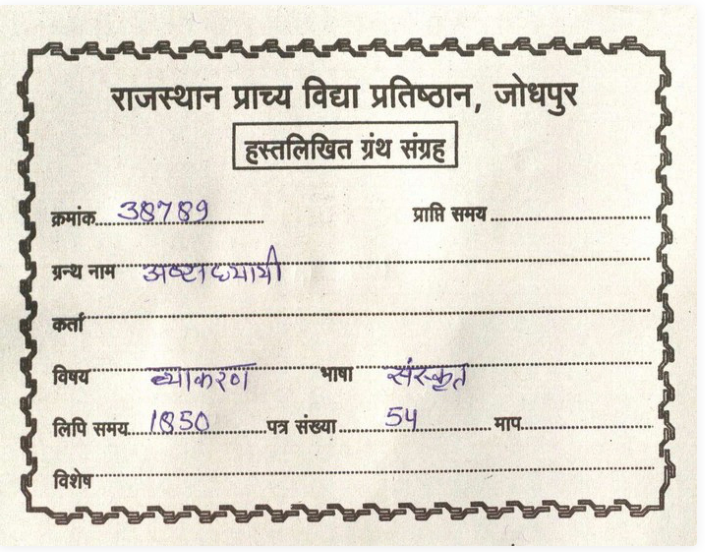
Aṣṭādhyāyī
This 19th-century Sanskrit manuscript from the Rajasthan Oriental Research Institute, Jodhpur, preserves a significant portion of Pāṇini's *Aṣṭādhyāyī*, the foundational text of Sanskrit grammatical analysis. The sample reveals the characteristic sūtra-style aphorisms with their dense, telegraphic formulation, including the famous *pratyāhāra* (phonemic abbreviations) and metalinguistic rules that constitute the backbone of Pāṇinian grammar. Notable features include the presence of traditional benedictory verses (*maṅgalaśloka*) honoring Pāṇini as the 'eye-opener' of the world through the collyrium-stick of knowledge, and the inclusion of section markers (*sūtra-pāda* divisions) that reflect the text's pedagogical transmission. The manuscript's 1850 date and 54 folios indicate it belongs to a period of renewed scholarly interest in indigenous grammatical traditions, preserving the *vyākaraṇa* (linguistic analysis) system that remains unparalleled in its systematic treatment of phonology, morphology, and syntax.