
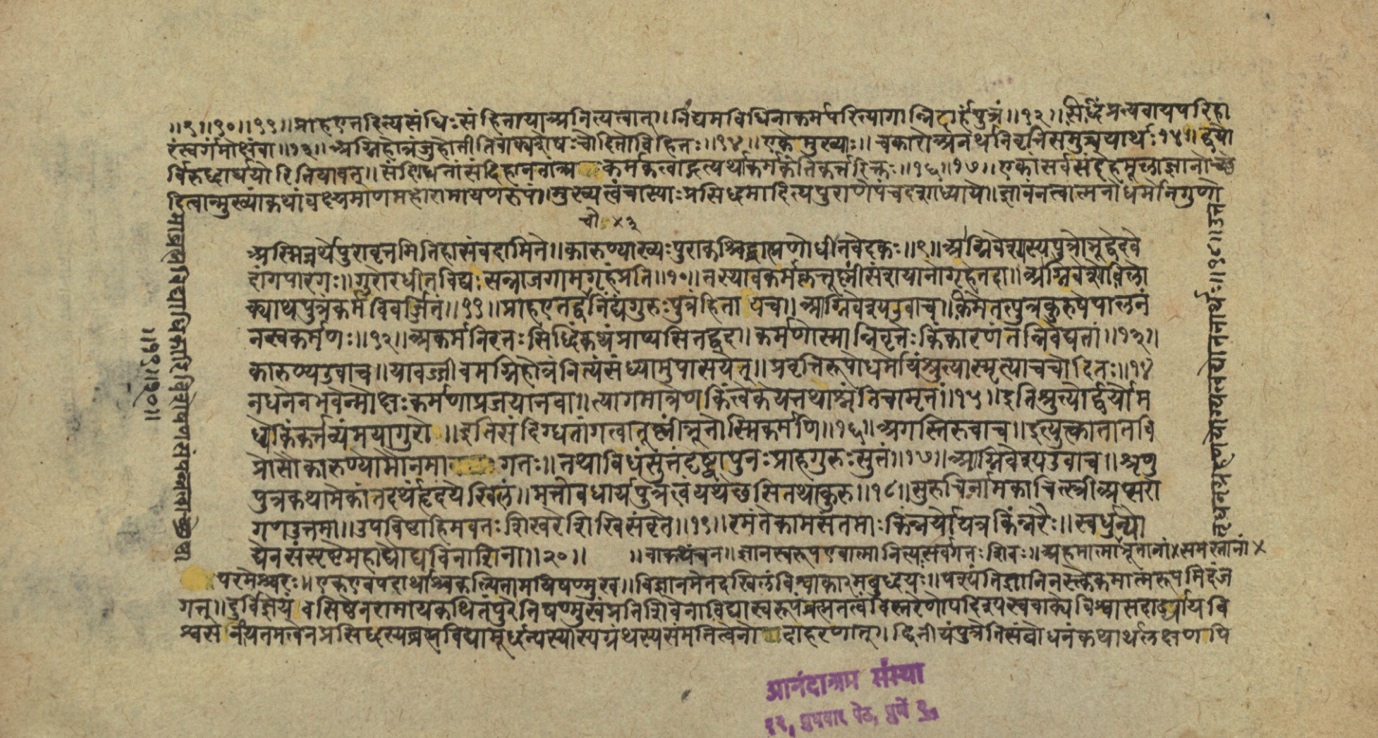
The Yogavāsiṣṭha teaches through stories — long, winding narratives designed to loosen the reader's grip on a fixed self. This manuscript, a copy with commentary from the Vairāgya-prakaraṇa, preserves one of its earliest dialogues: a young Brahmin who has given up action, and the father who challenges him.
The opening frame
The text opens with the same cosmic claim that runs through the whole work — the Self as the source and resting place of everything.
The nature of that Self-existent Reality is described as undiminished. For from whom all beings and living bodies arise at the time of creation, in whom they remain established, and in whom alone they dissolve at the time of dissolution — unto that true Self belongs the sovereignty over all beings. I salute Śrī Rāma, from whom all beings arise, in whom they remain established, and into whom they attain cessation.
The son who stopped acting
The first story is a family argument about the most practical of questions: should you act at all?
There was once a Brahmin named Kāruṇya, well-versed in the Vedas, son of Agniveśya, who had gone beyond passion. His teacher, having completed his studies, came to his house. Agniveśya said: 'Son, why do you not perform your own duty of maintenance? How will you attain perfection, being devoted to inaction?' Kāruṇya said: 'As long as one lives, one should...'
The father's question — how can perfection come from inaction? — sets up the story's answer: the tale of a king who must act, a messenger from Indra, and the discovery that duty and detachment are not opposites.
Philosophy as therapy
The Yogavāsiṣṭha is often called the 'sermon of the Advaita tradition' — a text meant to be lived with, its stories returning to the reader at different stages of life. This manuscript, one of the rare copies with a ṭīkā, preserves that teaching in its original wrapper: not as doctrine but as dialogue, between a father and son, about the oldest question of all.