
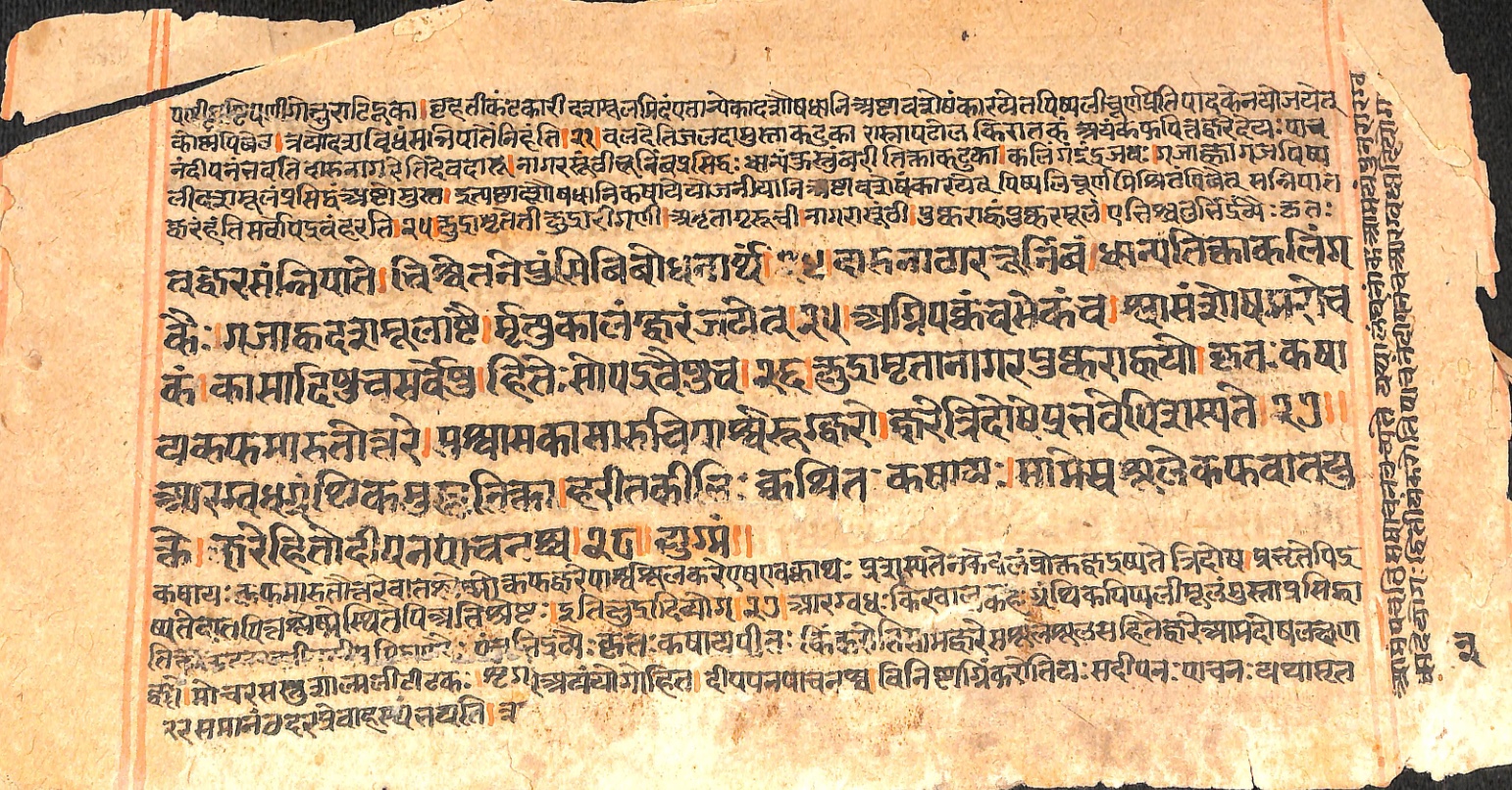
A hundred yogas — not postures, but medicinal preparations. The Yogaśataka is a classical collection of a hundred formulas, and this manuscript is its commentary, written for the 'easy understanding of this Ocean of Medical Knowledge.' It is a doctor's handbook, page after page of decoctions, pastes, and pills.
The ocean made navigable
The commentary opens by explaining its own purpose — and its ambition.
This commentary on the Yogas, beginning with the words 'yo gānāṃ ṭīkā', is undertaken for the easy understanding of this Ocean of Medical Knowledge (Vaidyajñānārṇava). Now, the causes of diseases of living beings, the causes of the manner of diet of living beings, and [conditions] arising from the drinking of poison.
The image is deliberate: the source text is an ocean, and the commentary is a boat.
The great decoction of ten roots
At the heart of the formulas is daśamūla — the 'ten roots' — the famous combination that anchors Ayurvedic respiratory and fever medicine.
Elā, Pṛśniparṇī, Gokṣura, Aṭikā, Vṛhatī, Kaṇṭakārī — these are the eleven drugs of Daśamūla. Boiling them in eight parts of water and reducing to one-eighth part, one should make a decoction. To this, one should add Pippalī powder in one-fourth quantity and drink it lukewarm. It destroys the thirteen types of Sannipāta (complex fevers).
The precision is pharmaceutical — eight parts of water reduced to one, a fourth part of long pepper added, drunk warm — and the claim is total: thirteen kinds of sannipāta fever, one decoction.
The formulas keep coming
From there the commentary continues its rounds — decoctions for cough and dyspnea, for swelling, for urinary disorders, for menstrual bleeding — each formula named, measured, and indicated. The Yogaśatakaṭīkā is a reminder that the tradition's genius was not only in grand theory but in the patient accumulation of working recipes, tested, written down, and handed on.