
A house is more than shelter — in the Vāstu tradition, it is a statement about the life you intend to live. The Vāstusaukhya, the section on 'household happiness' from the Tōḍarānanda, is a manual for getting that statement right: where to build, how to orient, and which trees to plant.
A science assembled from the masters
The text opens by naming its sources — a whole shelf of Vāstu authorities.
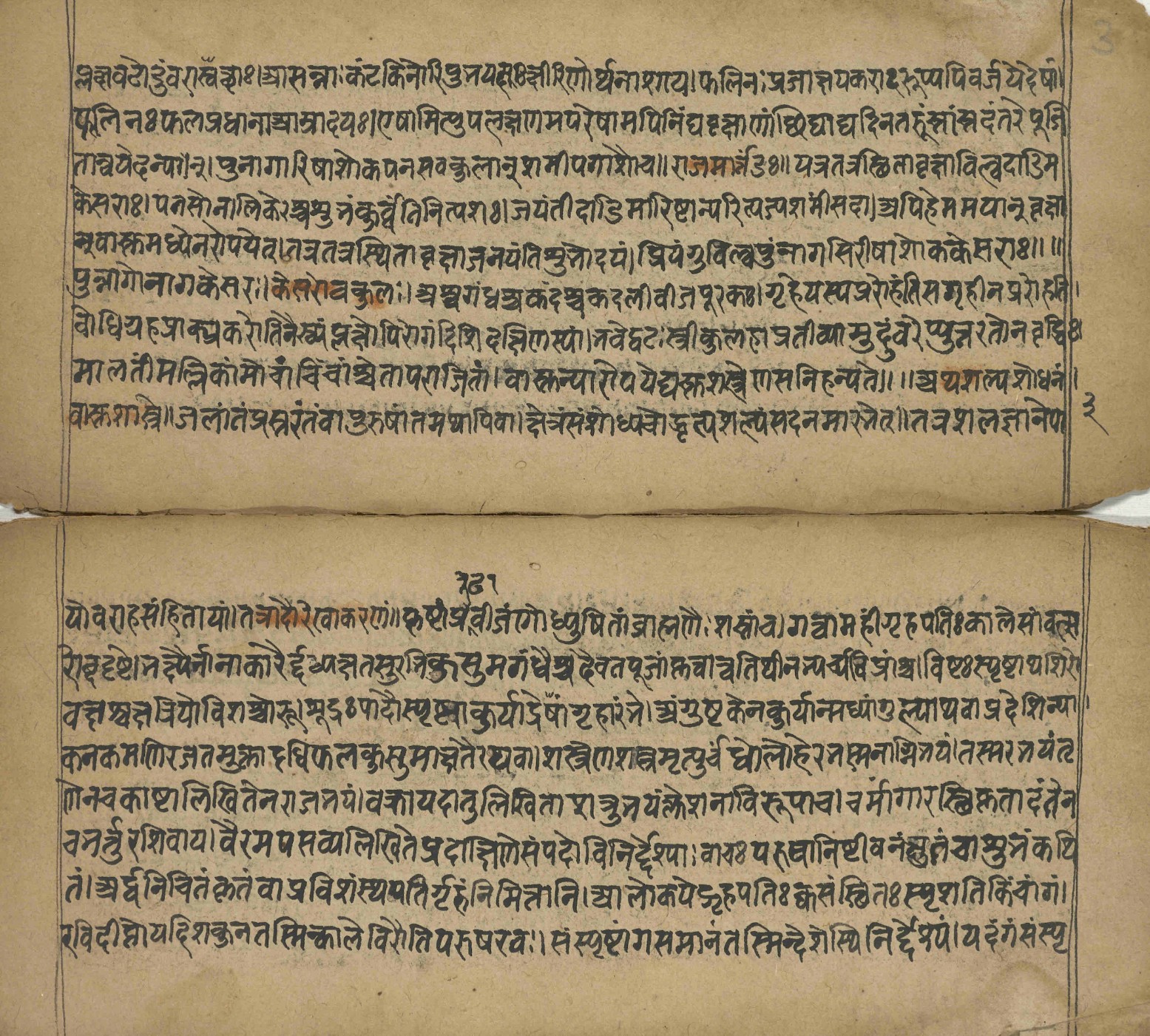
He whose mind is devoted to the two lotus feet of Govinda, that King Tōḍaramala indeed creates household happiness. Examined by the words of Varāha and Lalla, and by the treatises of Vasiṣṭha, Garga, Bṛhatpārāśara, etc., and fashioned by Viśvakarman. The entire Vāstu-nirṇaya is thus described, which increases intelligence, wealth, health, happiness, and fame.
It is a digest — the accumulated wisdom of the tradition, organized under the authority of the legendary architect Viśvakarman.
Which trees to keep
The text's tree-lore shows how practical the science was — the planting around a house was a matter of prosperity and health.
Nearby thorny trees, milk-yielding trees for wealth destruction, fruit-bearing trees for population decline — one should avoid these even if made of silver. One should cut them down, and in the interval of days, having worshipped, one should take shelter of the praised. Bilva, Dadima, Kesara. Panasa and Narikela always. Jayanti, Dadima, Arista, and other trees, Shamipaga always.
The bael, the pomegranate, the jackfruit, the coconut — the auspicious trees are named, and the thorny ones are to be felled, with a small ritual to accompany the cutting.
Dwelling as a practice
Vāstusaukhya treats the house not as an object but as an environment — built, planted, and oriented so that its residents thrive. It is a reminder that architecture in the Indian tradition was never just engineering: it was a discipline for arranging the world so that happiness had a place to stand.