
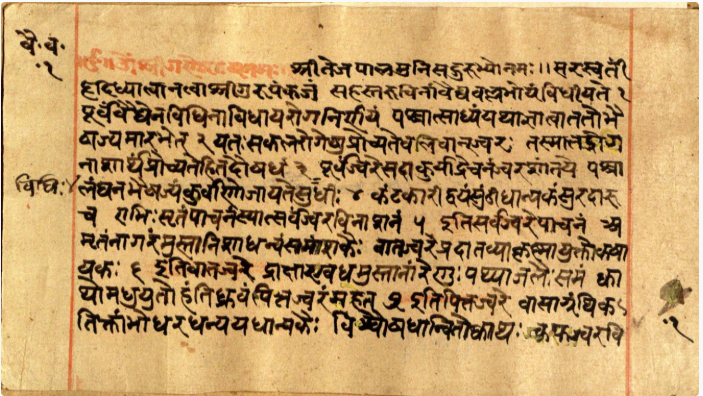
The Vaidyavallabha is a fever specialist's book. Composed by Kavihastiruci — 'the physician-poet with an elephant's hand' — and dated Saṃvat 1907 (1850 CE), the manuscript declares its method on the very first folio: determine the disease properly, decide whether it is curable, and only then begin treatment. Everything after that is a fever formulary with unusual range.
The fever taxonomy in practice
Fever here is not one disease but a family. The text names vāta, pitta, kapha, sannipāta, vāta-pitta, kapha-pitta, śīta, cāturdhika, tṛtīyaka, and ekāntara fevers, each with its own decoction. The sannipāta entry shows the scale: a decoction built on śālaparṇī, pṛśniparṇī, two bṛhatīs, and gokṣura, with bilva, agnimantha, bhūnimba, nimba, amṛtā, dāru, pathyā, akṣa, dhātrī, mustā, triphala, vāsā, arimeda root, trivṛt, priyaṅgu, rasnā, arka root, kṛmiśatru, and the bitter ones, combined with daśamūla.
The decoction with daśamūla destroys the great sannipāta-jvara arising from vāta, pitta, and kapha.
The head-paste and the fever pill
Alongside the decoctions sit two wonderfully simple universal remedies. The first is a paste: "costus, sandalwood, and sand ground with water, applied to the head, destroys all fevers." The second is a pill: borax, black pepper, long pepper, and aconite root mixed with equal amounts of fresh ginger — "removes all fevers." After the botanical megamixes, these two read like a physician's quick kit, kept close at hand for the patient who arrives burning and desperate.
A paste made by grinding costus, sandalwood, and sand with water, applied to the head, destroys all fevers — thus a paste for all fevers.
The same manuscript treats fertility
The Vaidyavallabha is not only about fever. Its pages include a section on female infertility and pregnancy: a fumigation of puṭī and tagara at the proper season, sarpākṣī root and leaves rubbed with one-colored cow's milk, and a regimen for a barren woman — "during the fertile period, a barren woman should drink for seven days; one should give her milk-rice, mung bean, and desired food." The range is typical of these compendia: the same physician who mixes a sannipāta decoction is expected to manage conception and birth.
A named tradition
The colophons anchor the text in a lineage: composed by Hastiruci, disciple of Hitaruci Gaṇi of the Tapāgaccha — the chapter endings name the great teacher Śrī Hitaruci and the work's tenth vilāsa on diseases from yakṣma to gulma. A signed, dated, school-specific medical manuscript from 1850 is a gift to the history of Indian medicine: it shows a living tradition of fever therapy being copied, taught, and extended within a named monastic lineage.
|| Oṃ || Salutations to Śrī Gaṇeśa. Salutations to the true gurus, the sage Śrī Tejapāla. Having meditated upon Sarasvatī in the heart and having bowed to the lotus-feet of the guru, this Vaidyavallabha is composed by Hastiruci. First, having determined the disease by the proper method, the physician should then begin the treatment after knowing whether it is curable or not. Since fever accompanied by vali (wrinkles/looseness) is declared among all diseases, therefore beneficial medicine is prescribed for the destruction of that disease. First, one should always perform fasting for the pacification of fever; afterwards the wise one should employ fasting-medicine.
Of all the fever texts in this batch, the Vaidyavallabha is the one I would want on a shelf: precise about classification, generous with formulas, and honest enough to include the simple remedies alongside the complex.