
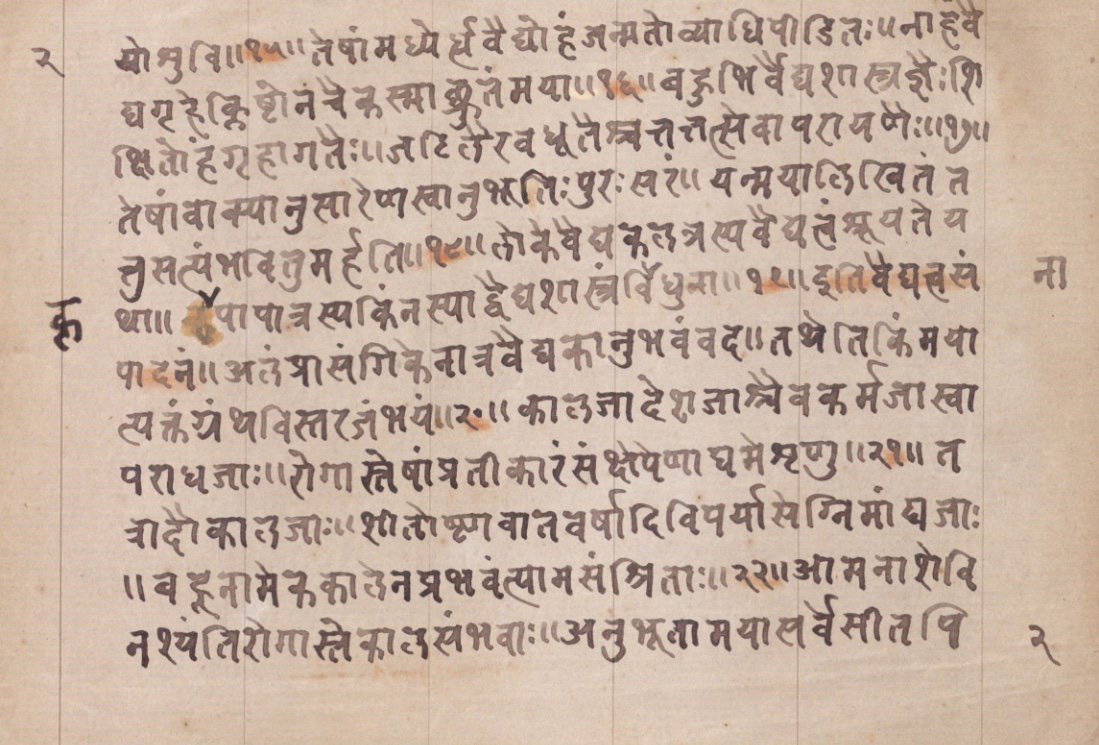
The Vaidyānubhava — 'The Physician's Experience' — is unlike any medical text in the collection. Its author opens by calling saṃsāra itself a disease, and Hari the physician. Then he tells us he was born ill, that he studied under many physicians who came to his house, and that he is writing from experience — anubhava — rather than from the śāstras alone. The frame is explicitly Vedāntic, grounded in a metaphysics, but then—without missing a beat—the text turns to actual fevers, actual diarrheas, actual cures.
The metaphysics first: worldly existence as disease
The opening verses do something unusual in a medical text. They frame the problem as spiritual: a man "who has not studied the scriptures, possessed of passion and hatred, becomes blind with intoxicated [ignorance]." The root illness is not a disorder of vata or pitta; it is a disorder of understanding. And the cure is not a medicine alone: dispassion, faith, and meditation are as much remedies as any herb.
I bow to Śrī Hari, the Lord of Physicians, the sole remover of the disease of existence; whose foot-water is cooling, the sole pacifier of the threefold afflictions. Born from the fire of dull intellect, the severe indigestion of sense-objects—this saṃsāra-disease, rooted in that, has the nature of the fever of sin and suffering.
But this is not abstraction. The author then treats the spiritual metaphor as a working model: "For one without beginning or middle, fasting, not digestion; by purgation of dispassion alone does the disease attain ripeness." Disease is disease, whether of the body or the soul. The remedy for saṃsāra is as pragmatic as the remedy for fever.
Diseases mapped onto geography
When the text turns to clinical medicine, it introduces a classification that most Ayurvedic texts do not emphasize: diseases arise from four origins. Some arise from time (kālaja)—from the reversal of seasons, from weakness of digestion, from undigested food. Some arise from region (deśaja). And here the author is specific: "In lands having excess of kapha and vāta, such as the western [region] including Magadha. In the Gurjara [lands], having excess of kapha, there are many [people with] digestive disorders. In Kīkaṭa, those of pitta origin occur."
For all, jaundice and such [diseases occur]. Having given priority to the respective remedies for those doṣas in diet and such, health generally arises for them with certainty.
Disease is not abstract; it is tied to place. A physician treating patients in Magadha faces different diseases from one treating patients in Gurjara. The climate, the water, the foods available—these are not incidental; they are part of the diagnosis.
Fever and its causes: anger, desire, karma, fault
The Vaidyānubhava covers ordinary fevers with specific remedies: a decoction with kiratatikta (Swertia chirata), embelia, and castor root for common fever; ginger and vata-alleviating herbs for vata fever; parpata with grapes for pitta fever. But it also recognizes that fevers have psychological and spiritual origins: anger-born fever, desire-born fever, grief-born fever, fear-born fever. For these, the remedy is not just herbal; it is psychological or spiritual adjustment—consolation, fulfilling desire, removing fear, purification.
Water mixed with the juice of kirata (Swertia chirata) and nagara (ginger) destroys vata-pitta fever, just as Hari (Vishnu) destroys the elephant (demon Gajasura). For vata-pitta fever.
Chronic fevers (jirna jwara) have their own regimen. Panchakola—a combination of five pungent substances (Pippali, Pippali root, Chavya, Chitraka, and Nagara)—taken in the morning with honey is specifically praised: "Having risen in the morning, I took this with honey; with that, the irregular fever subsided along with the two doshas." This is not hearsay; the author speaks from personal experience.
A physician's personal chronicle
What distinguishes this text is the author's repeated insistence on experience over theory. "Following their words, with my own experience foremost, what I have written should indeed become true." He frames his work as practical knowledge gained by living with disease, studying under multiple physicians, and testing remedies on actual patients. When he describes treatments for digestive disorders, for asthma, for paralysis, for urinary ailments, he often adds: "I have experienced this," or "this application brings immediate comfort."
I, who am speaking here among them, am indeed from birth afflicted by disease. I have not been troubled in the house of a physician, nor have I heard from one alone. I have been instructed by many physicians learned in the science, who came to my house, who were reciters, detached, and devoted to that service.
An encyclopedia of treatment
The Vaidyānubhava covers an encyclopedic range: fever (all types), diarrhea and bloody diarrhea, vomiting, hiccup, colic, asthma and cough, skin diseases including leprosy and ulcers, mouth and tooth diseases, ear and eye and nasal conditions, headaches and hemiplegia, diabetes and urinary disorders, epilepsy, consumption, sexually transmitted infections, wounds, and even possession. For each, it gives specific formulations drawn from actual practice. A decoction with various herbs for pitta-kapha fever. Pomegranate seed extract for diabetes. Castor and chili seed oil nasal application for epilepsy. Mercury combined with sulfur and jaggery for syphilitic chancre.
What makes the Vaidyānubhava extraordinary is not that it covers all these diseases—other texts do—but that it frames medical knowledge as something earned through lived experience, refined through study with many teachers, and then transmitted with the humility of someone who knows the limits of knowledge: "The scriptural injunction consisting of regional language [is] from the greed of me, the foolish physician; the spreading out [of this] is a mountain of faults." Yet the author spreads it out anyway, because patients need help and the knowledge, however imperfectly expressed, works.