
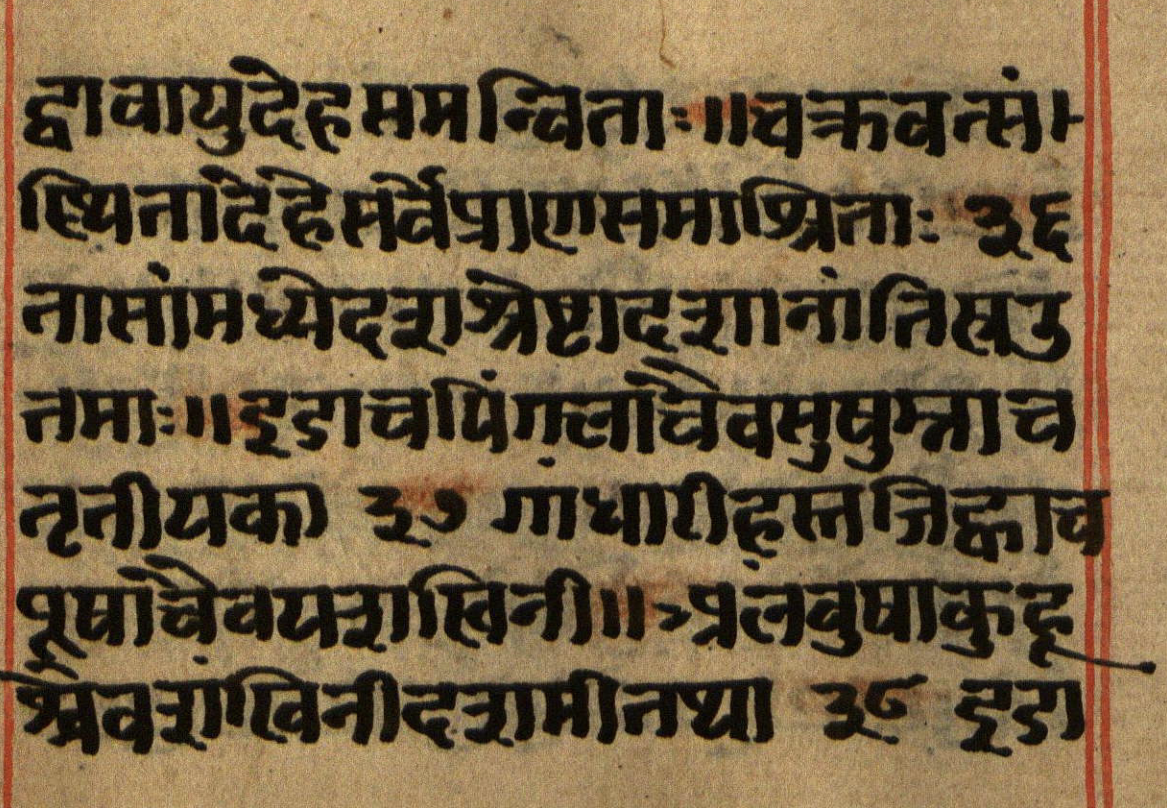
The manuscript catalogued as 'Manusmṛti' is actually a copy of the Svarodaya — the 'Arise of Breath' — a dialogue between the Goddess and Īśvara on the science of breath as destiny. It makes an extraordinary claim on its first pages: that a knower of svara is bound by neither tithi, nor nakshatra, nor planet. Breath, not the stars, is the astrologer's true clock.
The body's three rivers
The text maps the cosmos onto the body. Iḍā is the Ganges, on the left; piṅgalā is the Yamunā, on the right; and the central channel is Sarasvatī — their confluence is a Prayāga inside the body. Seventy thousand nāḍīs are said to stand in the body; among them ten are chief, and among the ten three are supreme: iḍā, piṅgalā, and suṣumnā, with the kuṇḍalinī sleeping "in the form of a coiled serpent." The ten vital winds are named and located: prāṇa in the heart, apāna in the anus, samāna at the navel, udāna in the throat, vyāna throughout the body. The text then names the secondary winds: nāga (belching), kūrma (closing of eyes), kṛkala (sneezing), devadatta (yawning), and dhanañjaya (pervading even after death).
The nāḍīs, endowed with air and body, are situated in the body like a wheel, all dependent on prāṇa. Among them, ten are excellent; among the ten, three are supreme: iḍā, piṅgalā, and suṣumnā as the third.
The breath-clock of every action
The practical heart of the book is a timetable. The left nostril (the moon) is auspicious for departure, gentle actions, commerce, and seeing friends; the right (the sun) governs fierce deeds, battle, and eating. "At departure, the left is auspicious; at entry, the right is auspicious." Gifts given while the right nostril flows "become multiplied by crores upon crores." The sun and moon alternate through the day in sixty ghaṭikās — and the wise time every act by which nostril is open. But the text goes deeper: which tattva (element) is flowing? Is earth, water, fire, air, or space dominant? "Earth has five qualities, water four, fire three, wind two, and space one." Each element carries different fruits. Earth brings stable gain; water yields instant results but those that perish; fire brings death; air brings loss; space brings nothing.
Travel omens in the breath
Even direction of travel is regulated. "The moon should be in the northeast, the sun in the southwest. One should not go to the southwest when the right nostril is active. One should not go to the northeast when the left nostril is active. For one who goes there, fear of enemies arises and good fortune does not return." The same science that times a journey reads the signs of death — the sun seen in water without reflection, the middle fingers unbent, the throat drying without disease — each with its numbered months of life remaining. The text catalogs omens: "If one reaches sixty years, then death is certain. Bad dreams occur, and then the death of mother and father. Separation from wife and son, fear of disease and fire, affliction of the house, fear of the king."
At departure, the left is auspicious; at entry, the right is auspicious. Gifts given while the right nostril flows become multiplied by crores upon crores.
The meditator's gift: knowing the elements
For one who masters the breath and elements, the benefits are profound. "One who knows the distinctions of the nāḍīs, the distinctions of the prāṇa-tattva, and the distinctions of the suṣumnā and the miśra — he is liberated." The text teaches meditation on the seed syllables: "One should meditate on the seed syllable 'Laṃ'; one should meditate on the earth element as square, yellow, fragrant, and golden in color. One should meditate on the seed syllable 'vaṃ'... of the nature of water, half-moon shaped, of the color of a ruby." Through this knowledge, the yogi moves beyond dependence on planetary time into the direct reading of the body's own cosmic clock.
Beyond the stars
The deepest claim is soteriological: "Neither the lunar day, nor the constellation, nor the day of the week, nor the planets... none of these exist there." For the yogi who knows the breath, astrology is transcended — the prāṇa is the supreme friend, and its mastery yields the eight siddhis, the nine treasures, and knowledge of the three times. The colophon calls the whole work the dialogue of Umā and Maheśvara, and its teaching the jewel in the crown of knowledges.