
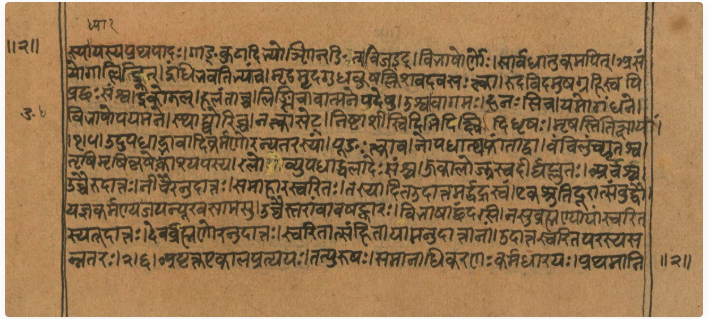
The Aṣṭādhyāyī was usually studied with a commentary. But there was another way to copy it — bare. The Sūtrapāṭha is Pāṇini's grammar stripped to its skeleton: nothing but the sūtras themselves, in order, without explanation. This manuscript is that skeleton, preserved from Jodhpur.
The grammar in its pure form
The text opens as the Aṣṭādhyāyī always does — with the homage and the pratyāhāra-sūtras.
By whom the entire grammar was proclaimed, having received the alphabet-series from Maheśvara; to that Pāṇini, salutation. By whom men's speeches were cleansed with pure streams of words; darkness born of ignorance was split asunder; to that Pāṇini, salutation. a i u ṇ. ṛ ḷ k. e o ṅ. ai au c. ha ya va ra ṭ. Vṛddhi is ā, ai, au. Guṇa is a, e, o.
Then the rules run on, unbroken, in their canonical order — a text meant to be recited and held in memory.
Rules without examples
The bare form changes how the grammar works on the reader. There are no examples to lean on, no commentator to explain — the sūtras must carry the entire weight.
The suffix ktvā after mṛḍ, mṛd, gudh, kuṣ, kliś, vad, and vas. The augment saṃ after rud, vid, muṣ, grah, svap, and prach. Of ik before jhal. The suffix sic after han. Of yam in the sense of 'to smell'. Optionally in the sense of 'to obtain'. And the augment ic after sthā and ghu.
The value of the skeleton
Why copy the grammar without commentary? Because the sūtras were meant to be memorized — the bare text was the version a student carried in the head, the commentary the version read at the desk. This manuscript preserves the grammar in its hardest, purest form: the rules alone, a machine with no instructions, trusted to generate the entire language.