
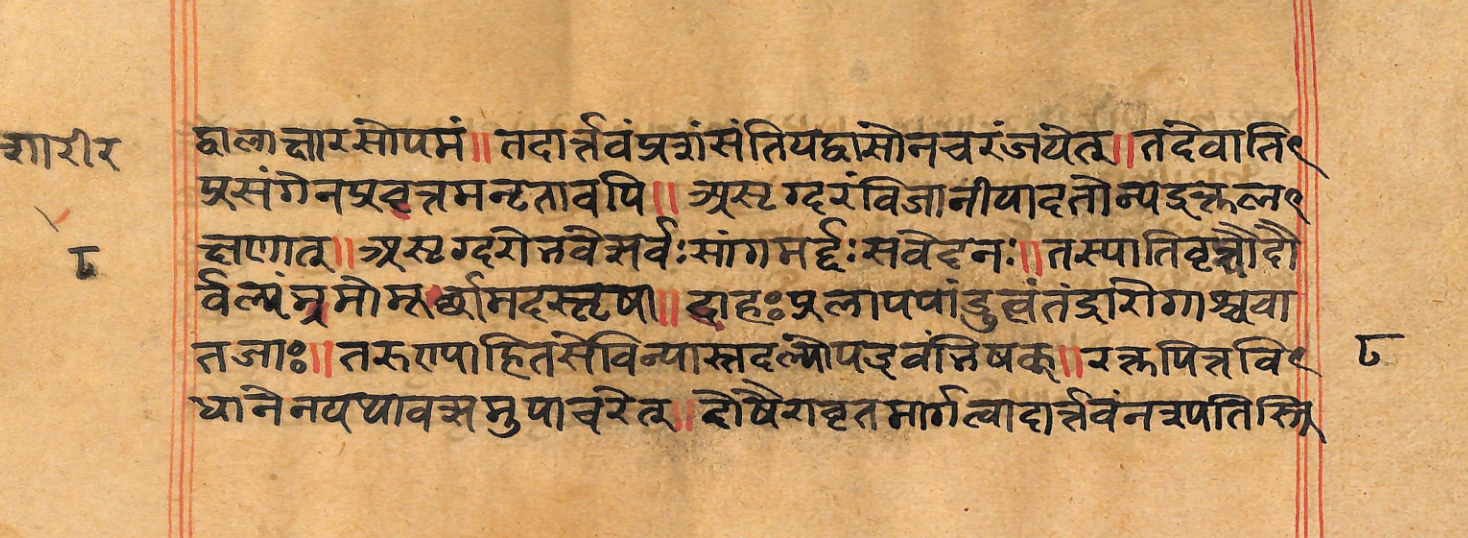
The medical classic of Suśruta begins its section on the body — the Śārīrasthāna — not with anatomy, but with cosmology. This manuscript, dated Samvat 1704, opens with Sāṃkhya philosophy: the unmanifest Prakṛti, the three guṇas, and a body whose organs are mapped onto gods and elements. Anatomy, in this tradition, is a branch of philosophy.
Prakṛti and Puruṣa
The text sets out the two fundamental principles with the care of a philosophy lecture.
Both are infinite. Both are without marks. Both are eternal. Both are boundless. And both are all-pervading. But one is Prakriti, which is unconscious, possessed of the three gunas, having the nature of a seed, having the nature of production. But the many Purushas are conscious, without gunas, without the nature of a seed, without the nature of production. Therefore, the effect corresponds to its cause.
From the guṇas arise the eleven sense-organs; from the subtle elements the gross ones — and the human body is the meeting point where all of it becomes visible.
A body mapped onto the cosmos
The manuscript maps each organ to a divine or elemental lord — the moon governs the mind, the directions govern hearing, wind governs touch, the sun governs sight, fire governs speech — so that the body is a microcosm with a divine address for every part.
The Lord of ego. The moon of the mind. The directions of hearing. The wind of touch. The sun of sight. The waters of taste. The earth of smell. Fire of speech. Indra of the two hands. Vishnu of the two feet. Mitra of the anus. Prajapati of the generative organ.
From philosophy to the clinic
The same text then turns thoroughly practical — diagnosis of semen and menstrual blood, treatments for their defects, and careful description of menorrhagia.
Like lac-dye extract. They praise that menstrual blood which does not stain the cloth. That same [blood], when it flows excessively even outside the proper time, one should know as asṛgdara (menorrhagia) from that very moment. All [asṛgdara] is associated with coitus and pain.
The journey from the unmanifest to menstrual blood in a single section is the signature move of classical Ayurveda: a philosophy of the whole, applied to the very particular. That is what the Śārīrasthāna preserves — the conviction that to understand the body you must first understand everything.