
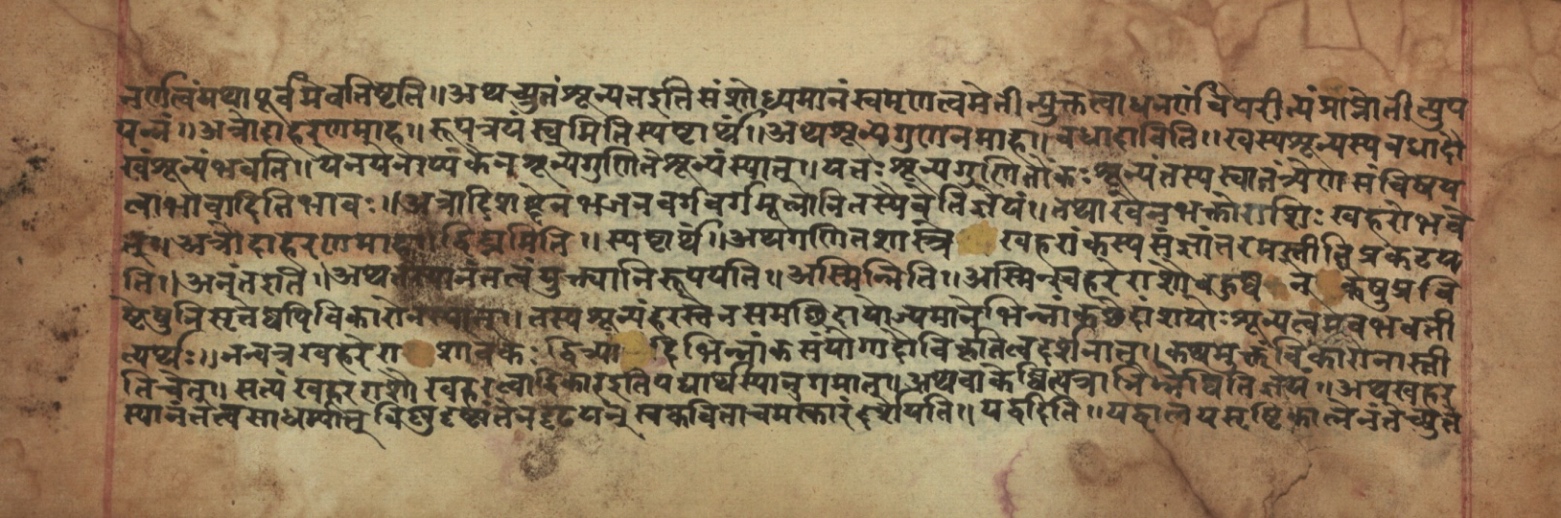
Debt and credit, gain and loss — those, says this Sanskrit commentary on algebra, are what positive and negative quantities really mean. The Sūryabhāṣya works through the arithmetic of negative numbers with everyday examples, and then goes further, treating division by zero and giving the result a name: ananta, the infinite.
Positive and negative as debt and credit
The commentary states the sign rules the way a classroom teacher would, but grounds them in finance rather than abstractions.
The sum of two positive quantities would be their addition; likewise, the sum of a positive and negative quantity would be their difference. Here, positive and negative should be understood as gain and loss, or as debt and credit.
So two gains add; a gain and a debt cancel; two debts accumulate. The manuscript then walks through the rest of the rules: subtracting a positive makes it negative, subtracting a negative makes it positive, and multiplying two negatives gives a positive.
Zero and the infinite
The most striking passage is about zero. Multiplying by zero gives zero — clear enough — but dividing by zero is where the text reaches for a concept that would take European mathematics centuries to formalize.
In multiplication, etc. of kha (zero), kha (zero) becomes zero. By whatever digit zero is multiplied, it becomes zero. A quantity divided by kha (zero) becomes kha-hara (having zero as divisor). In mathematical science there is another name for a digit having zero as divisor — ananta (infinite). In this kha-hara quantity, even when many are entered into it or removed from it, there would be no change.
That is a recognizable, informal description of infinity: adding or removing finite amounts leaves it unchanged. The manuscript is drawing a philosophical parallel — the infinite as that which remains unmoved by addition and subtraction — while doing real mathematics in the same breath.
Why this matters
This commentary shows a mathematical culture that treated zero, negative numbers, and infinity as ordinary working tools centuries before they were standard elsewhere. It is a reminder that the history of mathematics is not a single straight line — some of its most fundamental ideas were being taught, copied, and commented upon in Sanskrit while they were still unthinkable in much of the world.