
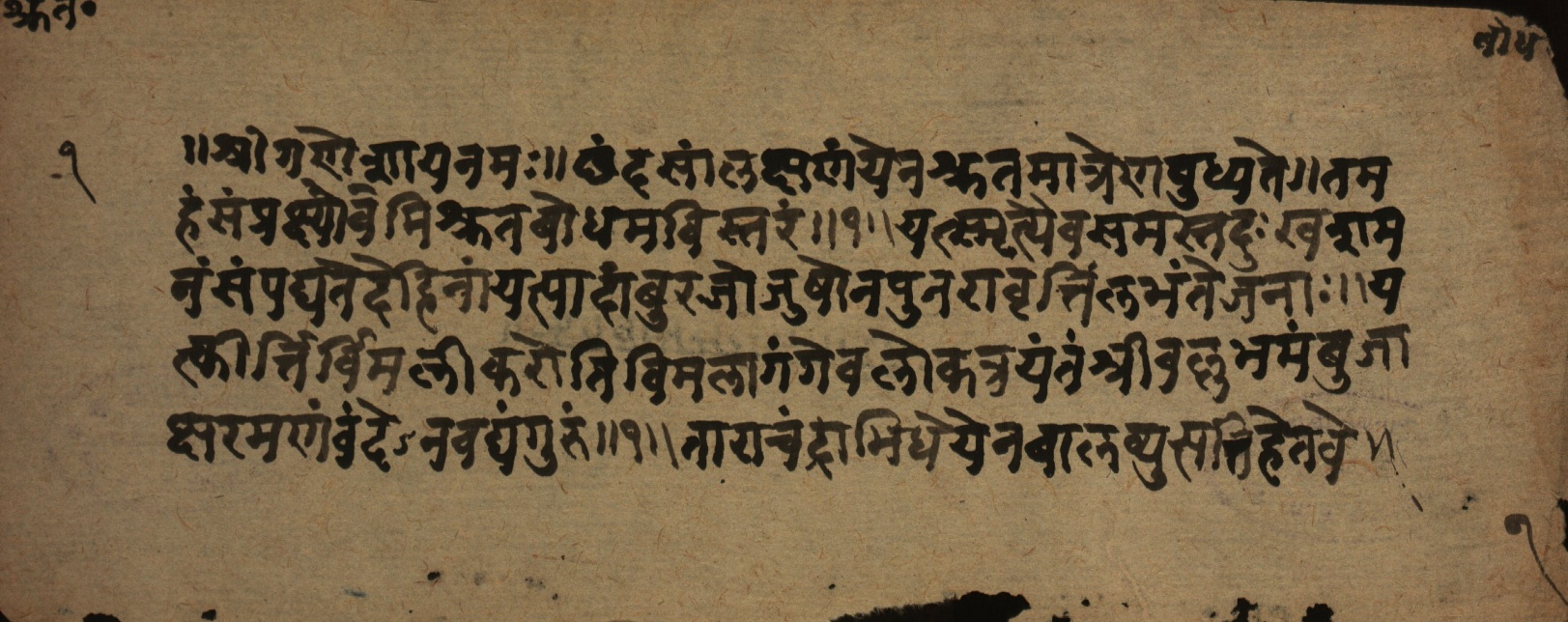
The Śrutabodha is a short Sanskrit treatise on prosody attributed to Kālidāsa — its name means 'understanding by hearing,' because the characteristics of meters can be grasped merely by listening. This manuscript is the Bālavivekinī, 'the young student's discerning commentary,' composed by Śrī Mā Bā Kaḷamkara of Wai, and it does exactly what its name promises: it walks a beginner through the machinery of Sanskrit verse.
Heavy and light: the two weights of verse
Everything rests on guru and laghu — heavy and light syllables. The commentary is painstaking: a short vowel is one mātrā, a long one two; a vowel followed by a conjunct consonant becomes heavy; anusvāra and visarga add weight; and at the end of a pāda, weight is optional. It quotes the Śikṣā — "one mātrā is short, two mātrās is called long" — and Māgha and Śaṅkarācārya for the fine points of conjuncts.
One mātrā is short; two mātrās is called long. That which has an anusvāra, ends in visarga, is long, or has a conjunct following — at the end of a pāda, that is to be known as guru.
The eight gaṇas, each with a personality
The commentary introduces the eight three-syllable gaṇas and gives them social roles: "ma and na are friends, bha and ja are servants, ra and sa are neutrals, ta... is the enemy, and low." A whole table of outcomes follows — from a friend to a servant brings victory, from a servant to a friend there is no success, from an enemy's wealth comes the death of prosperity. Meter-reading here shades into divination: the first gaṇa of a poem is chosen for its omen as much as its sound.
The meters, one by one
Then the catalog: the Āryā with its twelve-eighteen-fifteen mātrās; the anuṣṭubh — "in a verse, the sixth should be known as guru, everywhere the fifth as laghu"; the Vasantatilakā, Mālinī, Mandākrāntā, Śārdūlavikrīḍita, Sragdharā, and dozens more, each with example verses praising Kṛṣṇa, Rādhā, and the gopīs. The examples double as devotional verse — the cowherd boy who swallowed the forest fire, the child who liberated the yamalārjuna trees.
Why it matters
The commentary is blunt about the stakes. "One who composes poetry without knowing the classification of syllables, and without discriminating between the auspicious and inauspicious — such a poet is verily an animal." Knowledge of meter, by contrast, brings "happiness and fame in this world, and heaven." The colophon records the book was completed in the year of King Ramadanta, on the fifth day of the dark fortnight of Phālguna — with the wish that readers and teachers alike find supreme auspiciousness.
Or rather, of those desiring meters. That is, of desires. May there be fame and renown for me too through the works composed by Kālidāsa, such as the one beginning with 'praise'—for those desiring such, he will state earlier in this work. 'With lovers whose brows are trembling with intoxication,' 'O youth desiring the sport of dalliance,' 'The beauty of Rambhā's pillar-like thighs'—such statements fulfill that desire. One should not think 'This is for filling the meter of a great poet like you.' 'Chandas is desired in verse'—so says Amara.
That is, of desires. May there be fame and renown for me too through the works composed by Kālidāsa, such as the one beginning with 'praise'—for those desiring such, he will state earlier in this work. 'With lovers whose brows are trembling with intoxication,' 'O youth desiring the sport of dalliance,' 'The beauty of Rambhā's pillar-like thighs'—such statements fulfill that desire. One should not think 'This is for filling the meter of a great poet like you.' 'Chandas is desired in verse'—so says Amara. Characteristic mark.
May there be fame and renown for me too through the works composed by Kālidāsa, such as the one beginning with 'praise'—for those desiring such, he will state earlier in this work. 'With lovers whose brows are trembling with intoxication,' 'O youth desiring the sport of dalliance,' 'The beauty of Rambhā's pillar-like thighs'—such statements fulfill that desire. One should not think 'This is for filling the meter of a great poet like you.' 'Chandas is desired in verse'—so says Amara. Characteristic mark. Sign, mark, characteristic.
It is understood. That treatise named Śruta-Bodha I shall now explain. 'I' means: to the extent that there is my desire in describing the characteristics of those meters, of those alone I shall describe the characteristics, not of all—this is the meaning. Therefore, briefly, concisely—the characteristics of some meters, this is the meaning. || 1 || There, first, for the purpose of making known the characteristics of meters, by one Āryā verse I state the definition of guru syllables: A conjunct-initial, long, with anusvāra, mixed with visarga—this syllable should be known as guru, optionally when at the end of a pāda.