
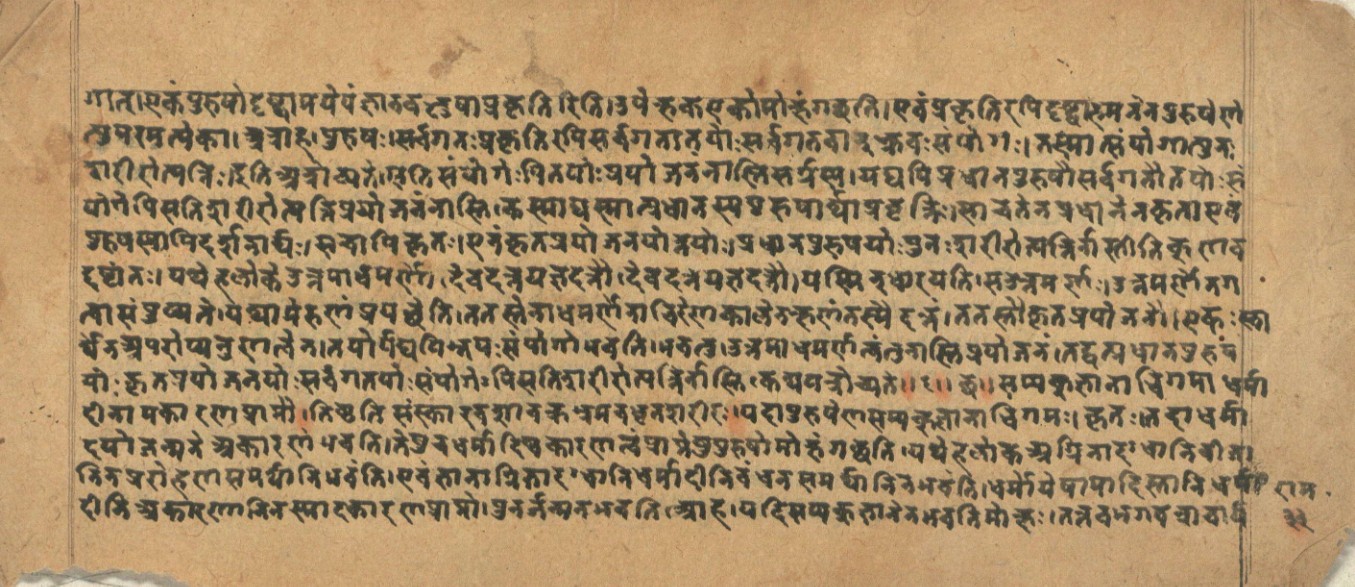
This three-folio fragment of the Sāṃkhya — one of the six orthodox schools — is a compact essay on a single question: how does liberation happen? Its answer is the school's most famous image, worked out in careful detail: Prakṛti is a dancer who performs for Puruṣa, and liberation is the moment she stops — not because she is dismissed, but because she has been fully seen.
The knowledge that ends knowledge
The text opens with an extraordinary claim: through the practice of the tattvas — the twenty-five principles that constitute reality — there arises remainder less knowledge: "I am not, not mine, not I." This is the heart of Sāṃkhya liberation. It is not the acquisition of something new, but the clarification of what was never bound. The text explains: "From non-perversion, pure, absolute knowledge arises." Perversion is doubt; non-perversion is the absence of confusion. When this knowledge arises, the entire edifice of ignorance — the taking of oneself as body, as sense, as mind — simply ceases.
Through the practice of the tattvas, [knowledge arises]: "I am not, not mine, not I." From non-perversion, pure, absolute knowledge arises.
The dancer who turns back
The text quotes the analogy directly. "One actor goes to the stage. Thus Prakṛti also, having been seen by this Puruṣa, ceases, one [turns back]." The realization is described as knowledge without remainder: the seer finally sees that he was never the seen. Prakṛti is nature, the entire productive power of the cosmos — matter, qualities, forms, all visible reality. She dances because she exists to be perceived. But the moment Puruṣa — pure witnessing consciousness — truly sees her, she has no more reason to perform. Not because she is rejected, but because her work is done.
The problem of all-pervasiveness
The fragment does not content itself with metaphor; it presses the philosophical objection. "Puruṣa is all-pervading, Prakṛti is also all-pervading; due to their all-pervasiveness, whence their conjunction? Therefore there is no conjunction of both." If both consciousness and nature permeate everything, how can they ever conjoin? The answer is unexpected: they conjoin "like [iron] with fire," or like two travelers, Devadatta and Yajñadatta, who walk the same road at different times. Proximity without fusion. They are not mixed; they are adjacent. This is real philosophy, working through objections rather than merely repeating a metaphor.
Puruṣa is all-pervading, Prakṛti is also all-pervading; due to their all-pervasiveness, whence their conjunction? Therefore there is no conjunction of both.
The potter's wheel still turns
The final concern is deeply practical: if knowledge has ended the conjunction, why does the body persist? Why does the wheel keep spinning? The text invokes saṃskāras — residual impressions, latent tendencies — and the analogy of the potter's wheel. "From the attainment of correct knowledge, when the causes of Dharma and the rest are obtained... it remains, by force of impressions, like the whirling of a wheel, with body sustained." Once the potter's hand leaves the wheel, it continues to rotate for a while on its own momentum. The dancer may have retired, but the stage still echoes. Embodiment after liberation is momentum, not bondage — the continuation of effects that began before knowledge arose.
For a three-folio fragment, this is remarkably complete: a thesis on liberation, an objection, a reply to the objection, and an account of what happens afterward. It is Sāṃkhya in miniature — and the dancer metaphor still lands with its full force.