
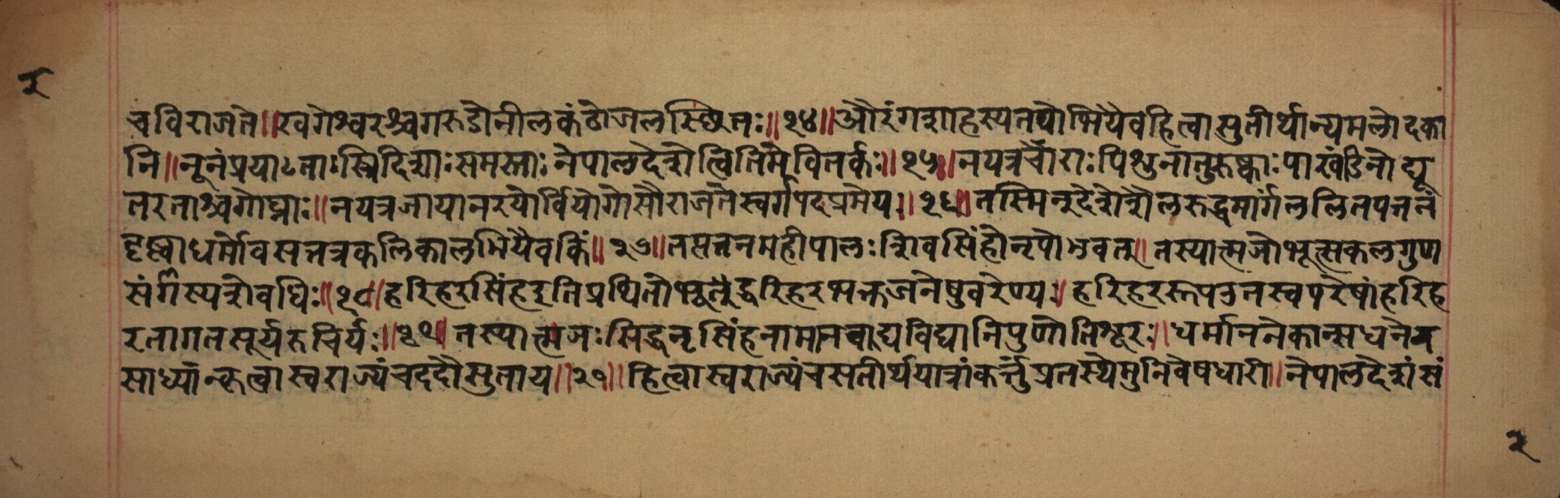
Not every Sanskrit court text praises a dynasty. Sabhāvinoda — 'the delight of the assembly' — spends some of its most beautiful verses praising a place: Nepal, described as a land so virtuous that heaven itself might be mistaken for it.
A royal poem's opening
The text begins conventionally enough — invocations, then the Sūryavaṃśa lineage.
I bow to Śrī Ḍhuṇḍhirāja, who destroys all sins, who is the joy of Pārvatī's heart, and who was given a modaka by Kamalā. The Sūryavaṃśa flourishes on this earth, in which mighty kings arose; in which were Māndhātṛ and others, devoted to dharma; in which was Rāma, the giver of all objects.
The solar dynasty is invoked — Māndhātṛ, Rāma — as the pedigree of the kings the poem will celebrate.
The land without faults
Then comes the praise of Nepal, and the poem rises to its best lines.
Where there are no thieves, no slanderers, no cruel men, no hypocrites, no deceitful people, nor cow-killers; where there is no separation of husband and wife — there, O king, one should consider heaven itself to be present. In that land where the path is blocked by mountains, in Lalitapattana, having seen Dharma himself, what fear of the Kali age is there?
The praise is built on negatives — what the land lacks — and the absence of fault is its glory. The mountain-walled valleys keep out not just invaders but vice.
A poem as a place's portrait
Sabhāvinoda is a reminder that Sanskrit kāvya was not only romance and epic — it was also place-writing, praise of kings, and the celebration of particular lands. Its portrait of Nepal, sheltered by mountains and free of the Kali age's vices, is the kind of passage a court would remember and quote: a kingdom described as heaven, in verse.