
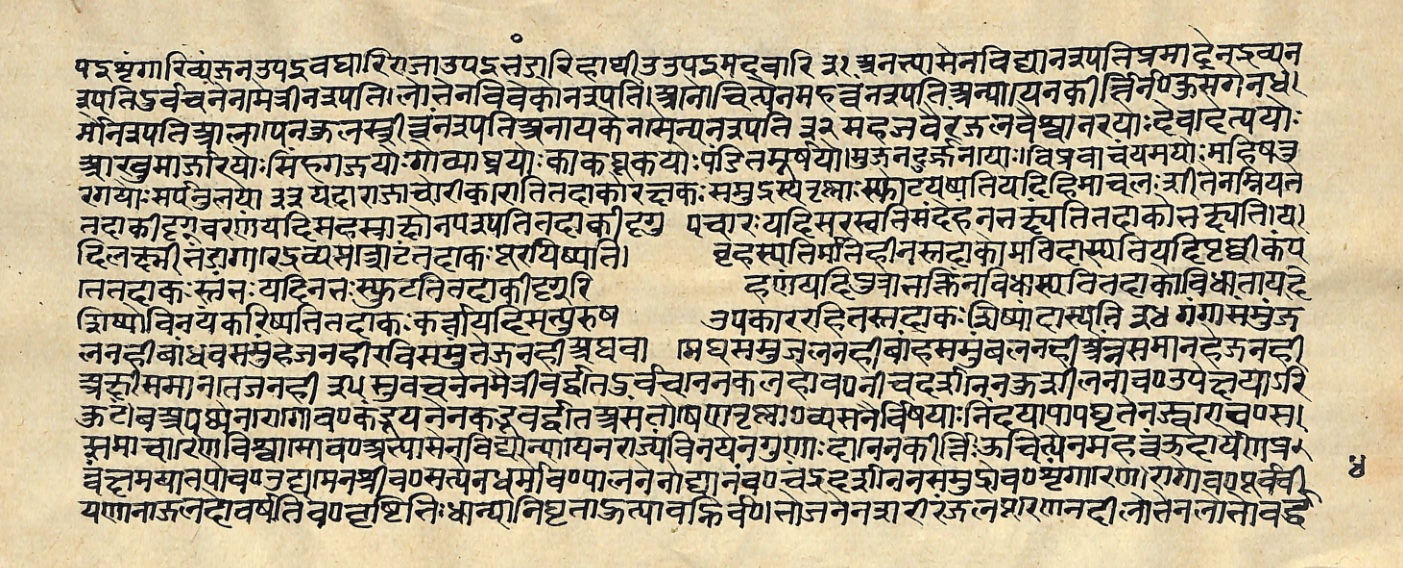
Every virtue has a weakness that quietly destroys it. That is the premise of a striking chain of aphorisms in the Sabhāśṛṅgāra, a collection of verses that runs through the ways good things come to ruin — and then shifts to the enmities that nothing can fix.
How good things perish
The text catalogs the ruin of virtues with the economy of a proverb-list.
Knowledge perishes through lack of practice, wealth perishes through negligence, a minister perishes through harsh speech, discrimination perishes through greed, counsel perishes through lack of deliberation, fame perishes through injustice, righteousness perishes through bad company, a woman perishes through excessive talk, an army perishes through lack of a leader.
Each pairing is precise: the virtue and its specific solvent. Nothing here is destroyed by an enemy — everything is destroyed by neglect from within.
Enmities that cannot be cured
Then comes the catalogue of natural enmities — the pairs that will never make peace.
Natural enmity arises between dog and cat, gods and demons, mouse and cat, eagle and serpent, cow and tiger, crow and owl, wise man and fool, good person and wicked person, Brahmin and barber, buffalo and horse, serpent and mongoose.
The list moves from the animal to the social — and lands on its real point: some conflicts are built into the order of things, and wisdom is knowing which ones they are.
A mirror held to conduct
Sabhāśṛṅgāra is the kind of text that was read aloud in assemblies, each verse a small lesson. Its genius is in the pairing — for every good thing, the flaw that undoes it; for every enmity, the reason it is fixed. It is a practical ethics compressed into poetry, and the manuscript preserves it the way it was meant to be used: verse by verse, one at a time.