
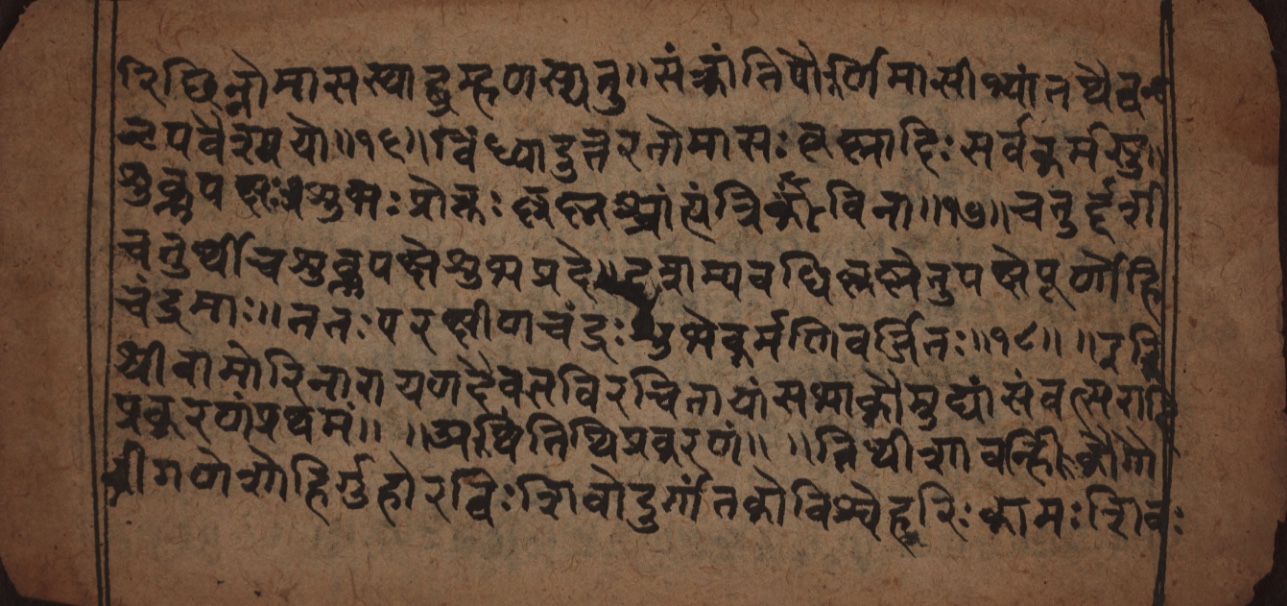
The 'Moonlight of the Assembly' — Sabhākaumudī — is a work that refuses to choose between astronomy and law. Its author, Vāmorinārāyaṇa, announces in the opening verses that he has drawn from the ocean of jyotiṣa and from dharmaśāstra alike, and the text that follows is a single science of time.
Composed on the Narmadā's bank
The colophon-style opening gives the work its setting.
Having bowed to Mihira (the Sun), from the ocean of Jyotiṣa, having taken the essence, and from Dharmaśāstra, Sāmakaumudī is composed for one's own satisfaction by Vāmorinārāyaṇa, knower of law. In the Śaka year 1260, the year called Mānava, on the southern bank of the Narmadā, this work is composed.
A date, a place, and a double allegiance: the stars and the law together.
The time that shapes action
The body of the work is calendrical — the sixty-year cycle of names, the six seasons, and the tithis that make an act auspicious or not.
The all-conquering, all-sustaining, opposing, transformed, harsh one; Nandana and Vijaya, and Jayamanmatha and Durmukha; Hemalambi and Vilambi — these are the sixty years. From the moon's passage through two signs, the seasons: śiśira (late winter), vasanta (spring), grīṣma (summer), varṣā (rains), śarad (autumn), and hemanta (early winter).
The year is not neutral — each of its sixty names carries a character, and the timing of ritual turns on them.
When to act
The text's practical heart is the classification of tithis — which lunar days favor which undertakings.
North of the Vindhya, the month begins with the dark fortnight for all actions. The bright fortnight is declared auspicious always, except for śrāddha. The fourteenth and the fourth in the bright fortnight give good results. In the dark fortnight, the full moon marks the limit; beyond it, the waning moon is excluded from auspicious action.
It is a whole ethics of timing — a science that tells you not only what to do, but when. The Sabhākaumudī is that rare thing: a book that made astronomy and law serve one another, so that the sky and the calendar could together order a life.