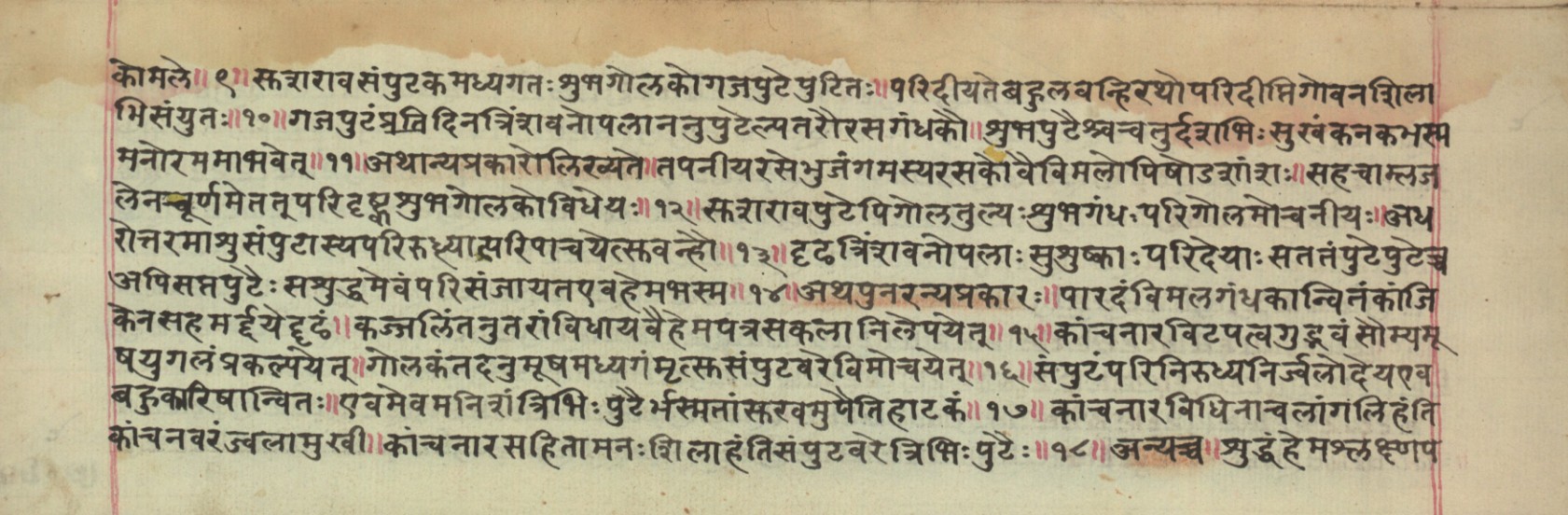
Gold is a medicine — if you know how to prepare it. That is the premise of the Rasamuktāvalī, a treatise on rasaśāstra, the branch of Ayurveda that works with metals and minerals. Its subject is hema bhasma, the calcined ash of gold, and the manuscript is a step-by-step recipe for making it: mercury, sulfur, a sealed crucible, and fire.
The furnace and the formula
The method is precise about equipment and proportions. Gold is ground with mercury and sulfur into a paste, formed into a ball, and fired in a covered dish inside a gaja-puṭa — the 'elephant-dung furnace.'
That auspicious ball placed in the middle of a covered dish, fired in a gaja-puṭa (elephant-dung furnace), is given with abundant fire. Mercury equal to gold, and purified sulfur of one-sixteenth part — this powder, ground with sour liquid, should be made into an auspicious ball. One should fire the gaja-puṭa daily with thirty forest stones, carefully processing mercury and sulfur. With fourteen auspicious firings, the delightful gold ash is easily obtained.
The numbers matter — equal mercury, a sixteenth part of sulfur, fourteen firings — because the whole enterprise is chemistry conducted in the language of ritual.
What gold ash was for
Once the gold has been reduced to ash, the text lists what it treats, and the list is long.
Purified gold (Hataka) bestows divine radiance, destroys wounds, asthma, cough, consumption, bile disorders, and wind disorders. It cures diabetes (prameha), disorders of the digestive tract (grahani), dysentery, skin diseases (kushtha), fever, and also cures impotence while kindling the fire of desire.
The same page adds that gold is bitter, astringent, and sweet, preserves youth, purifies speech, and removes wrinkles. This is a therapeutic tradition that treated the noble metals as medicines — and the preparation was everything.
A whole pharmacopoeia of metals
The Rasamuktāvalī does not stop at gold. Later sections walk through silver, copper, iron, tin, lead, and the secondary metals, each with its own purification, incineration, and list of indications — and each with the warning that improperly processed metal is worse than none at all. Reading it, you see a tradition that took mineral medicine seriously enough to write exact, repeatable procedures — a medieval laboratory manual in verse.