
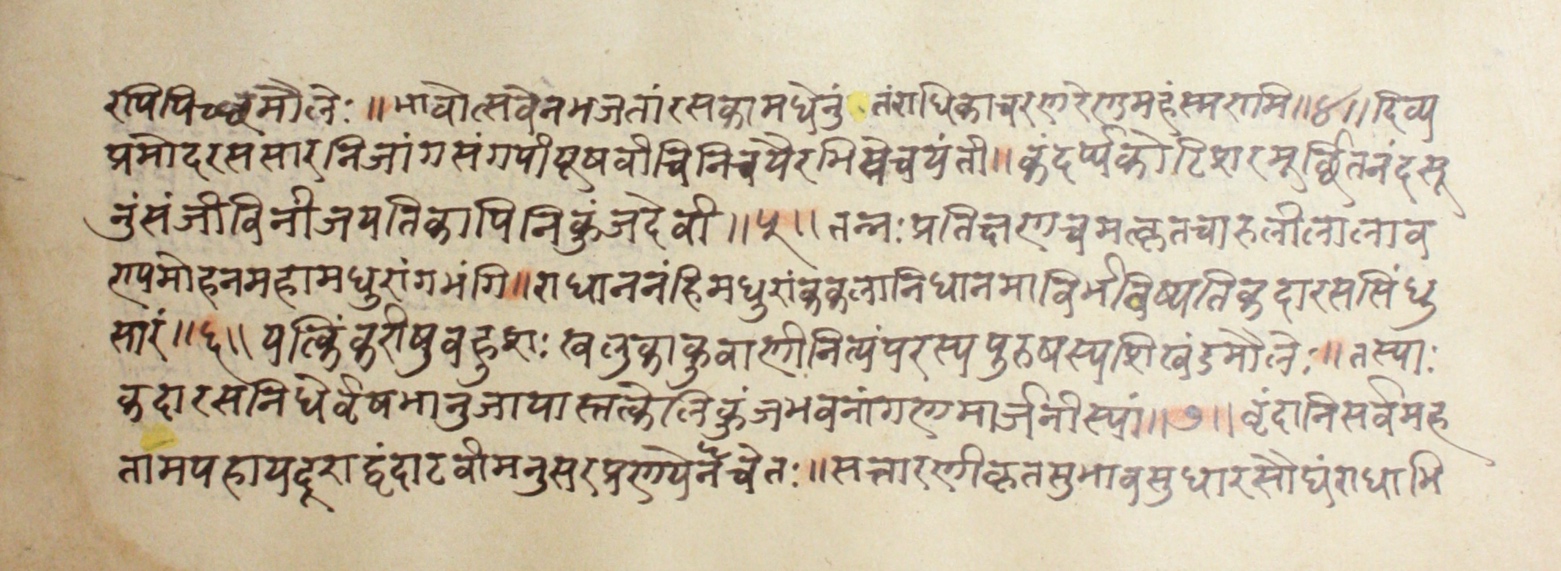
A second copy of the Rādhāsudhānidhi survives in the collection — and its opening is a reminder of why this poem was copied more than once. The same images return: Rādhā as the treasure of rasa, her foot-dust as the object of meditation, and the poet's longing to be near her.
The treasure of rasa
The opening salutations establish the poem's theology — Rādhā as the essence of devotional emotion.
Śrī Rādhāvallabha is victorious. Obeisance, obeisance to Śrī Rādhā. Now begins the composition of Śrī Rādhā-sudhā-nidhi. She whose garment's edge, when playfully moved, creates a supremely blessed and most blessed breeze by which even the self-satisfied become accomplished — may there be obeisance to her, to the direction of Vṛṣabhānu's daughter.
Even the movement of her garment's edge is liberating — the poem opens by making Rādhā's presence itself a form of grace.
The dust of her feet
Then comes the image that runs through the whole work: the foot-dust as a wishing-cow of rasa.
One with a peacock-feather crown! I meditate upon that dust of Rādhikā's feet, which is a wish-fulfilling cow of rasa for those who worship with the festival of ecstatic emotion. Glorifying that certain grove-goddess who, with waves of nectar arising from the embrace of her own body filled with the essence of divine bliss, sprinkles the son of Nanda.
The image is deliberately extravagant — the dust of her feet grants every wish of devotion — and the poem keeps returning to it, like a devotee circling a shrine.
What a second copy tells us
The survival of two copies of the Rādhāsudhānidhi in one collection is a fact about the poem's popularity: this was a text people wanted, copied by hand and kept. The bhakti poetry of the Rādhā tradition traveled through such copies — each one a small act of devotion in itself, preserving the treasure of rasa for the next reader.