
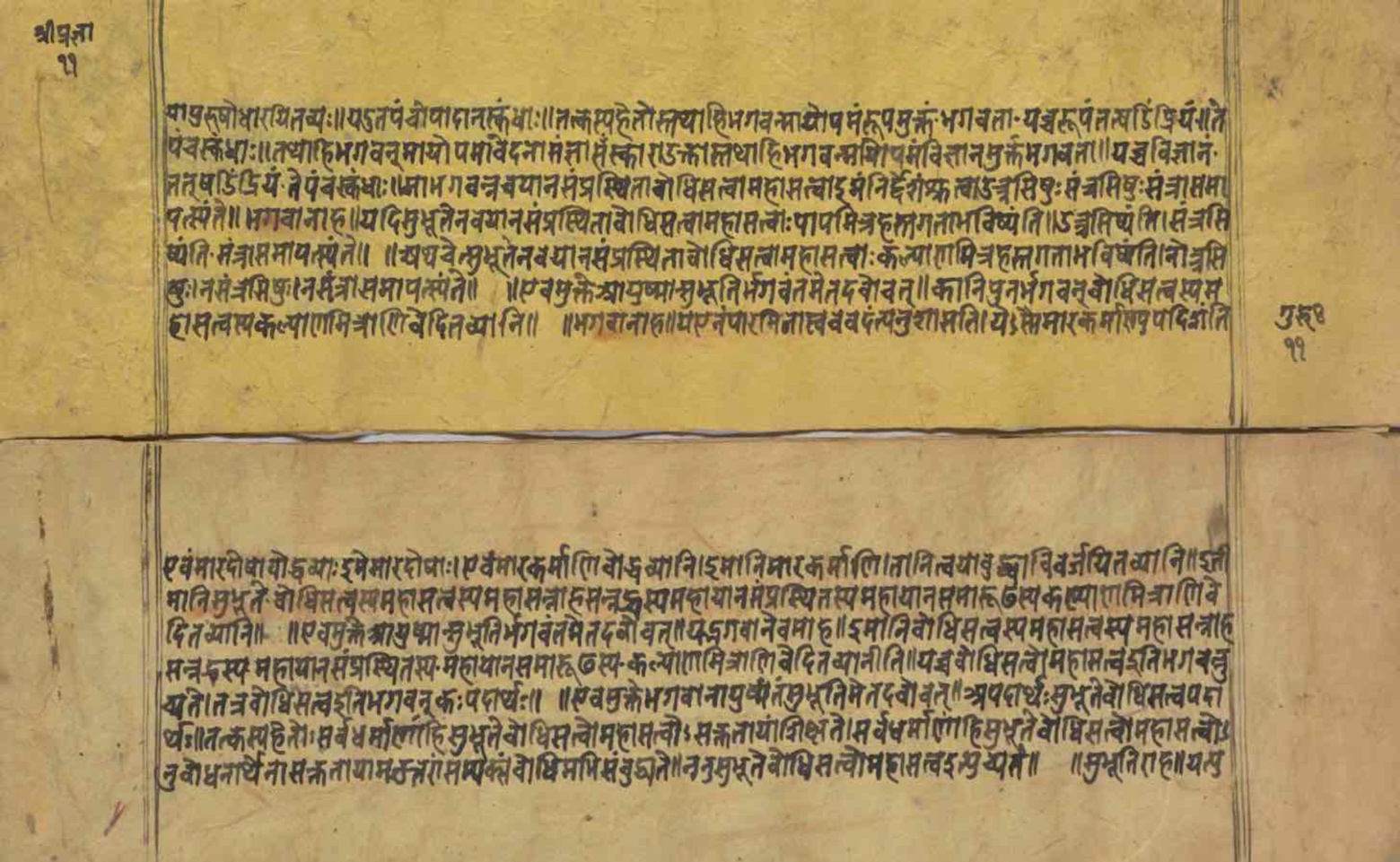
Wisdom, in the Prajñāpāramitā tradition, is not something you accumulate — it is something you see. This manuscript of the Aṣṭasāhasrikā ('eight thousand lines') Prajñāpāramitā opens by praising that wisdom with a single image: it is like space, without stain, without proliferation, without syllables.
Praise of the perfection of wisdom
The opening verses set the tone for the whole tradition — wisdom as the vision that sees the Tathāgata.
Like space, without stain, without proliferation, without syllables — whoever sees you with true perception, sees the Tathāgata. One who is compassionate, who has taken refuge in you, who goes before the Buddha and Dharma, attains greatness with ease, O you who are affectionate to matchless devotion.
To see wisdom truly is to see the Buddha. The identity is that direct — the perfection of wisdom is not a description of reality but the seeing itself.
All things like an illusion
The core teaching follows: form, feeling, perception, formations, and consciousness — the five aggregates that make up experience — are all like an illusion. The manuscript records the dialogue in which the Buddha and Subhūti work through what this means.
One should maintain [the view that phenomena are] like an illusion. Form has been declared by the Blessed One to be like an illusion, and whatever is form, that is to be understood as the five aggregates. Thus indeed, Blessed One, feeling, perception, and formations have been declared to be like an illusion; thus indeed, Blessed One, consciousness has been declared to be like an illusion.
Not a doctrine, but a way of seeing
This manuscript — 421 pages of the Prajñāpāramitā — is a window into the Mahāyāna's most ambitious idea: that wisdom is not a belief but a perception, and that the one who perceives the illusion-like nature of things sees what the Tathāgata saw. The text's own image for itself is a lamp: it does not add light to the world, it reveals what is already there.