
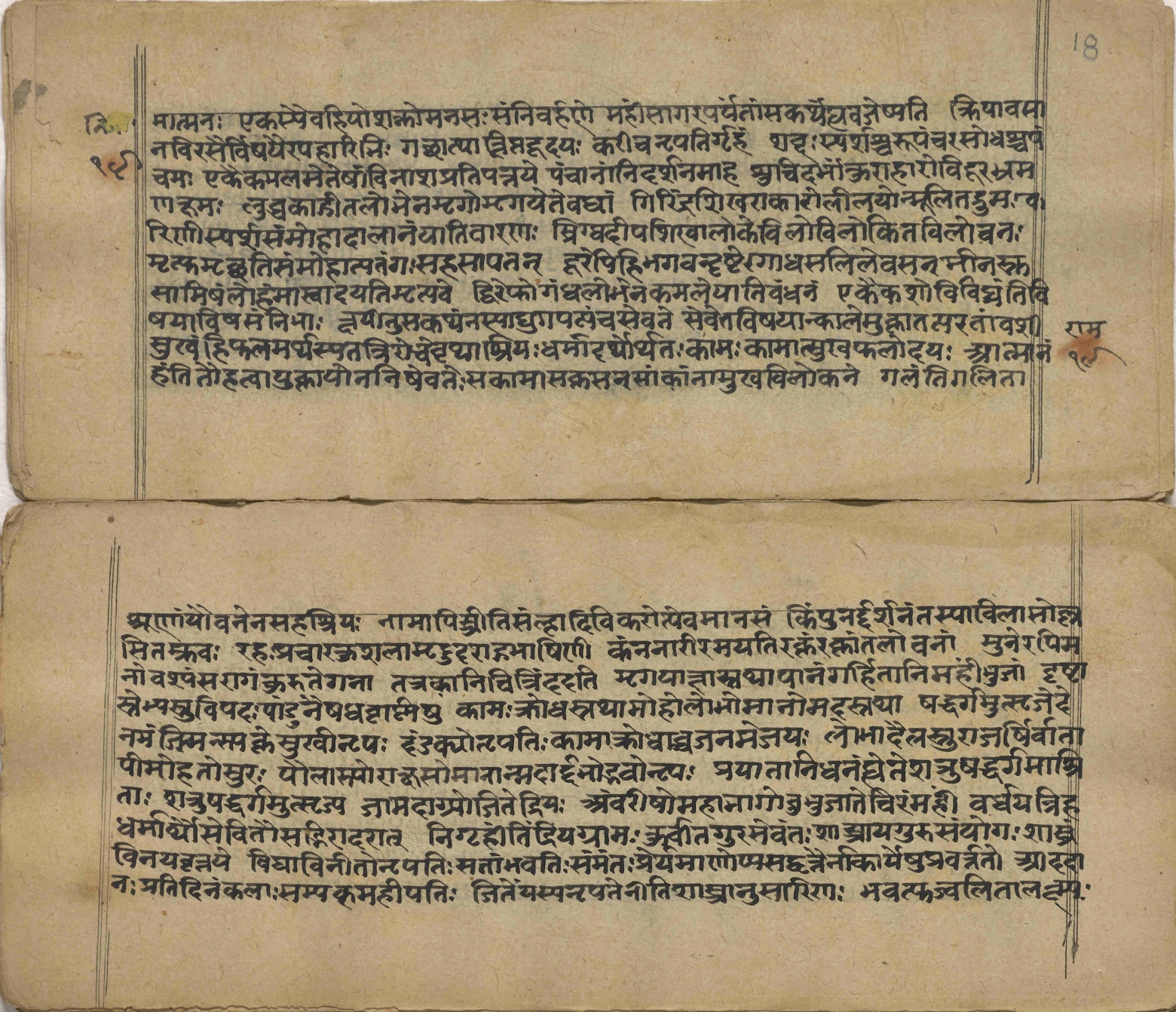
A second copy of the Nītimayūkha survives in the collection — and this one adds something its sister manuscript did not name: Kauṭilya. The treatise on royal consecration and statecraft here cites both Kāmandaka and the author of the Arthaśāstra for the same doctrine of the seven-constituent kingdom.
The seven constituents, with Kauṭilya
The doctrine is stated in its classic form, then grounded in two authorities.
Having performed the consecration, he should rule the kingdom, and that [kingdom] has seven constituents; they are: the sovereign, the minister, the ally, the treasury, the territory, the fortress, and the army. Kauṭilya also [says]: the sovereign, the minister, the territory, the fortress, the treasury, the army, and the ally. This much is called the seven-constituent kingdom, dependent on intelligence.
The two lists are the same seven in different order — and the text notes that political science is the science of practical matters, so the order matters for use.
The senses against the king
Like its sister copy, the manuscript follows the theory of the state with a warning about the ruler's inner enemies — the senses that undo kings.
The soft-hearted king is seized here by sound, touch, form, taste, and smell as the fifth. Each one of these is sufficient for destruction. The deer, wandering in the form of roaming, is killed through song; the elephant, whose form is like a mountain peak, goes to the tethering post due to the delusion of touch; the moth, with restless eyes, falls into the flame.
The weight of a second copy
The survival of two copies of the Nītimayūkha in one collection is itself a fact about the tradition: this was a working text, copied and recopied by those who needed it. The second copy, with its citation of Kauṭilya, reminds us that the Indian science of statecraft was cumulative — the newest digest could still reach back to the Arthaśāstra for its first principles.