
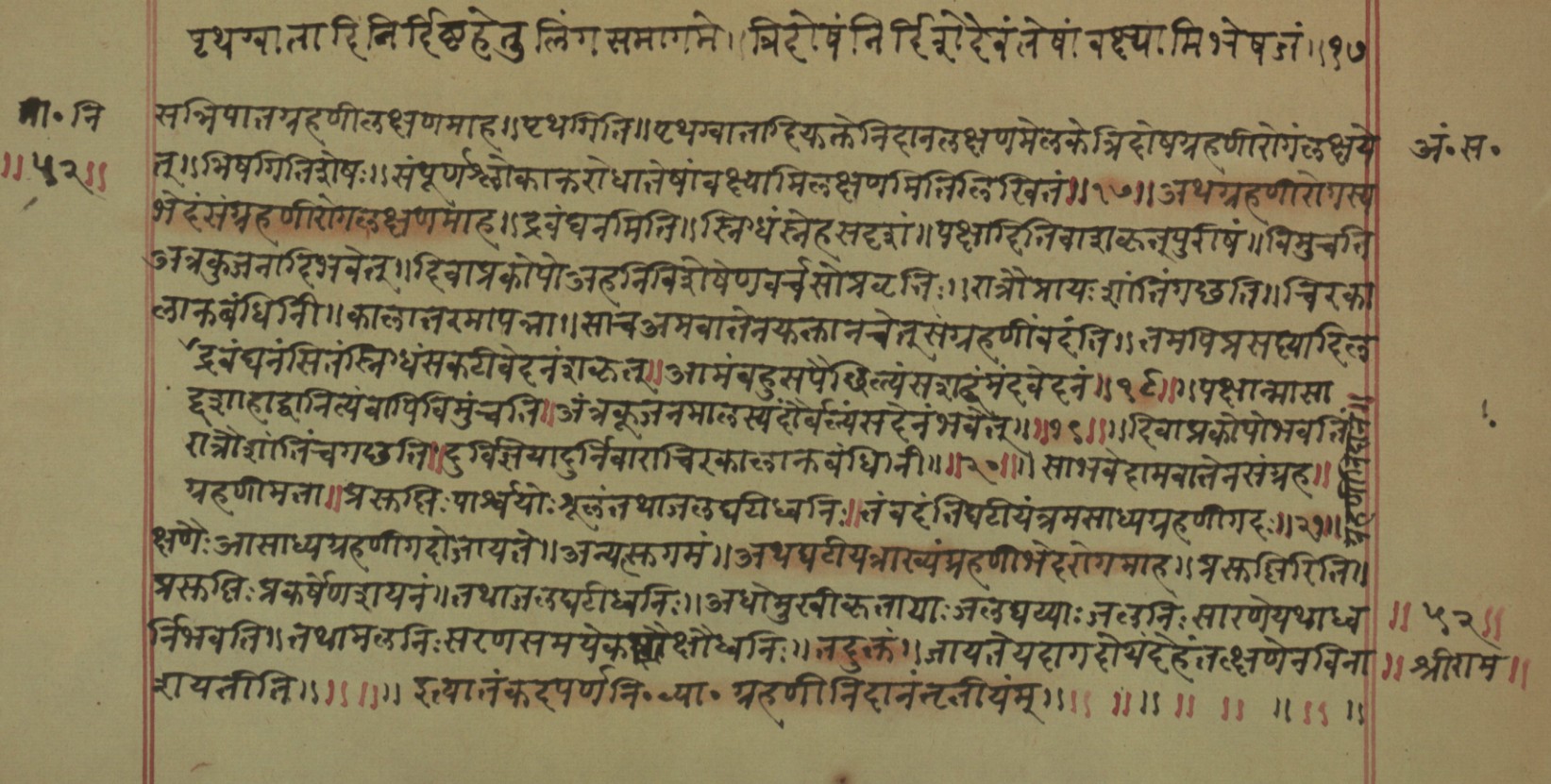
This incomplete Mādhavanidāna — 63 folios from the Poona University Collection at the Bhandarkar Oriental Research Institute — preserves the chapter on grahaṇī, the classical malabsorption syndrome where food passes through the gut without being properly digested. It is diagnosis in the raw: stools described by color and sound, a prognosis hinging on whether the belly gurgles, and an etiology that reads like a list of modern gut triggers.
Three flavors of the same failure
Grahaṇī is named for grahaṇī, the seat of digestive fire — and the disease is really that fire going out. The manuscript splits it by doṣa. In the kapha type, the person passes yellowish-green, undigested stool with foul-sour eructation, burning in heart and throat, loss of appetite, and thirst. The pitta type alternates liquid and dry stool "with froth," tormented by cough and asthma. When the signs of all three come together, the physician is told to diagnose tridoṣa grahaṇī and treat the whole picture at once.
When the causes and signs separately indicated by vāta and others come together, one should diagnose the tridoṣa [grahaṇī]; I shall now describe their treatment.
The gurgle that matters
What makes this manuscript vivid is its physicality. The chronic form is tied to a specific sound: intestinal gurgling compared to water being poured from a ghaṭī vessel — the text calls it jala-ghaṭī-dhvani, and it is listed among the ominous signs. The kapha patient's heart feels "as if filled with cloud or water, stagnant, obstructed, and motionless." Stools are "like kadamba flowers, thick with many fine tips," or "like siddhartha seeds, fine small lumps." These are the notes of a clinician who looked, listened, and remembered.
Why it happens: the etiological list
The causes are scattered through the chapter and they are strikingly familiar: heavy, unctuous, cold foods; excessive eating; daytime sleep; incompatible foods; and eating before the previous meal has digested. The manuscript even names the culprit combinations — milk with fish appears in the adjacent discussion of kuṣṭha as the classic viruddha (incompatible) pairing, alongside substances "contrary in rasa, vīrya, and vipāka."
For that person, food is digested with difficulty. Heartburn, vomiting, and loss of appetite — these are the associated troubles. Sweetness of coating in the mouth... The heart — it becomes as if filled with cloud or water, stagnant, obstructed, and motionless.
A diagnostic text worth copying
This manuscript is a working copy — marginal annotations and interlinear glosses show a scholar actively engaging with Mādhavakara's text, noting variant readings from the Aṣṭāṅga Saṅgraha and citing Cakrapāṇi. It is a reminder that the nidāna tradition was not abstract: every entry was a checklist a physician could run through at the bedside, from the first loose stool to the fatal gurgle.
Pungent, undigested, burning, alkaline, etc., making pitta excessive. Flooding, killing the fire, like hot water [fire].
Flooding, killing the fire, like hot water [fire]. Undigested, alkaline, etc.
Undigested, alkaline, etc. Thus, that substance with alkaline.
Now he describes the characteristics of grahaṇī disease, its types and saṅgrahaṇī disease: 'dravaṃ ghanaṃ api'—liquid, also solid; 'snigdhaṃ'—unctuous, oil-like; 'pakvāmamapi vā saśūlaṃ puriṣaṃ'—digested or undigested stool with pain; 'vimuñcati'—it releases; here there may also be gurgling; 'divā prakopo'—aggravation by day, 'ahani viśeṣeṇa varcaso pravṛttiḥ'—especially passage of stool during the day; 'rātrau prāyaḥ śāntiṃ gacchati'—it generally subsides at night; 'cirakālāt anubaṃdhanī'—prolonged, continuing for a long time; 'kālāntaramāpannā'—arising after some time; 'sā ca āma-vātena muktā na cet saṅgrahaṇīṃ vadaṃti'—and if it is not associated with āma-vāta, they call it saṅgrahaṇī. He describes that: 'prasahya'—forcibly; 'dravaṃ ghanaṃ sitaṃ snigdhaṃ sakaṭīvedanaṃ śakṛt'—liquid, solid, white, unctuous stool with pain like a cart [passing].
He describes that: 'prasahya'—forcibly; 'dravaṃ ghanaṃ sitaṃ snigdhaṃ sakaṭīvedanaṃ śakṛt'—liquid, solid, white, unctuous stool with pain like a cart [passing]. 'āmaṃ bahu sapicchilyaṃ saśabdaṃ maṃdavedanaṃ'—undigested, abundant, with mucus, with sound, mild pain; 'pakṣānmāsāddaśāhādvā nityaṃ vā'pi vimuñcati'—releases after a fortnight, a month, ten days, or daily; 'aṃtrakūjanamālasya daurbalyaṃ sadanaṃ bhavet'—there is intestinal gurgling, lethargy, weakness, depression.
'āmaṃ bahu sapicchilyaṃ saśabdaṃ maṃdavedanaṃ'—undigested, abundant, with mucus, with sound, mild pain; 'pakṣānmāsāddaśāhādvā nityaṃ vā'pi vimuñcati'—releases after a fortnight, a month, ten days, or daily; 'aṃtrakūjanamālasya daurbalyaṃ sadanaṃ bhavet'—there is intestinal gurgling, lethargy, weakness, depression. 'divā prakopo bhavati rātrau śāntiṃ ca gacchati'—there is aggravation by day and it subsides at night; 'durvijñeyā durnivārā cirakālānubaṃdhanī'—difficult to diagnose, difficult to cure, of long duration.
The alkaline substance from bamboo manna, etc., is mentioned; the alkaline water prepared from chaff-flower, etc. Mixed as a condiment, in Kamrup, etc., thus alkaline.
Mixed as a condiment, in Kamrup, etc., thus alkaline. After a long time, painfully, liquid, dry, thin, small, with froth.
After a long time, painfully, liquid, dry, thin, small, with froth. Repeatedly releasing feces, afflicted by cough, asthma, and pain from wind.
'Physician' is the remainder [of the verse]. The complete syllables of the verse: 'I shall describe their characteristics' is written.
After a long time, sometimes liquid, sometimes dry, thin, small. With froth, accompanied by froth. From wind, or here [?] feces. Again, repeatedly, afflicted by cough and asthma, one should release, meaning one should let go. Who should release?
With froth, accompanied by froth. From wind, or here [?] feces. Again, repeatedly, afflicted by cough and asthma, one should release, meaning one should let go. Who should release? The person—the remainder.
From wind, or here [?] feces. Again, repeatedly, afflicted by cough and asthma, one should release, meaning one should let go. Who should release? The person—the remainder. Now, having mentioned the etiology, he describes the symptoms of pittagrahani: causing burning, producing burning.