
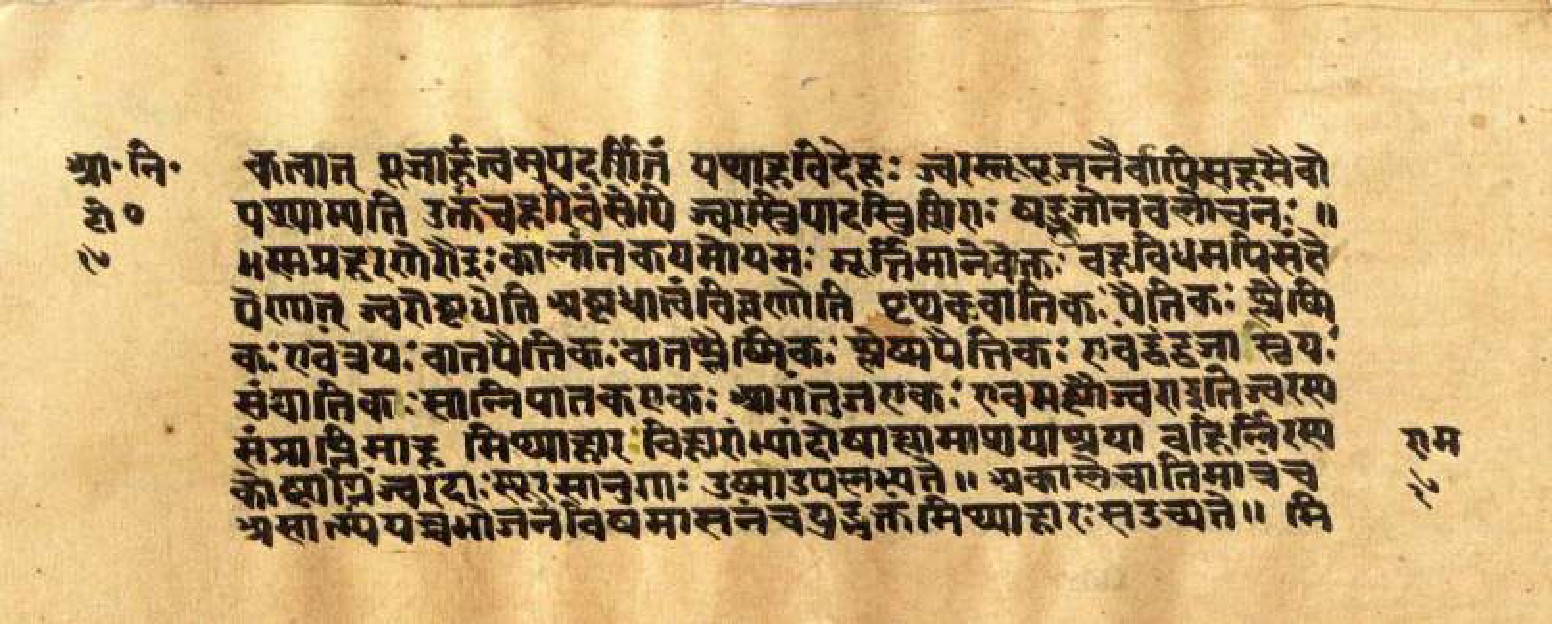
The Mādhavanidāna opens with something unusual: a whole preface on how to know disease at all, before a single symptom list. It lays out the fivefold examination—nidāna (cause), pūrvarūpa (premonitory signs), rūpa (manifest symptoms), upaśaya (what alleviates), and samprapti (pathogenesis)—and then spends its remaining pages running fever through that grid. The manuscript even names its patron: King Hammīra, "a destroyer of the life-lotuses of the Yavanas," whose court sponsored the work in an act of royal piety.
Five Questions Before One Remedy
The preface is emphatic about sequence: "First, the physician should examine the diseases, then afterwards the medicine, then the procedure; only after that should he act with knowledge." The five factors are presented as a complete epistemology—proximate and remote causes, general versus specific premonitory signs, and upaśaya, the clever diagnostic trick of giving something that opposes the suspected cause and watching what happens. This is not guesswork; it is a method for moving from ignorance to knowledge, and knowledge to healing.
Consider nidāna, the cause. Fever may arise from remote causes—phlegm accumulated in winter, aggravated in spring—or from proximate ones—the aggravated doṣas themselves. The physician must know both. An untreated winter accumulation of kapha becomes spring fever; if the physician treats only the fever and not the accumulated cause, the fever will return. This layering of causes within causes, the insistence that true cure must go to the root, distinguishes Ayurvedic medicine from symptomatic treatment.
First, the physician should examine the diseases, then afterwards the medicine, then the procedure; only after that should he act with knowledge. And that knowledge of the disease is not possible without five [factors].
Fever Born of Anger
The fever chapter is anything but dry. The text retells the myth: fever was born from Rudra's wrath-fire, created from the angry god's third eye, "scorching all beings." Hārīta personifies it as "the king of diseases, three-headed, six-armed, nine-eyed, terrible with ashes as weapons, resembling Kālāntaka-Yama." Then, having evoked this terrible figure, the text calmly classifies it: vātika, paittika, ślaiṣmika, three dual combinations, sannipātika, and āgantuja. Myth and classification coexist; neither negates the other.
Born from Rudra's wrath-fire, scorching all beings—by the angry Rudra, a third fiery eye was created from the forehead; from that, this disease fever was produced by anger.
The Doṣa Clock of Fever
Prognosis is tied to time with remarkable precision. A tridoṣaja fever—one involving all three doṣas—"kills or releases a person in eighteen days, fifteen days, or seven days" depending on which doṣa dominates: excess vāta releases in seven days, pitta in ten, śleṣma in twelve. Continuous fevers resolve on the same rhythm. The geography of the body matters too: a doṣa seated in the heart produces quotidian fever, one in the throat produces tertian, one in the head produces quartan, each traveling toward the stomach in its own time.
This is not mysticism. A physician who observes the fever's pattern—its regularity, its timing within the day, its relationship to the seasons and the patient's own constitution—gains information about which doṣa predominates and therefore which treatment will work. The fever itself becomes a language, and the physician becomes a translator.
The āma Warning
The most clinically practical page is the one on āma-jvara, fever with undigested toxins: excessive salivation, nausea, chest heaviness, loss of appetite, strong fever. The instruction is a caution that still governs Āyurvedic practice today: "In that āma condition, digestive medicines etc. should not be given; when medicine is applied, the fever increases and destroys life." Treat the undigested matter first, the text insists, or the remedy becomes the poison.
This is the recognition of a fundamental truth: not all fever is the same, and the same treatment given at the wrong stage can harm. A physician who cannot distinguish simple fever from āma-fever risks making the patient worse. This humility—this recognition that giving the right medicine at the wrong time is giving the wrong medicine—is built into the very structure of diagnosis. The five factors are not luxuries but necessities. Rush through them, and you will miss the patient's true illness.
A Scholar's Fever Manual
The Mādhavanidāna is a scholar's fever manual: mythology to explain origin, logic to secure diagnosis, and a hard clinical warning to keep the physician humble. King Hammīra's patronage gave the author freedom to write comprehensively, to draw on multiple traditions, to combine Hārīta's personification of fever with a clinical classification system. The result is a text that works at every level—for the philosopher seeking cosmological understanding, for the student learning diagnostic method, and for the practicing physician facing an actual fever in an actual body, constrained by actual time, needing to know what to do and when to do it.