
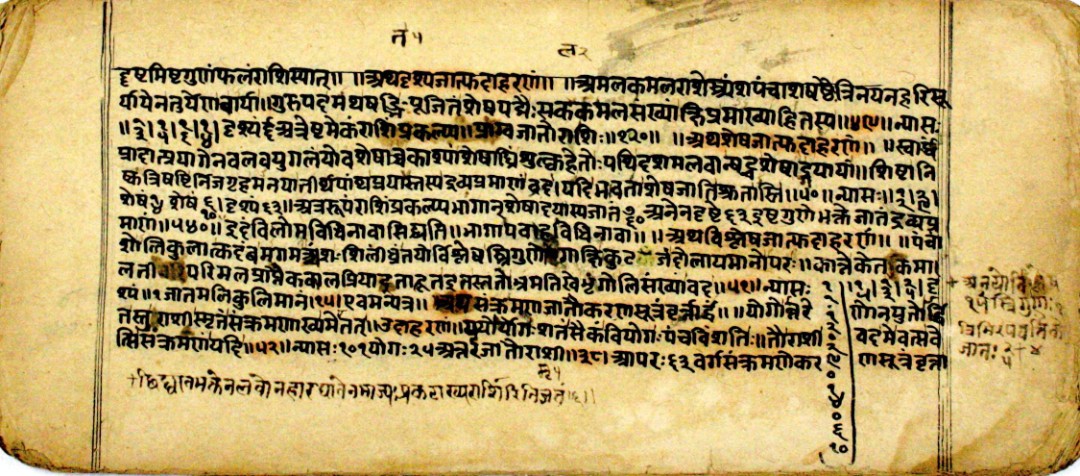
The most famous textbook in Indian mathematics opens not with a theorem but with a prayer — and then tells you that twenty cowrie shells make one kākiṇī, four kākiṇīs make one paṇa, and sixteen paṇas make one dramma. That is the Līlāvatī of Bhāskara II, a twelfth-century treatise that teaches arithmetic in verse, and every unit, rule, and worked example is a stanza meant to be recited.
A currency system built from cowrie shells
The definitions section of the manuscript starts with money, weights, and measures, all anchored to everyday objects. Cowrie shells stack up into kākiṇīs, paṇas, and drammas; barley grains define the guñjā; and sixteen māṣas make a karṣa. The text works its way from grain to gold with the same care a modern textbook gives to the metric system.
Twenty cowrie shells (vāraṭikās) make one kākiṇī; four kākiṇīs make one paṇa; sixteen of those make one dramma; and sixteen drammas make one niṣka.
What makes this remarkable is the format: the rule is a verse, the conversion is a verse, and the reader is expected to carry the whole system in their head — no tables to flip to, just poetry.
Word problems as small stories
The Līlāvatī rarely presents a bare sum. Instead, each problem is a miniature narrative — pilgrims scattering wealth, bees visiting flowers, swans on a lake. One of the most famous is the Arjuna problem, where the arithmetic is hidden inside a battle scene.
Arjuna, enraged at Karna's slaughter, took aim at him on the battlefield. With half of his arrows, he warded off Karna's shower of arrows; with four arrows, he killed Karna's horses; with six, his chariot; with three, his umbrella and banner; and with one arrow, he severed Karna's head from his body.
The answer — a hundred arrows — falls out of a square-root method the text explains in the same breath. The pedagogy is unmistakable: wrap the mathematics in a story, and the student remembers both.
Why verse worked
Putting mathematics in verse was not ornament; it was storage. In a manuscript culture, a well-formed stanza was easier to memorize, copy, and recite without error than a page of prose. The Līlāvatī's poetic frame — its salutations, its lilt, its playful problems — is precisely what let this arithmetic survive centuries of hand-copying, and why a reader today can still follow a cowrie-shell economy line by line.