
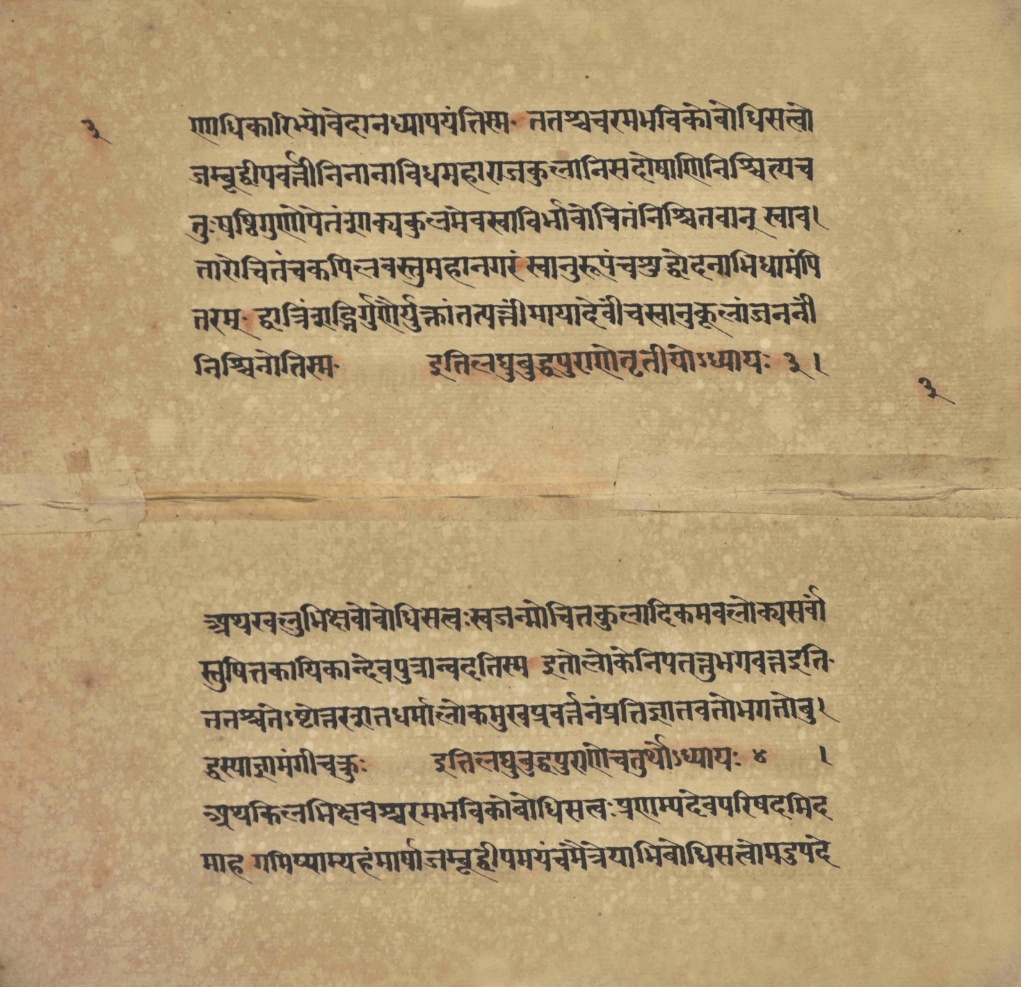
The life of the Buddha begins before birth — with a choice. The Laghubuddhapurāṇa, a Sanskrit retelling of the Buddha's life, opens not in a palace but in the Tuṣita heaven, where the Bodhisattva of the final existence surveys every great family of Jambudvīpa before deciding where to be born.
A family chosen with care
The text describes the Bodhisattva's final birth as the result of a systematic examination — the same care a discerning buyer gives to a purchase.
The Bodhisattva of the final existence, having examined the various great royal families of Jambudvīpa and found them defective, determined that the Śākya family alone, endowed with sixty-four qualities, was suitable for his manifestation. He determined that Kapilavastu, the great city, was suitable for his descent, and King Śuddhodana, endowed with thirty-two qualities, as his father, and Queen Māyādevī as his mother.
Nothing about the birth is accidental: the family, the city, the father, and the mother are all assessed and chosen. Even in narrative, the tradition insists the Buddha's arrival was deliberate.
The descent and the prophecy
Before descending, the Bodhisattva establishes the future Buddha Maitreya in Tuṣita to carry on the teaching, and then comes down to Jambudvīpa surrounded by gods. The manuscript follows the familiar arc — the prophecy, the examination by the sage Asita, the renunciation under the Pushya constellation, and the years of austerity — each episode told as a discrete chapter.
Then, in order to see the Lord Bodhisattva, whose lotus feet are worshipped by gods and demons, and to examine those characteristics, the great sage Asita came there. The king, being delighted, listened to the signs of the one who would become perfectly enlightened.
A Sanskrit purāṇa of the Buddha
What makes this manuscript remarkable is its form. It is called a purāṇa — a genre usually associated with the Hindu pantheon — and it tells the Buddha's story with the same frame: 'Thus indeed I heard,' the Jeta Grove, the assembly of bhikṣus and bodhisattvas. It is a document of a Buddhist tradition that spoke Sanskrit, borrowed the purāṇic idiom, and gave the Buddha the full narrative dignity of a scripture.