
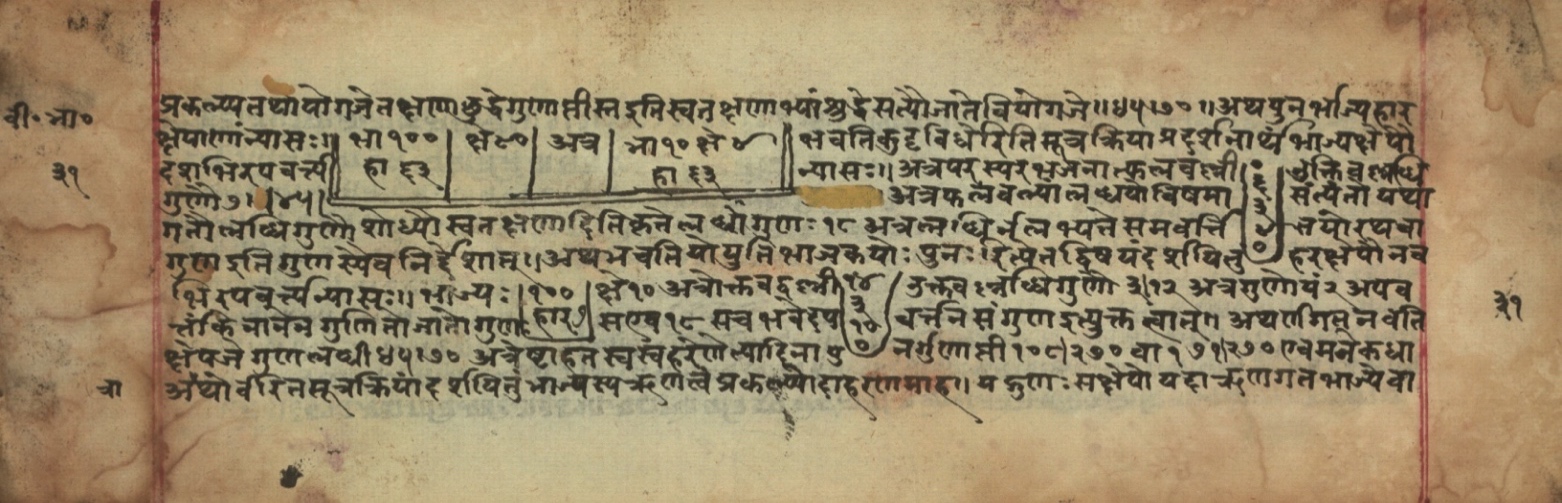
Before algebra classes met the letter x, Indian mathematicians met the pulverizer — kuṭṭaka, the algorithm that grinds two numbers against each other until the answer falls out. The method is the Extended Euclidean Algorithm, expressed in verse and designed for the astronomers who needed it constantly: to reconcile calendars, align planetary periods, and keep the arithmetic of the sky honest.
What the Pulverizer Does
The kuṭṭaka solves what modern mathematicians call linear indeterminate equations: find the multiplier which, applied to one number and adjusted by an addend, divides evenly by another. In equation form: find x such that ax + c ≡ 0 (mod b), or equivalently, such that ax + c = by for some integer y. Astronomers needed it constantly — for calendars, planetary periods, and the arithmetic of the sky.
To establish the meaning of the kuṭṭaka (pulverizer) method, he states a sūtra: "mitho bhajet tau dṛḍhabhājyahārau" etc.
The name "pulverizer" captures the method's spirit: you take two numbers and pulverize them through mutual division, extracting quotients until the process ends in zero. What emerges is the greatest common divisor and the coefficients needed to express it as a linear combination of the originals — the heart of what modern algebra calls the Extended Euclidean Algorithm.
Grinding Dividend and Divisor
The method: divide the dividend and the divisor into each other repeatedly, collecting the quotients in a vertical chain. The sūtra is a recipe — "divide those two mutually, the firm dividend and divisor" — and the commentary shows the chain taking shape, ending in zero.
...whatever remainders arise from the firm dividend and divisor, having divided those mutually, whatever quotients result, those should be placed below, below; and at the end of the lower casting, zero should be placed—the chain of results is produced: 2 | 2 | 1 | 1 |
The quotients 2, 2, 1, 1 form the "chain of results." This is the skeleton of the algorithm. Each quotient is the integer part when dividing the current remainder by the next remainder. Stop when the remainder reaches zero. The final non-zero remainder is the greatest common divisor (gcd) of the two original numbers.
100, 63, and an Addend of 90
The commentary then works a concrete case the way a teacher would: dividend 100, divisor 63, addend 90 — reduced by ten first to keep the arithmetic light.
Then again, the setting down of dividend, divisor, and augment: [Having reduced by ten | Dividend 100, Divisor 63, Augment 90 || Then | Dividend 10, Divis...
Even the reduction step is deliberate: strip the common factor before grinding, so the operation stays manageable. That instinct — simplify first, then solve — is the same one a modern programmer brings to an algorithm. The scribe is teaching optimization, not just method.
The Quotient Chain and Back-Substitution
Once the chain of quotients is established, the algorithm reconstructs the coefficients by working backward through the chain, building up the linear combination that expresses the gcd as a × dividend + b × divisor. This backward pass is the "lifting" that converts the division chain into the solution.
For the example 100 and 63: the algorithm finds the quotient chain, then determines how many times to apply the multiplier to 100, and what addend to use, so that the result divides evenly by 63. The answer emerges not from guessing, but from the structure of the division process itself.
Why the Sky Needed the Pulverizer
The astronomical sections make the motive explicit. The divisor is the "omitted days," the quotient is the elapsed revolutions, the multiplier is the remainder of revolutions — the pulverizer is what reconciles a civil calendar with a sidereal one.
In the case of addition (prakṣepa), the divisor is the omitted days (kudina); the quotient obtained there is the produced fruit (result). The vikalās (seconds) would be deficient. The multiplier (guṇa) is to be applied to the remainder of the tip (liptāgra).
A civil year (365 days) does not evenly divide a sidereal year (the true astronomical period). Over centuries, the discrepancy accumulates. To know what day of the week a date falls on, or to intercalate leap months correctly, you must solve: "What integer x, when multiplied by the remainder of sidereal revolutions and added to the omitted days, gives a multiple of the civil year?" The pulverizer answers this question, and keeps calendars aligned and planetary tables honest.
The pulverizer is one of those quiet inventions that did enormous work: it kept calendars aligned for more than a millennium. This damaged, partial manuscript preserves a scholar patiently teaching it — step by numbered step — to students who would carry the method into the next generation of astronomical tables and ephemerides. The kuṭṭaka is not famous like the cakravāla, but it is equally essential, and its solution here is complete and algorithmic — ready to code, if the language were not verse instead of pseudocode.