
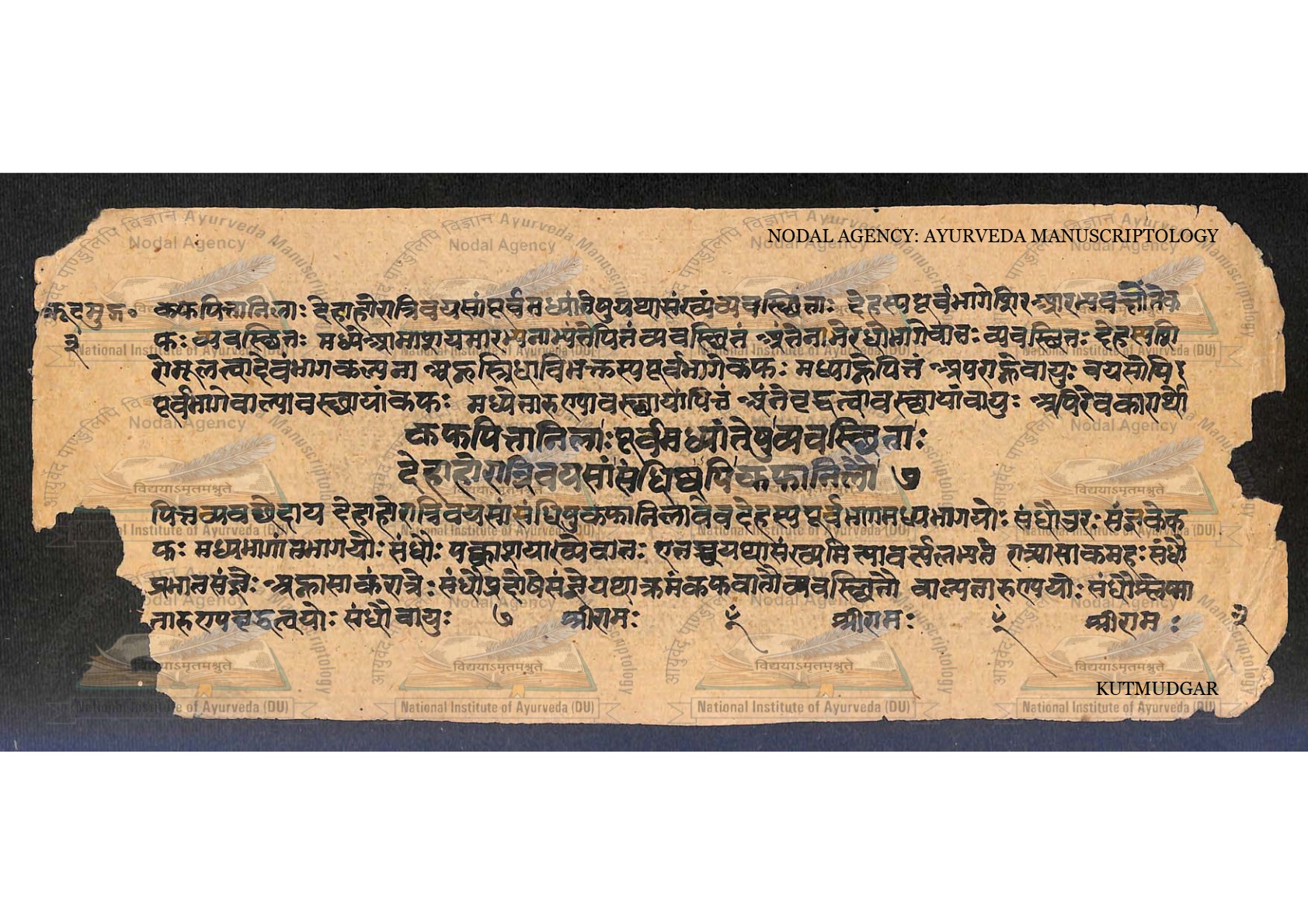
The Kūṭamudgara — the name means 'false hammer' — is a compact Ayurvedic treatise that treats the six tastes like a balance sheet for the three doṣas. Its opening gambit on the second folio: sweet, sour, and salty build kapha while calming vāta; pungent, bitter, and astringent do the opposite. Everything else in the text is a working-out of that one insight across the body, the clock, and a human lifetime.
Three regions, three doṣas, one rule
The most elegant idea in the manuscript is that the body, the day, and a lifespan all divide into the same three parts. Kapha rules the first region — from the head to the navel; pitta the middle, from the stomach to the navel; and vāyu the lower body. The same order applies to the day and to the stages of age. So a taste taken at the 'beginning' (of a meal, of the day, of life) and one taken at the 'end' land on different doṣas entirely.
The six tastes beginning with sweet, when examined through their application in food and drink, act in sequence — first, middle, and end. Sweet pacifies vāyu at first, pitta in the middle, and provokes kapha at the end.
The sixty-two disease ledger
From there the text builds a diagnostic matrix. If each doṣa can be increased, balanced, or depleted, then combinations of the three produce six states — vāyu increased with pitta balanced and kapha depleted, and so on — and inversion doubles them to twelve, from which the author counts up to sixty-two kinds of imbalance. It reads less like a recipe book and more like a combinatorial table a scholar used to classify whatever walked into the clinic.
One taste, many hours: water and harītakī
The same temporal logic governs daily habits. A page on seasonal water notes that water is tridoṣa-destroying and especially pitta-destroying — and that drinking it is recommended in hemanta, śiśira, grīṣma, and śarad but restricted from wells in spring and the rains. And there is a lovely entry on Pathya Harītakī, the chebulic myrobalan taken both before and after meals: eaten after food it kindles digestion; licked before food it prepares the stomach — the compound term bhuktābhukta, 'eaten and uneaten.'
When eaten after meals, it promotes digestion of food; when licked [before meals], it is beneficial for the food. After eating, it kindles the digestive fire for cooking the food.
Why a hammer?
The title gets its own explanation near the end of the manuscript: like a wooden mace that confuses an enemy by not showing itself as a weapon, this treatise slips past the intellect and strikes at the root of error — smooth, polished, and well-rounded, it is "very famous on earth" precisely because it disarms confusion about doṣa and taste. For a 21-folio manuscript, that is a fair claim: I finished it feeling like the six tastes were no longer six isolated flavors but a single, moveable framework.