
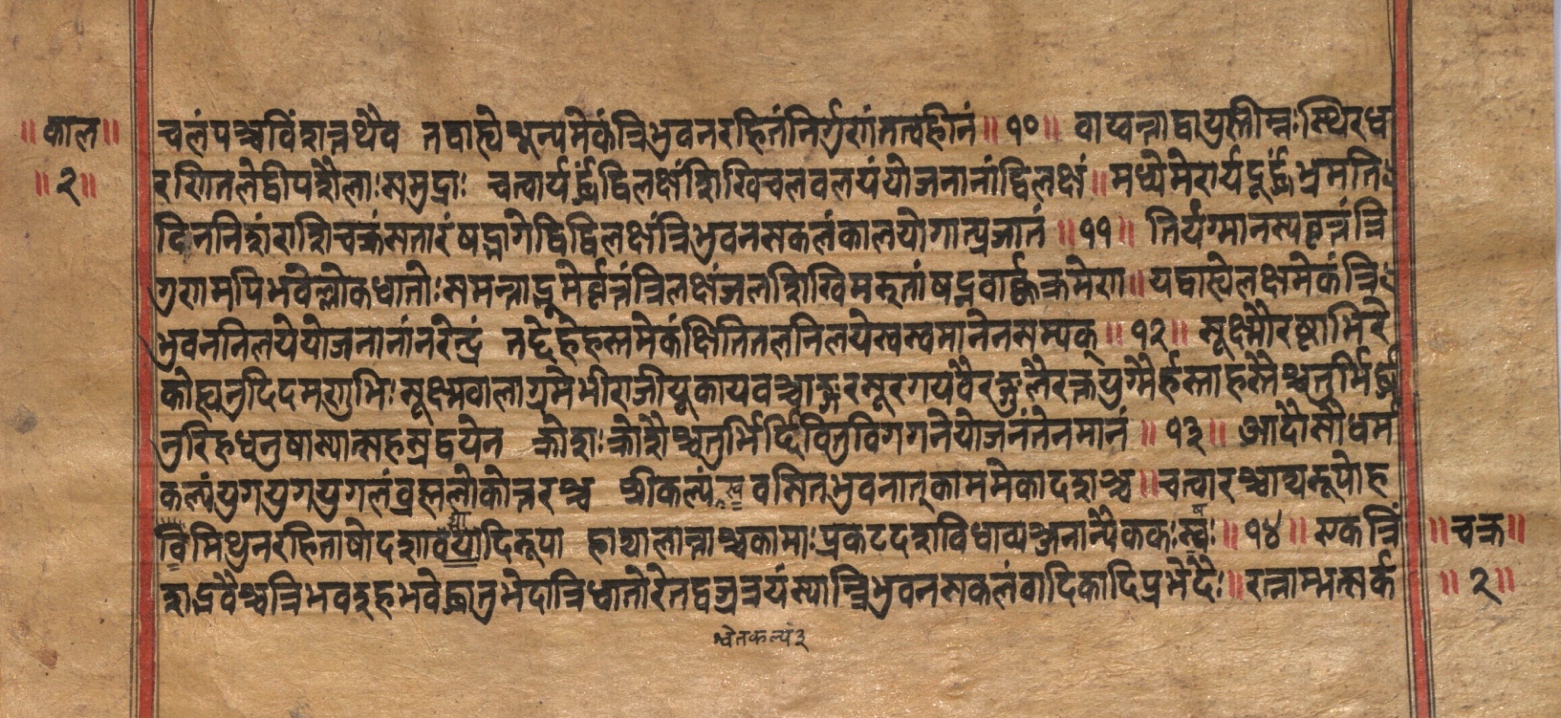
No system in Indian thought took time more seriously than the Kālacakra. The 'Wheel of Time' tantra is a complete science of time — cosmic, astronomical, and inner — and its promise is bold: in the Kali age, it teaches, this yoga is the path to liberation. This manuscript, from the Oriental Institute at Baroda, preserves its opening.
A yoga for the Kali age
The text opens with homage and an announcement of purpose.
Om homage to glorious Kālacakra. The all-knowing, embodiment of wisdom, sun-like in form, lotus-petal-eyed Buddha, seated on the lion throne, the god-king bowed to by the gods with their heads — I, having bowed, asked the wise Sucandra, placing my lotus-folded hands upon my head. The yoga of glorious Kālacakra in the age of Kali for the sake of liberation of men.
The framing is deliberate: this teaching is not for a golden age of easy practice, but precisely for the degenerate age, when the path is hardest and the need greatest.
The universe measured
The tantra then builds its cosmic geometry — the measurements of the world-container, the mountains, oceans, and continents, all folded into the same system that measures the breath.
Wind, end, life, then firm earth, cold, continents, mountains, oceans, four half-lakhs, the garland of peaks and hair, two lakhs of yojanas. In the middle of Meru, day and night revolve, the zodiac circle with stars — all of the three worlds, born of time-yoga.
The body as the universe
The signature idea of the Kālacakra is that the outer world and the inner body are the same system — the planets, the elements, and the breaths all map onto one another, and the practitioner who understands the correspondence understands time itself. This manuscript, 218 pages of the tantra, is a window into that grandest of Buddhist sciences: the wheel of time, turning both outside and within.