
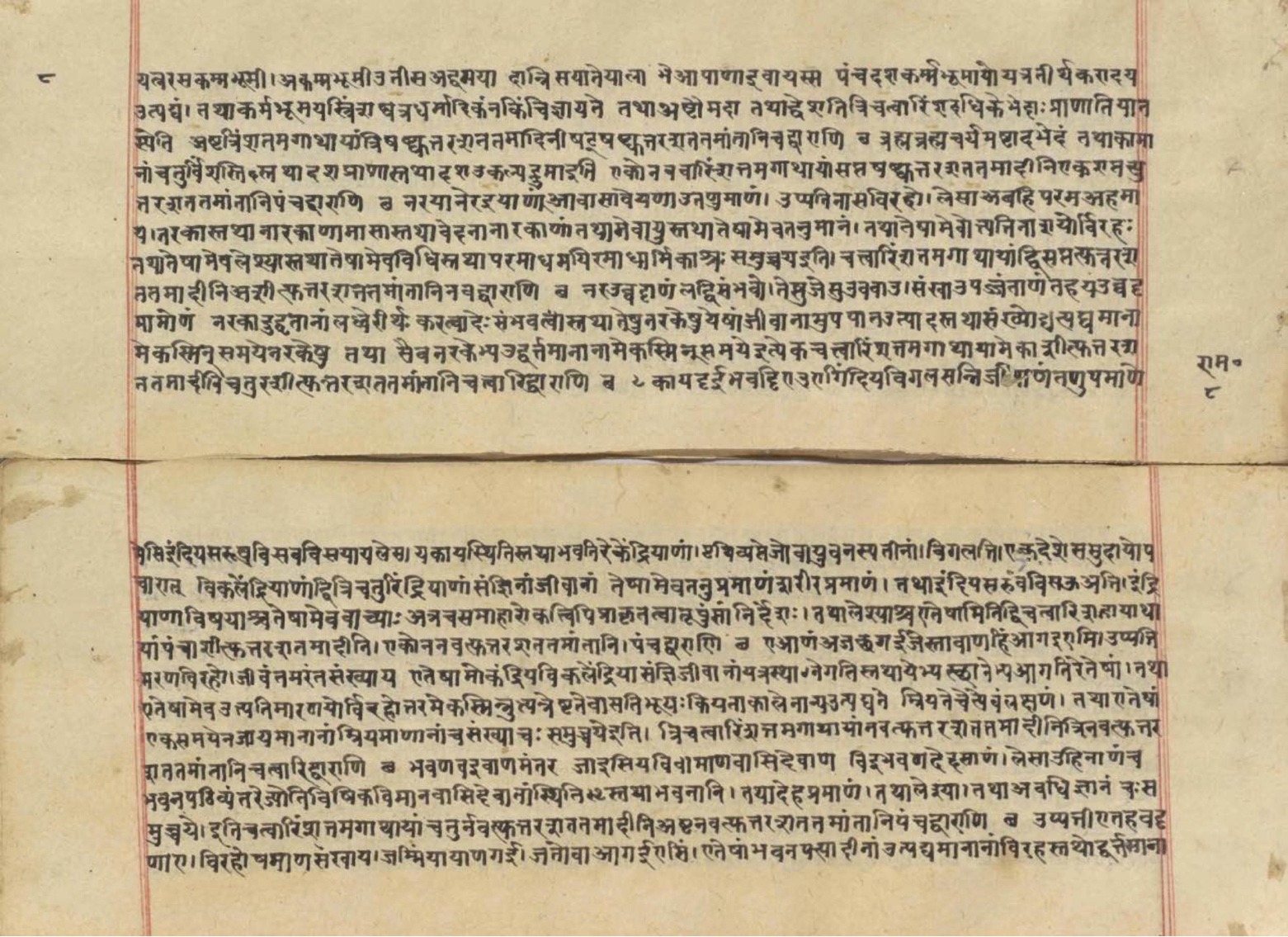
The Pravacanasāroddhāra — 'the essence extracted from the doctrine' — is a Jain text that organizes the entire teaching into numbered categories, and this manuscript preserves a great commentary on it. Its centerpiece is the sermon itself: the Blessed Lord Mahāvīra, seated on a jeweled lion-throne, delivering the essence of the teaching to the faithful.
The sermon in the assembly
The commentary sets the scene with the care of a chronicler — the city, the palace, the throne, and the preacher.
In the assembly hall resplendent with three unparalleled walls — in that place, seated on a magnificent lion-throne inlaid with various jewel fragments, the Blessed Lord Mahāvīra, whose supreme greatness was honored by the chief of gods, demons, kinnaras, and human kings, delivered to all those present, who were worthy of the highest teaching, the essence of the sermon. Then, by the master Sudharma, who was the chief of those who followed, [it was preserved].
Mahāvīra speaks; Sudharma remembers. The transmission is the whole tradition in miniature — the word given, then carried.
The doctrine as numbered categories
What follows is a teaching organized the way a Jain catechesis always is — by enumeration. The commentary moves through the regions where Tīrthaṅkaras are born, the karma-lands and karma-less lands, the destinations of rebirth, and the doors of honor.
In the karma-less lands, in the Udisa and other continents, in the Videha and other regions, in the fifteen karma-lands where Tirthankaras and others are born. Thus in thirty-three dharma-lands something is born, thus in eight Maha-lands, thus in forty-eight additional Bhogabhumis.
A world mapped by numbers
The Jain cosmological imagination loved number — how many lands, how many gates, how many modes of rebirth — because enumeration was a way of holding the vast together. This great commentary, running to nearly four hundred pages, is a monument to that habit of mind: the doctrine organized, numbered, and memorized, so that nothing of Mahāvīra's sermon would be lost.