
Somewhere in the early modern Sanskrit world, a scribe wrote down the proper way to go hunting — and it reads less like a manual for the chase and more like a liturgy for the kill.
Six Mantras for the Muzzle-Loader
The text opens not with the animal but with the weapon: a muzzle-loader that must be consecrated like a vessel for worship. Water is placed in a large vessel, covered with the hand, and sanctified with six mantras — one each to Brahman, Viṣṇu, Śambhu, Sarasvatī, Lakṣmī, and Pārvatī.
Now, the procedure for hunting: First, the consecration of the muzzle-loader. Having placed water in a large vessel and covering it with the hand, one should consecrate it with these six mantras: "Oṃ namo brahmaṇe" (Obeisance to Brahman), "Oṃ namo viṣṇave" (Obeisance to Viṣṇu), "Oṃ namaḥ śambhave" (Obeisance to Śambhu)
The needle and the bead used to load the weapon receive their own mantras, among them "Oṃ namaḥ śrīṃ kālikāyai" — Kālī is already present at the loading bench.
Read the Mantra Into the Animal's Ear
The hunt itself is reframed as sacrifice. The animal is an offering to the gods, and the hunter's task is to make the death a willing one — the mantra is read into the ear of the victim so that it "releases its life" as an offering.
...having mentally recited the animal mantra, let the animals worthy of being offerings to the deity release their lives, pleasing Indra and the other gods—having formed this intention, seeing the animal, reading this in its ear
Kill correctly and the death is a gift; kill carelessly and it becomes demerit. The ritual is what separates the two.
After the Kill: Seven Times Seven
Once the animal is dead, the hunter repeats the mantra seven times seven and performs the morning sandhyā worship the next day, citing the Saṅkarṣaṇa-mīmāṃsā-bhāṣya-vārttika as authority. The text also draws a line: cruel animals such as bears, tigers, and boars are killed without mantra at all.
Having killed them, whether individually or collectively, one should recite [the mantra] seven times seven, having repeated it, and on the next day, having performed the morning sandhyā worship
The Kālī Mantra Over the Meal
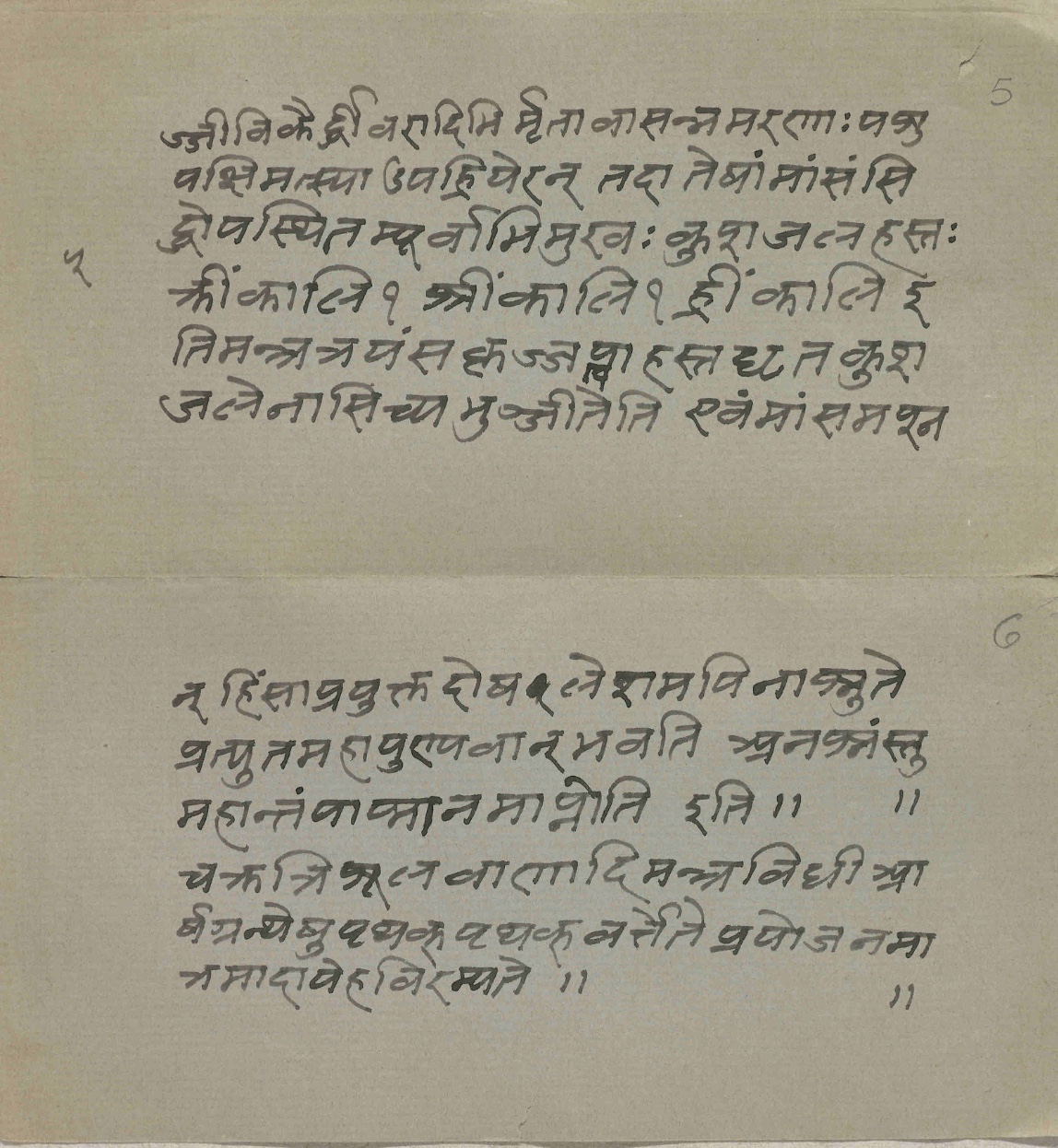
The liturgy does not stop at the forest. Even meat bought from fishermen — animals "dead or dying, caught by nets" — can be eaten without sin if the eater holds kuśa grass and water, faces upward, and recites a triplet of mantras before the meal.
...one should, with kusha grass and water in hand, facing upward, having recited once the three mantras "Shrim Kali 1, Shrim Kali 1, Hrim Kali", sprinkling with the water held in the hand with kusha grass, should eat. Thus, eating meat, one does not incur evil.
The Mṛgayāvidhi is a reminder that hunting and religion were never opposites in this world: the forest was a ritual arena, and every shot and every bite was supervised by the gods. Whatever one makes of the theology, the manuscript shows a society trying to make the killing it depended on morally legible.