
Can the sky tell you how long you will live? The Hillājadīpikā — the 'Lamp of Hillāja' — is built on that question. Attributed to Nṛsiṃha, it is a treatise on āyurdaya, the calculation of lifespan, and its signature method reads the Sun's position relative to the full moon to decide between long life and short.
What hillāja means
The treatise opens by defining its own name — a rare and useful habit for a technical text.
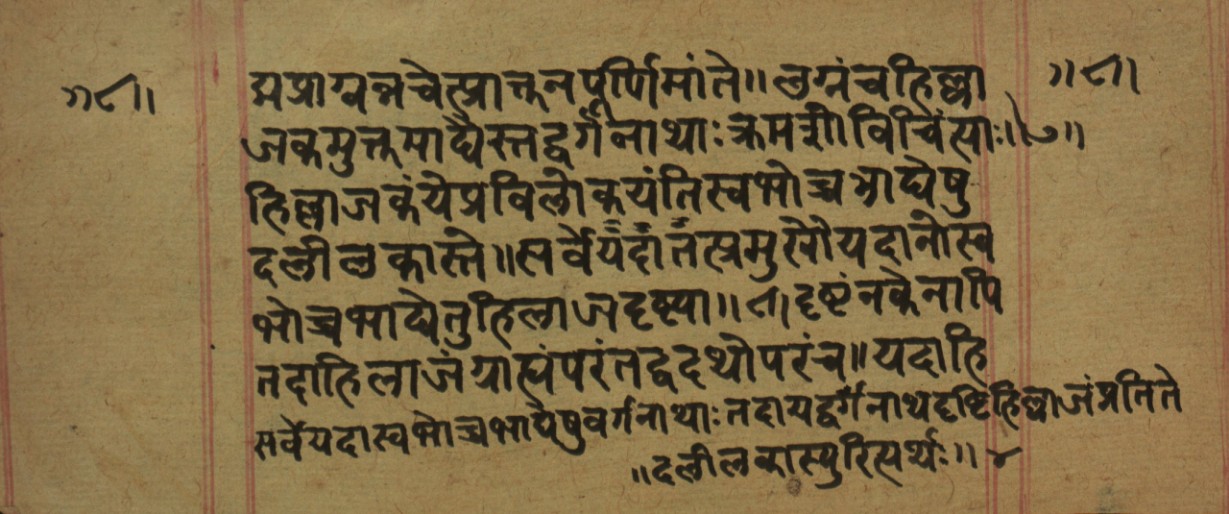
Hillāja — by this name, the body is released; first the Sun, then the ascendant — hence it is auspicious. Previously full moon or the ascendant, and divisible — this solar course is indeed worthy of examination.
The method works from the position of the Sun at the full moon, combined with the ascendant and the placement of the sign-lords. It is a computational astrology: not a vague 'you will live long,' but a procedure for arriving at a verdict from specific planetary data.
Lifespan in six grades
The results are ranked, the way a medical text ranks the severity of a disease. Longevity is divided into six classes, from uttama — excellent — down to atināṣṭa, the utterly destroyed.
Those who observe Hilla in their own exaltation, etc., are playful. When all the said [factors] are in their own exaltation, then Hilla is visible. In such a case, by whomsoever it is said, even in Hilla, the other is seen above. For when all the lords of the signs are in their own exaltation, then the sight of the lord of the sign is directed towards Hilla.
The strength of the planets — whether they sit in exaltation, their own sign, a friendly sign, or a debilitated one — decides which of the six grades a native falls into. Every case is meant to be checkable, given the birth data.
A technical literature in its own right
The Hillājadīpikā belongs to a whole family of longevity texts, and this manuscript pairs it with the Lājadīpikā and related works in a single compendium. Two copies of the same treatise survive in this collection — a reminder of how often these technical manuals were copied and recopied, each scribe keeping a working reference alive for the next generation of astrologers.