
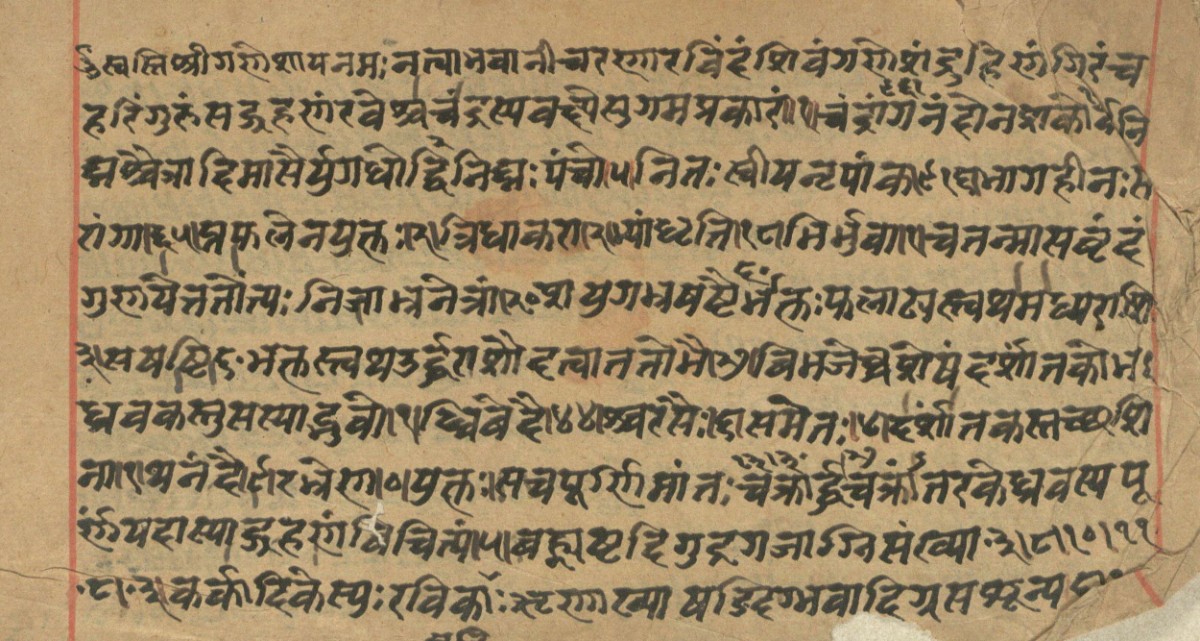
An eclipse is a question with a date. When exactly will the Moon enter the shadow, how long will it stay there, and when will it emerge? Grahaṇagaṇita — literally 'eclipse computation' — is the branch of Indian astronomy that answered those questions with arithmetic, and this small manuscript (just three pages of densely packed verses) is a working copy of that craft.
The algorithm in verse
The text opens with invocations to Gaṇeśa, Bhavānī, Śiva, and the planets, then moves straight into the mathematics of the Moon — intercalary months, mean longitudes, and the time-units of an eclipse.
Having bowed to the lotus feet of Bhavānī, to Śiva, Gaṇeśa, Brahma, and the mountains, to Hari, the Guru, the good planets, I shall speak of the Moon in an easy manner.
What follows is a chain of sexagesimal computation: the text works with nāḍīs and palas, with mean longitudes and the digits of the Moon, reducing a long sequence of multiplications and divisions to a final answer about contact and obscuration.
Eclipse parameters as technical terms
Its vocabulary is precise: sparśa, first contact; vimarda, the middle of total obscuration; and the durations that connect them. The margin of the page records the intermediate numbers — the 'arrows,' 'wheels,' and 'digits' that are the steps of the computation — so a practitioner could check their own work against the verse.
In Bhāgadika, touch alone [is] the nāḍīs 51, having been refined by the former, excluding the vika, and the Moon 35, the wheel, in the remainder of nāṭkōṣṭha, in the lipādikā, from the middle arrow to the southern half, in the dik 35, the inter-arrow as stated.
What looks cryptic at first is a record of intermediate results — the working shown for a computation, preserved in the margin the way a modern student keeps scratch work beside a formula.
Why eclipse math mattered
Eclipses were not just spectacle; they punctuated the calendar and the ritual year, and getting their timing right was a matter of practical and religious consequence. This fragment is a reminder that the mathematics of the sky was a working technology — compact enough to be memorized, precise enough to predict the Moon's vanishing, and copied by hand so the knowledge survived.