
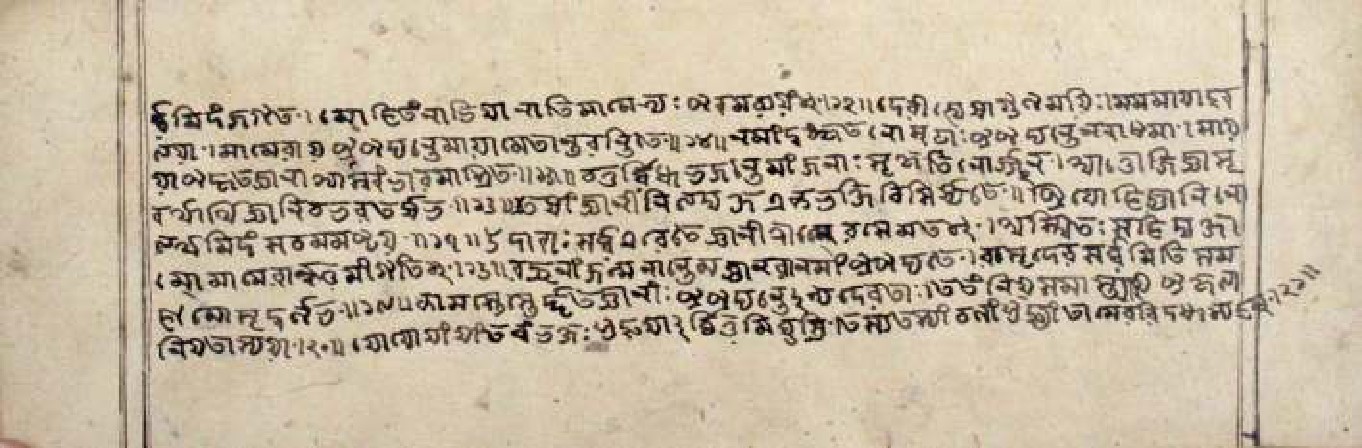
This manuscript is a meeting of worlds. Its opening invokes Rādhā-Kṛṣṇa and Jayadeva's Gītagovinda; its pages carry the Bhagavad Gītā written in Bengali script; and tucked among the ślokas are a Nala-Damayantī episode, a Hanumān hymn, a multiplication table, and the Gītā-māhātmya's promises of heaven. It is the Gītā as Bengal actually read it — in the vernacular, mixed with the whole devotional universe.
The Gītā in Bengali letters
The core of the manuscript is a Bengali-script Gītā. Dhṛtarāṣṭra's opening question appears in Bengali transliteration, and Arjuna's despondency is unmistakable. His physical collapse before the battle is rendered with stark immediacy: "Seeing this my own people arrayed and eager to fight, O Kṛṣṇa, my limbs fail and my mouth dries up. My body trembles and my hair stands on end. The Gāṇḍīva slips from my hand and my skin burns." The same familiar verses, in a script that made them readable to a Bengali household.
Seeing this my own people arrayed and eager to fight, O Kṛṣṇa, my limbs fail and my mouth dries up. My body trembles and my hair stands on end. The Gāṇḍīva slips from my hand and my skin burns.
A whole library in one binding
Around the Gītā, the manuscript gathers a small library. A Nala-Damayantī passage shows King Nala comforting his weeping wife in a desolate forest. His words blend duty with tenderness: "O beloved, of beautiful form, this body of yours is wasting away. Remembering your smile today, my mind is being consumed, O fair one. As long as the body falls, so long you are my refuge. Such is my resolve today—how can I abandon you? He who, seeing me fallen into calamity, would abandon his wife, a forest-dweller—he destroys all his deeds and enters hell below." There is a hymn to Hanumān—"the messenger of Rāma, the lord of kings, therefore I remember Māruti"—and a passage from the Bhāgavata on the yamalārjuna trees, where the child Kṛṣṇa frees the two demigods cursed to stand as trees.
O beloved, of beautiful form, this body of yours is wasting away. Remembering your smile today, my mind is being consumed, O fair one.
Eleven times nine
Then, unexpectedly, a multiplication table for eleven appears in the same hand: "Eleven and nine multiplied is 99. Eleven and ten multiplied is 110. Eleven and eleven multiplied is 121." The scribe who copied the Gītā also copied arithmetic—the same manuscript served prayer, poetry, and the marketplace. This mixing of domains reveals how Indian texts moved through household life: the sacred and the practical lived side by side on the same page.
Knowledge in the Vedic frame
The philosophical content mirrors the structure of the Gītā itself. Verses on the nature of knowledge and action are preserved intact: "Knowledge is covered by this eternal enemy of the wise, O son of Kunti, in the form of desire, which is never satisfied and burns like fire. The senses, mind, and intellect are said to be its abode. With these it deludes the embodied being, covering knowledge." Yet the manuscript adapts these verses for a Bengali audience, adding glosses and explanatory markers that help a reader navigate the complexity of Kṛṣṇa's teaching.
Knowledge is covered by this eternal enemy of the wise, O son of Kunti, in the form of desire, which is never satisfied and burns like fire.
The three qualities and the path
Another section addresses the threefold nature of happiness, a core teaching of the Gītā adapted to practice. Sattvic happiness, the text explains, seems like poison at first but becomes nectar through practice—the path of self-knowledge. Rajasic happiness begins as nectar but ends as poison, the way of sense indulgence. Tamasic happiness, born of sleep and delusion, brings only confusion. The scribe's choice to include this passage suggests a manuscript designed for serious practice, not mere devotion.
The promise of the māhātmya
The closing pages contain the Gītā-māhātmya from the Varāha Purāṇa, which quantifies the text's power: reciting ten, seven, five, four, two, or even one śloka grants access to the lunar world, and full practice leads to mokṣa and Vaikuṇṭha. It is a fitting end for a manuscript that treats the Gītā as a living, vernacular presence—copied beside love stories, hymns, and sums, and read as scripture for this world and the next. The Bengali Gītā was never meant to be a museum piece, locked away in Sanskrit. It lived in Bengali homes, spoken aloud, memorized alongside multiplication tables, and trusted to teach the path to freedom.