
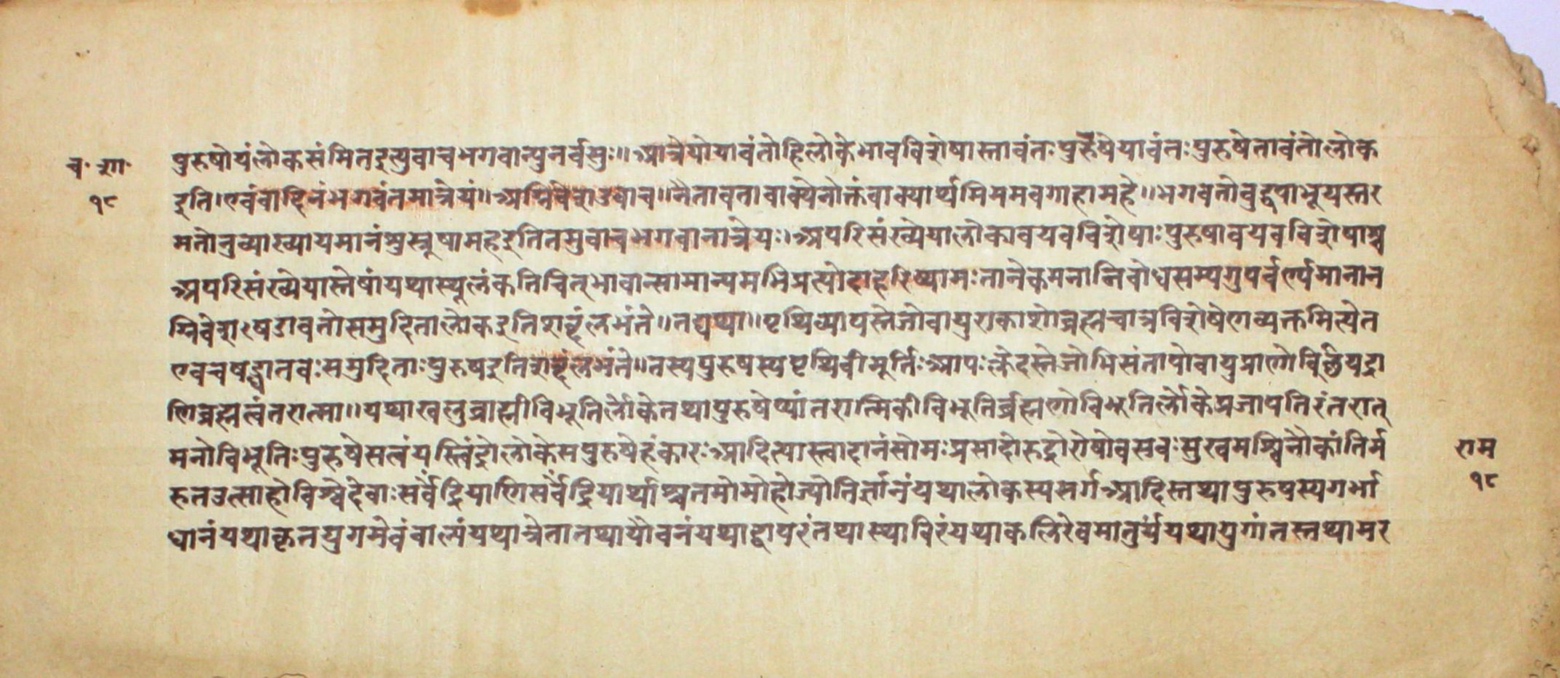
Where does a fetus come from? This manuscript of the Carakasaṃhitā answers with a list that mixes biology and philosophy: the father, the self, adaptability, essence, and inherent nature. The embryo is not just a physical assembly — it is a being with continuity, and it develops through the same elements that make up the cosmos.
Five sources, one embryo
The passage sets out the constituents of conception without reducing life to matter alone.
The embryo arises from these conditions: from the father, from the self, from adaptability, from essence, and from the inherent nature. Initially, at the union of semen, blood, and life, the term 'embryo' is applied when it resides in the womb. The embryo, composed of modifications of the five great elements — space, air, fire, water, and earth — serves as the foundation of consciousness.
Notice what is included: the father contributes seed, but the self (ātman), the adaptability of the mother's constitution, nutrition, and temperament all have a share. Embryology here is never just biology — it is the meeting of matter and continuity of consciousness.
The body as the universe
The most famous idea in this part of the Carakasaṃhitā is the correspondence between the person and the world. The text has a wonderful dialogue in which the sage Atreya spells it out to his student Agniveśa.
Lord Punarvasu said: 'This human being is commensurate with the universe.' Atreya explained: 'Whatever distinct entities exist in the world, the same exist in the human being, and whatever exists in the human being, the same exists in the world.'
The six elements — earth, water, fire, air, space, and Brahman — appear in the body as solid form, moisture, heat, life-breath, cavities, and inner self. The same elements that compose the cosmos compose the person, which is why understanding the body and understanding the world are, in this tradition, the same study.
An ancient framework, still coherent
This manuscript is a window into a medical tradition that refused to separate the physical from the philosophical. Conception is a biological event and a cosmic one; the fetus is a body and a self. Reading it, you see why the Carakasaṃhitā remained the backbone of Ayurvedic learning for two thousand years — it asks the big questions, and its answers are built to last.